
Europe Lipids Market Trends & Summary (2025–2033)
How Health Awareness, Aging Demographics, and Biotech Innovation Are Reshaping Europe’s Lipids Industry

Introduction: A Market Built on Health, Science, and Everyday Nutrition
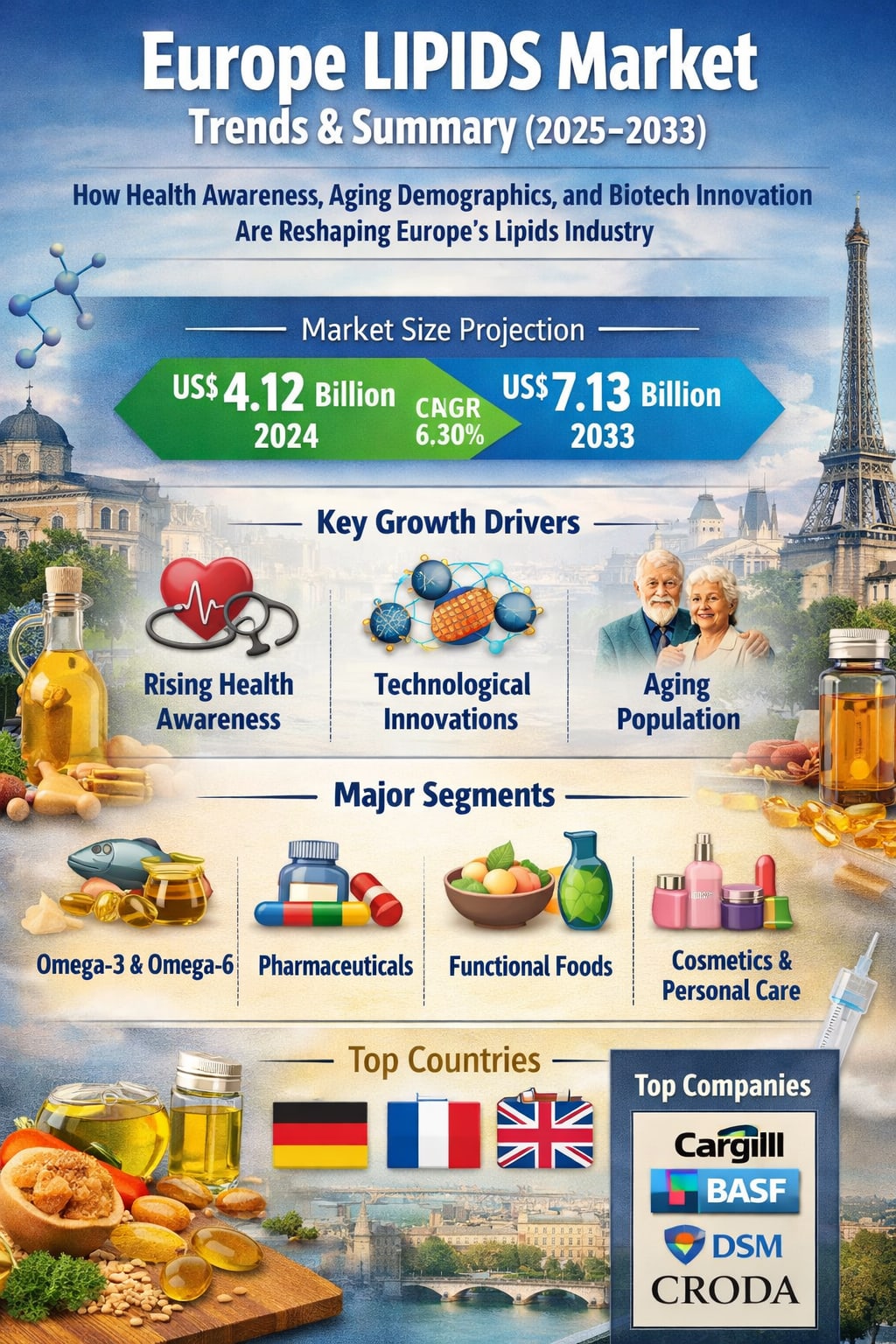
The Europe Lipids Market is entering a decisive growth phase, driven by the powerful intersection of healthcare innovation, nutrition awareness, and demographic change. According to Renub Research, the market is expected to reach US$ 7.13 billion by 2033, rising from US$ 4.12 billion in 2024, registering a compound annual growth rate (CAGR) of 6.30% from 2025 to 2033. This steady expansion reflects not just higher consumption of lipid-based products, but also a deeper integration of lipids into pharmaceuticals, functional foods, nutraceuticals, and advanced drug delivery systems.
Lipids are far more than dietary fats. They are essential biomolecules found in everyday foods such as butter, oils, cheese, olives, corn, almonds, and avocados. Chemically, they dissolve easily in organic solvents like methanol, ethers, ketones, and amines, but not in water—a property that makes them uniquely useful in both biological systems and industrial applications. In the human body, lipids serve as key energy reserves, structural components of cell membranes, and critical signaling molecules. Beyond biology, they are widely used in food and beverages, pharmaceuticals, personal care products, and even in industrial applications such as lubricants, coatings, polymers, surfactants, printing inks, solvents, and herbicide adjuvants.
What makes the European lipids market particularly dynamic today is how it sits at the crossroads of health trends, technological progress, sustainability goals, and medical innovation. From omega-3 enriched functional foods to lipid nanoparticles used in cutting-edge mRNA therapies, lipids are no longer just ingredients—they are strategic building blocks of modern health and industry.
Market Overview: Why Europe Is a Hotspot for Lipid Innovation
Europe’s lipids market is undergoing a structural transformation. One of the strongest forces behind this shift is the growing consumer focus on healthy and balanced diets. Across the region, shoppers are paying closer attention to labels, ingredients, and nutritional profiles. Healthy fats—especially omega-3 and omega-6 fatty acids—have moved from being niche supplements to mainstream dietary components. This has accelerated innovation in functional foods, fortified beverages, and nutritional supplements.
At the same time, technological advancements are reshaping how lipids are extracted, processed, and applied. Modern extraction and purification techniques are improving both efficiency and product quality, allowing manufacturers to source lipids from a wide variety of plant and animal origins while meeting strict quality standards. These advances are especially important for the pharmaceutical and personal care industries, where purity, consistency, and performance are non-negotiable.
Sustainability is another defining theme. With Europe’s strong commitment to environmental protection, there is increasing momentum behind renewable and sustainable lipid sources. Companies are investing in traceable supply chains, eco-friendly processing methods, and plant-based alternatives, aligning business growth with environmental responsibility.
Perhaps most notably, the pharmaceutical and nutraceutical sectors are emerging as major growth engines. Lipids are now central to advanced drug delivery systems, including lipid-based carriers that improve the bioavailability and stability of complex medicines. They are also increasingly used in health-promoting supplements, reinforcing their role not just as nutrients, but as functional and therapeutic components. Together, these trends are positioning the European lipids market as a critical pillar of both the food and healthcare ecosystems.
Key Growth Drivers of the Europe Lipids Market
1. Rising Health Awareness Across Europe
Health consciousness has become one of the most powerful drivers of the European lipids market. As preventive healthcare and long-term well-being gain importance, consumers are actively seeking products that support heart health, brain function, immune strength, and overall vitality. Lipids—especially omega-3 and omega-6 fatty acids—are widely recognized for their potential benefits in these areas.
This awareness has translated into growing demand for functional foods, dietary supplements, and pharmaceutical formulations enriched with high-quality lipids. Consumers are also increasingly drawn to clean-label and natural products, paying close attention to ingredient lists and sourcing. Public health campaigns and widespread nutritional education have further reinforced the message that not all fats are harmful—many are essential. As a result, lipid-based products are no longer seen as optional add-ons, but as integral components of a healthy lifestyle.
2. Technological Innovations in Lipid Applications
Technology is playing a transformative role in expanding the scope and value of lipid-based products. One of the most significant breakthroughs has been in lipid-based drug delivery systems, particularly in the pharmaceutical sector. A notable example is the launch of Lipid NanoParticle (LNP) Starter Kits by CordenPharma in March 2024, designed for use with mRNA-based therapies. These kits include carefully engineered lipids that support high-performance LNP formulations, enabling efficient delivery across different cell types and applications ranging from R&D to clinical trials.
Such innovations are not only boosting demand for high-purity and specialized lipids, but also opening new frontiers in gene therapy, personalized medicine, and advanced biologics. Improved extraction, purification, and stabilization technologies are also enhancing the functionality and shelf life of lipid-based products across food, pharmaceutical, and cosmetic industries. In this way, technological progress is not just supporting growth—it is actively redefining what lipids can do.
3. Europe’s Aging Population
Demographic change is another major growth catalyst. As of 2024, over 21% of the EU population is aged 65 or older, with countries such as Italy, Portugal, and Bulgaria recording some of the highest shares. The EU’s median age is projected to rise from 44.7 years in 2024 to 50.2 years by 2100, highlighting a long-term aging trend.
This shift has profound implications for the lipids market. Older adults are more likely to use dietary supplements and functional foods to manage or prevent age-related health issues such as cardiovascular disease, cognitive decline, and joint problems. Lipids, particularly omega-3 fatty acids, are strongly associated with benefits in these areas. As a result, demand for lipid-enriched foods, supplements, and medical nutrition products is expected to rise steadily, making the aging population a durable and long-term driver of market expansion.
Challenges Facing the Europe Lipids Market
Regulatory Complexity
One of the biggest hurdles for the lipids industry in Europe is the complex regulatory environment. The European Union enforces strict rules on safety, labeling, and health claims, and these regulations can vary across countries. Manufacturers operating in food, pharmaceuticals, and cosmetics must navigate multiple regulatory frameworks, which can delay product development and market entry.
Compliance with European Food Safety Authority (EFSA) standards is particularly demanding for functional and innovative lipids. While these regulations are essential for consumer protection, they also increase time-to-market and compliance costs, potentially limiting the speed of innovation and expansion for companies in the sector.
High Production Costs
Producing high-quality lipids is a capital-intensive process. Advanced extraction, purification, and stabilization technologies are required, especially for premium products like omega-3 fatty acids or structured lipids. In addition, sourcing high-quality raw materials—often from marine or carefully cultivated plant sources—adds to the cost, particularly when sustainability and traceability are prioritized.
These high production costs can compress profit margins, limit scalability, and raise end-product prices, making it harder for some consumers to access lipid-based products. For manufacturers, balancing quality, sustainability, and affordability remains a key strategic challenge.
Country-Level Insights
Germany
Germany stands out as one of the strongest markets for lipids in Europe, driven by robust demand from the pharmaceutical, food and beverage, and cosmetics industries. The pharmaceutical sector, in particular, is a major growth engine, especially in areas such as mRNA-based therapies and advanced drug delivery systems. Companies like Evonik Industries AG, Merck KGaA, and BASF SE are actively expanding their lipid production capacities, reinforcing Germany’s position as a regional leader. The country’s strong R&D ecosystem and supportive regulatory framework further enhance its competitiveness in the European lipids market.
France
France’s lipids market is growing steadily, supported by demand from cosmetics, food and beverages, and pharmaceuticals. In healthcare, lipids play a crucial role in modern drug delivery systems, including mRNA-based treatments. In the food sector, rising consumer interest in healthier oils aligned with the Mediterranean diet, such as olive and avocado oils, is boosting demand. The cosmetics industry also values lipids for their hydrating and anti-aging properties. With a solid research base and favorable regulations, France remains a key contributor to regional growth.
United Kingdom
The UK lipids market is experiencing strong momentum across pharmaceuticals, food and beverages, and cosmetics. Lipids are increasingly important in drug delivery technologies, while the food industry is seeing rising demand for health-oriented oils and functional ingredients. The cosmetics sector continues to leverage lipids for skin hydration and anti-aging solutions. Supported by a strong regulatory environment and advanced research infrastructure, the UK is emerging as an increasingly influential player in the European lipids landscape.
Market Segmentation Snapshot
By Product:
Triglycerides
Phospholipids
Sphingolipids
Ionizable Lipids
Others
By Type:
Omega-3 and Omega-6
Phospholipids
Medium Chain Triglycerides
Sterols
By Source:
Animal
Plant
By Application:
Food & Beverages
Pharmaceuticals
Nutrition & Supplements
Others
By Country:
France, Germany, Italy, Spain, United Kingdom, Belgium, Netherlands, Russia, Poland, Greece, Norway, Romania, Portugal, Rest of Europe
Competitive Landscape
The European lipids market features a strong mix of global and regional players, each analyzed across four dimensions: Overview, Key Persons, Recent Developments, and Financial Insights. Major companies include:
Cargill, Incorporated
Archer Daniels Midland Company
BASF SE
Croda International PLC
Kerry Group plc
Koninklijke DSM N.V.
NOF Corporation
Merck KGaA
These companies are investing heavily in R&D, capacity expansion, and advanced lipid technologies, particularly in pharmaceutical and nutraceutical applications.
Final Thoughts: A Market with Strong Fundamentals and Long-Term Potential
The Europe lipids market is on a clear upward trajectory, supported by health awareness, technological innovation, and demographic change. With the market projected to grow from US$ 4.12 billion in 2024 to US$ 7.13 billion by 2033, the opportunities span across food, healthcare, pharmaceuticals, and personal care industries.
While regulatory complexity and high production costs remain real challenges, they are balanced by strong demand fundamentals and continuous innovation. As lipids become increasingly central to functional nutrition, advanced medicine, and sustainable product development, Europe is well-positioned to remain one of the world’s most important and dynamic markets for lipid-based solutions.
In short, lipids are no longer just a supporting ingredient—they are becoming a strategic cornerstone of Europe’s health, food, and biotechnology future.
About the Creator
Keep reading
More stories from shibansh kumar and writers in Trader and other communities.
Asia Pacific Pediatric Interventional Cardiology Market Size and Forecast 2025–2033
Introduction The Asia Pacific Pediatric Interventional Cardiology Market is entering a period of sustained and meaningful growth as healthcare systems across the region place increasing emphasis on advanced, child-focused cardiac care. According to Renub Research, the market is expected to reach US$ 1,525.53 million by 2033, rising from US$ 829.09 million in 2024, at a compound annual growth rate (CAGR) of 7.01% from 2025 to 2033.
By shibansh kumarabout 18 hours ago in Trader
Germany Flight Disruptions Expose Growing Strain on European Air Travel
Germany flight disruptions have once again disrupted travel plans for thousands of passengers, underscoring the growing strain on Europe’s aviation network. A large number of flights were delayed or canceled in a single day, creating chaos across airports and raising concerns about the system’s ability to cope with rising travel demand. The situation reflects deeper structural challenges that continue to affect air travel across the region.
By Hammad Nawaza day ago in Trader
Foot Bindings
I asked my grandmother how she knew she'd fallen in love. I am not sure I ever did love him, she said. This was before I met my husband. I was naive, a naked spring, a raw nerve of a thing. That cannot ever be me, I knew. Sadness swept in gently like a Moscow thaw. It is no simple thing, looking into a woman's vast soul and seeing its foot bindings. Now, in Italy divorced with my skin singed off, when I say I don't love him mean: I have succeeded at feeling nothing most days and it mostly works. Do you want the comfort of Nothing? Do you want Nothing, too? Be warned: you'll never be free, even when you are nothing. Here is what doesn't work: Accepting the stages of grief. Talking about it. Sitting with the feeling. Missing him—no, the person you were when you believed in death do us part. Writing poetry. That, too. When I say I don't love him I mean: I feel capsized in an endless, starved tide. What sometimes works: selective memory. You must forget ripe tomatoes and his beard and feeling perfectly sheltered in a big blue world. Forget coffee in bed, laughter watching TV, blowing out the candles on the birthday cake and the quiet all-encompassing knowledge that you are chosen. Remember only how love turned to a banal everyday survival act, a trapeze act unsure whether he will catch you, how the warmth stagnated and became sour, remember the foot bindings and remember the resentment boiling in your veins as you stick it out for the kids. Six-hour Netflix binges help, too. A man's fingers tracing your spine. Frozen pizza at 2 a.m. Random trips to the museum just to stand near things that last a while. The realization that crying won’t change anything. Seeing that life is just a dream, and refusing to participate in your own suffering. Bite your fist. Walk on eggshells around joy. When I say I don't love him, I mean he didn’t break my heart, he just stopped touching it and it forgot how to beat right.
By Ella Bogdanova6 days ago in Poets


Comments
There are no comments for this story
Be the first to respond and start the conversation.