
Europe Hip Replacement Market Size and Forecast 2025–2033
How Ageing Demographics, Surgical Innovation, and Patient Awareness Are Reshaping Orthopaedic Care Across Europe

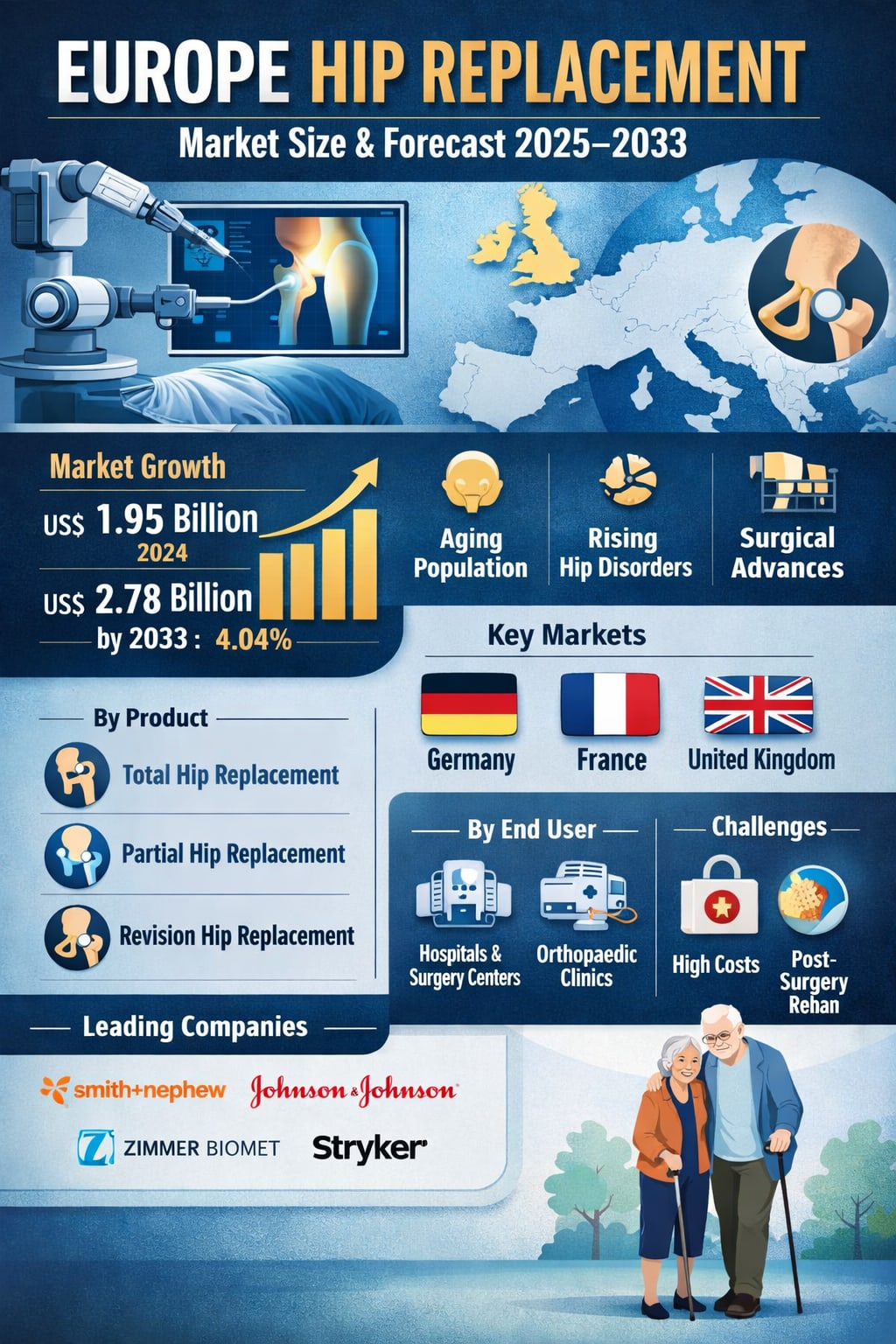
Introduction: A Market Built on Mobility, Longevity, and Quality of Life
Hip replacement surgery has become one of the most transformative procedures in modern orthopaedic medicine. For millions of Europeans struggling with chronic hip pain, limited mobility, and declining quality of life, hip arthroplasty offers not just pain relief—but a return to independence. As Europe’s population continues to age and lifestyle-related joint disorders become more common, the demand for reliable, durable, and technologically advanced hip replacement solutions is accelerating.
According to Renub Research, the Europe Hip Replacement Market is expected to grow from US$ 1.95 billion in 2024 to US$ 2.78 billion by 2033, expanding at a compound annual growth rate (CAGR) of 4.04% from 2025 to 2033. This steady growth reflects a powerful combination of demographic change, medical innovation, rising healthcare spending, and increasing patient awareness about joint health and mobility.
At its core, hip replacement surgery involves replacing a damaged or diseased hip joint with an artificial prosthesis, typically made from metal, ceramic, or high-performance plastic components. The procedure is most commonly performed on patients suffering from osteoarthritis, rheumatoid arthritis, avascular necrosis, hip fractures, or severe joint degeneration. Over the past two decades, improvements in surgical techniques and implant design have dramatically improved outcomes, reduced recovery times, and extended implant lifespan.
Today, hip replacement is no longer viewed as a last-resort procedure. Instead, it is increasingly seen as a proactive solution to restore mobility, reduce long-term disability, and improve overall quality of life—making it one of the most important growth segments within Europe’s broader orthopaedic and medical devices market.
Market Overview: Why Demand Is Rising Across Europe
The European hip replacement market is being shaped by several long-term structural trends. The most important of these is population ageing. Europe has one of the oldest populations in the world, and the proportion of people aged 60 and above continues to rise every year. Since the prevalence of hip disorders—especially osteoarthritis—increases significantly with age, this demographic shift alone is enough to ensure sustained demand for hip replacement procedures.
At the same time, lifestyle factors are playing a growing role. Rising obesity rates, lower physical activity levels, and longer life expectancy are contributing to higher rates of joint degeneration. Many patients are now seeking surgical intervention earlier than in the past, not only to relieve pain but also to maintain an active lifestyle well into older age.
From a healthcare system perspective, increasing healthcare expenditure across Europe is also supporting market growth. Governments and private healthcare providers alike are investing more in advanced surgical technologies, modern hospital infrastructure, and specialized orthopaedic centers. In parallel, favorable reimbursement policies in several European countries are making hip replacement procedures more accessible to a broader segment of the population.
Another important factor is rising awareness about joint health and quality of life. Patients today are better informed about treatment options, surgical outcomes, and long-term benefits. This has led to greater acceptance of hip replacement surgery and higher expectations regarding implant performance, durability, and post-surgery mobility.
Key Growth Drivers Shaping the Market
1. Technological Advancements in Surgery and Implants
One of the strongest growth engines of the European hip replacement market is rapid technological progress. Innovations such as robotic-assisted surgery and minimally invasive surgical techniques are transforming how hip replacements are performed. These technologies improve surgical precision, enhance implant alignment, reduce tissue damage, and significantly shorten recovery times.
A notable example came in August 2023, when Nuffield Health Warwickshire Hospital announced the introduction of the Mako robot-assisted surgery system for hip replacements. Systems like these allow surgeons to plan and execute procedures with remarkable accuracy, leading to better functional outcomes and higher patient satisfaction.
On the implant side, advances in materials science—including the use of ceramic, titanium, and highly cross-linked polyethylene—are improving implant longevity and reducing the risk of complications such as wear, loosening, or inflammation. These innovations are especially important as younger and more active patients increasingly opt for hip replacement and expect implants to last for decades.
2. Increasing Prevalence of Hip Disorders
The rising incidence of hip-related diseases is another major driver. Hip osteoarthritis (HOA) remains the leading cause of hip pain and disability among older adults in Europe. The risk increases sharply after the age of 50 and continues to rise with age, making it a central public health issue in ageing societies.
In addition to age, obesity and sedentary lifestyles are accelerating joint wear and tear, leading to earlier onset of hip problems. As more patients seek effective, long-term solutions for pain relief and mobility restoration, the demand for hip replacement surgeries continues to grow steadily across the region.
3. Rising Awareness and Healthcare Spending
Public awareness campaigns, improved diagnostics, and better access to specialist care have made patients more proactive about managing joint health. At the same time, healthcare spending in Europe is increasing, enabling hospitals and clinics to adopt advanced surgical tools and expand orthopaedic services.
This combination of informed patients and better-funded healthcare systems is driving higher procedure volumes, particularly in countries with strong public healthcare infrastructure and growing private healthcare sectors.
Challenges Facing the Market
High Costs of Surgery and Implants
Despite its strong growth outlook, the European hip replacement market faces significant cost-related challenges. Hip replacement surgery is expensive, especially when advanced implants and robotic-assisted technologies are involved. Costs include not only the implant itself, but also hospital stays, surgeon fees, and post-operative care.
In countries with limited healthcare funding or insufficient insurance coverage, out-of-pocket expenses can discourage patients from undergoing surgery, even when it is medically necessary. This cost barrier remains a key restraint on market expansion, particularly in parts of Eastern and Southern Europe.
Post-Surgery Rehabilitation and Recovery
Successful hip replacement does not end in the operating room. Post-surgery rehabilitation is essential for restoring strength, mobility, and function. However, access to high-quality rehabilitation services varies widely across Europe, especially between urban and rural areas.
Rehabilitation can be time-consuming and costly, and not all patients are able to fully adhere to therapy programs. Inadequate or delayed rehabilitation can lead to complications, prolonged recovery, reduced patient satisfaction, and, in some cases, the need for revision surgery.
Country-Level Insights
Germany: Europe’s Market Leader
Germany represents one of the largest and most advanced hip replacement markets in Europe. The country’s ageing population, combined with a strong healthcare system and high adoption of advanced surgical technologies, continues to drive procedure volumes.
German hospitals are at the forefront of robotic-assisted and minimally invasive surgeries, and the availability of high-quality implants further supports market growth. Both primary and revision hip replacement surgeries are on the rise, reinforcing Germany’s position as a key hub for orthopaedic innovation in Europe.
France: Steady Growth Driven by Innovation
In France, the hip replacement market is expanding due to similar demographic trends, particularly the growing elderly population and the rising prevalence of osteoarthritis. Advancements in surgical techniques and implant materials are improving patient outcomes and increasing acceptance of joint replacement procedures.
Rising healthcare expenditure and strong public healthcare coverage also contribute to sustained market growth, making France one of the most stable and attractive markets in the region.
United Kingdom: Demand Meets Systemic Challenges
The UK hip replacement market is driven by an ageing population and a high incidence of hip disorders. Technological advancements, including robotic-assisted surgery, are improving outcomes and reducing recovery times.
However, the market also faces challenges such as NHS waiting lists and rising private healthcare costs. Despite these issues, demand remains strong as more patients seek long-term solutions to pain and mobility limitations, ensuring continued market expansion.
Market Segmentation
By Product
Total Hip Replacement
Partial Hip Replacement
Revision Hip Replacement
Total hip replacement remains the dominant segment due to its broad applicability in treating severe joint degeneration. However, revision hip replacement is gaining importance as the number of patients with older implants increases and longer life expectancy leads to more repeat procedures.
By End User
Hospitals & Surgery Centers
Orthopaedic Clinics
Others
Hospitals and surgery centers account for the largest share, driven by access to advanced equipment, specialized surgical teams, and post-operative care facilities. Orthopaedic clinics are also growing in importance, particularly for elective and minimally invasive procedures.
By Country
France
Germany
Italy
Spain
United Kingdom
Belgium
Netherlands
Russia
Poland
Greece
Norway
Romania
Portugal
Rest of Europe
Competitive Landscape: Leading Companies in Focus
The European hip replacement market is highly competitive, with global and regional players investing heavily in R&D, product innovation, and strategic partnerships. Key companies covered from four perspectives—Overview, Key Persons, Recent Developments, and Financial Insights—include:
Smith & Nephew PLC
Johnson & Johnson
Integra LifeSciences Corporation
MicroPort Scientific Corp
Zimmer Biomet Holdings Inc
Stryker Corporation
B. Braun Melsungen AG
Globus Medical Inc.
These companies are focusing on next-generation implant materials, digital surgery platforms, and patient-specific solutions to strengthen their market positions and meet evolving clinical demands.
Future Outlook: A Market Built for Long-Term Growth
Looking ahead, the European hip replacement market is well positioned for sustained expansion through 2033. The combination of demographic ageing, technological innovation, rising healthcare investment, and growing patient expectations creates a strong foundation for long-term growth.
As implants become more durable, surgeries become more precise, and recovery times continue to shorten, hip replacement will increasingly be seen not just as a medical necessity—but as a quality-of-life investment. With the market projected to reach US$ 2.78 billion by 2033 at a CAGR of 4.04%, Europe’s hip replacement sector is set to remain a cornerstone of the region’s orthopaedic and medical devices industry.
Final Thoughts
The Europe hip replacement market stands at the intersection of medical innovation and demographic reality. As populations age and expectations for active, pain-free living rise, the role of hip replacement surgery will only become more central to modern healthcare. Backed by strong growth fundamentals and continuous technological progress, this market is not just expanding—it is redefining what mobility and independence mean for millions of Europeans in the years ahead.
About the Creator
6 Pieces of "Good" Financial Advice That Are Keeping You Broke
There's a certain type of financial advice that gets repeated so often it becomes gospel. Diversify everything. Save 6 months of expenses. Buy a home as soon as possible. Avoid debt at all costs. Max out your 401k. Don't invest until you're debt-free.
By Destiny S. Harris5 days ago in Trader
Samsung Shares Rebound as HBM4 Push Reinforces Company’s Technology Advantage
Samsung Electronics shares staged a notable rebound after a top executive emphasized the company’s technological edge in next-generation HBM4 memory. The comments renewed investor confidence in Samsung’s semiconductor roadmap, particularly its positioning in the rapidly growing artificial intelligence and high-performance computing markets.
By Hammad Nawaz3 days ago in Trader




Comments
There are no comments for this story
Be the first to respond and start the conversation.