
Asia Pacific Milk Powder Market Size and Forecast 2025–2033
Rising Urbanization, Infant Nutrition Demand, and Shelf-Stable Dairy Driving a US$ 18.25 Billion Market by 2033

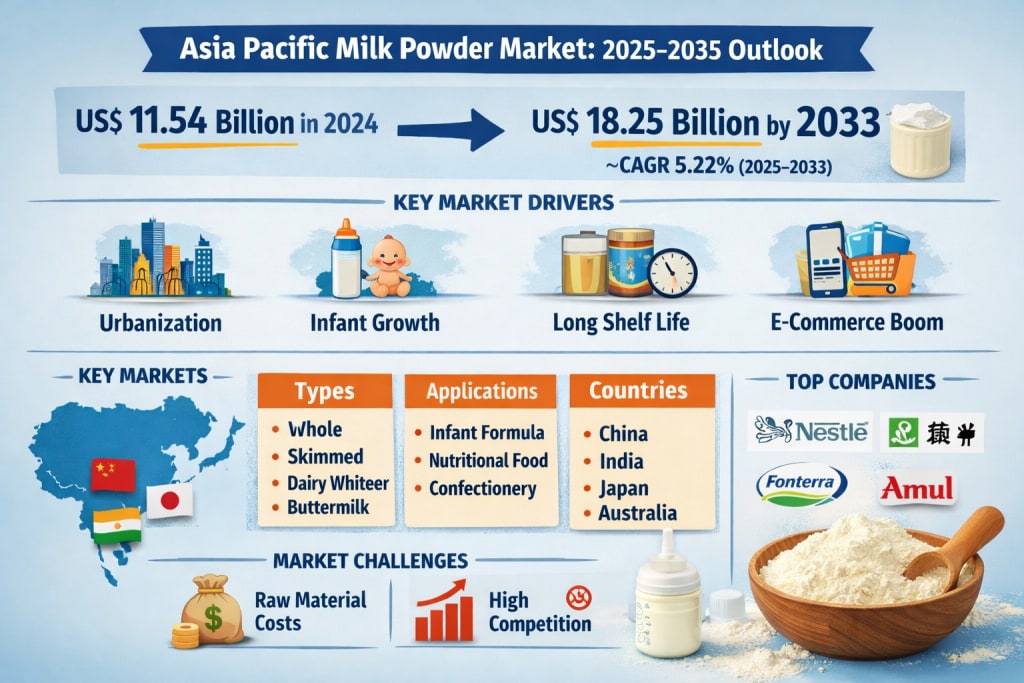
Asia Pacific Milk Powder Market: Big Growth in a Small Spoon
The Asia Pacific Milk Powder Market is on a steady growth trajectory and is expected to reach US$ 18.25 billion by 2033, up from US$ 11.54 billion in 2024, expanding at a CAGR of 5.22% from 2025 to 2033. This growth is being powered by a mix of structural and lifestyle changes across the region, including rising urbanization, longer shelf-life needs, changing dietary habits, a growing infant population, and the expanding food and beverage industry.
Milk powder, also known as powdered milk, is produced by removing water from liquid milk through evaporation. This process preserves most of the essential nutrients such as proteins, calcium, and vitamins while significantly extending shelf life. The result is a highly versatile, easy-to-store dairy product that does not require refrigeration, making it especially valuable in regions with limited cold-chain infrastructure.
Across Asia Pacific, milk powder has become a staple ingredient in infant formulas, bakery products, confectionery, nutritional foods, and processed foods. It is also widely used as a substitute for fresh milk in households where access to refrigeration or daily milk supply can be inconsistent. The region’s rapid economic development, expanding middle class, and increasing focus on health and nutrition are further strengthening the long-term outlook for this market.
Asia Pacific Milk Powder Industry Overview
Milk powder plays a crucial role in modern food systems due to its convenience, long shelf life, and nutritional stability. It is available in several forms, including whole milk powder, skimmed milk powder, fat-filled milk powder, buttermilk powder, and dairy whiteners, each serving different industrial and consumer needs.
In Asia Pacific, the importance of milk powder goes beyond convenience. Many countries in the region still face challenges related to cold storage, transportation, and consistent access to fresh dairy. In such environments, milk powder becomes a practical and cost-effective alternative. At the same time, growing urban populations with busy lifestyles increasingly prefer products that are easy to store, transport, and prepare.
Another major factor shaping the market is rising health awareness. Consumers are showing growing interest in fortified and functional milk powders enriched with calcium, vitamins, minerals, and probiotics. This is particularly visible in countries like China and Japan, where aging populations are driving demand for nutrition-focused dairy products, and in India, where milk powder is widely used in both household cooking and the food processing industry.
Combined with strong growth in packaged foods, bakery, confectionery, and infant nutrition, these trends are turning milk powder into a strategically important product category across the Asia Pacific food ecosystem.
Key Market Drivers
1. Convenience and Long Shelf Life
One of the strongest drivers of the Asia Pacific milk powder market is its convenience and long shelf life. Unlike fresh milk, milk powder does not require refrigeration and can be stored for extended periods without significant quality loss. This makes it ideal for regions with limited cold-chain infrastructure and for consumers who prefer stocking up on non-perishable essentials.
The long shelf life also helps reduce food wastage and spoilage, which is increasingly important in both urban and rural markets. For households, bakeries, food manufacturers, and institutional buyers, milk powder offers a reliable and flexible dairy solution. Its ease of transportation and storage further lowers logistics costs, making it attractive for both domestic distribution and international trade.
As urban lifestyles become busier and consumers look for practical, time-saving food options, milk powder continues to gain relevance across multiple applications, from daily beverages to industrial food production.
2. Growing Number of Infants
The rising infant population, especially in large countries such as China and India, is another major growth driver for the milk powder market. Milk powder is a core ingredient in infant formula, a category that depends heavily on consistent quality, long shelf life, and easy storage.
According to data cited from the National Bureau of Statistics (NBS), China’s birth rate in 2024 stood at 6.77 per 1,000, an increase of 0.38 per thousand from the previous year. While long-term demographic trends in some countries remain complex, even modest increases in birth rates can significantly boost demand for infant nutrition products due to the high value and regular consumption of formula and related dairy products.
Governments and health authorities across the region are also placing greater emphasis on child nutrition and early-life health, further supporting demand for fortified, high-quality milk powders designed specifically for infants and young children.
3. E-commerce and Modern Retail Expansion
The rapid expansion of e-commerce and modern retail is transforming how milk powder is bought and sold across Asia Pacific. With rising internet penetration and smartphone usage, consumers are increasingly purchasing everyday essentials, including milk powder, through online platforms.
E-commerce offers several advantages: wider product choices, easy price comparisons, doorstep delivery, and frequent discounts. This is especially beneficial for premium and imported milk powder brands, which may not always be available in traditional local stores.
At the same time, the growth of supermarkets, hypermarkets, and specialty stores is improving product visibility and brand positioning. These modern retail formats provide better shelf space, stronger marketing opportunities, and improved access to both domestic and international brands. Together, e-commerce and modern retail are reshaping distribution channels and helping manufacturers reach a broader and more diverse consumer base.
Challenges in the Milk Powder Industry
Fluctuating Raw Material Prices
One of the key challenges facing the Asia Pacific milk powder industry is the volatility of raw material prices, particularly fresh milk. Milk production is highly sensitive to factors such as weather conditions, feed costs, and animal health issues. Any disruption in these areas can quickly impact supply and push up prices.
Rising input costs often translate into higher production expenses, which may be passed on to consumers. This can affect demand, especially in price-sensitive markets. Moreover, price volatility makes long-term planning and stable pricing strategies more difficult for manufacturers, adding an element of uncertainty to the market.
Intense Competitive Pressure
The Asia Pacific milk powder market is also characterized by intense competition among both domestic and international players. The presence of numerous brands leads to price competition and, in some cases, thinner profit margins. Established companies face constant pressure from new entrants, private labels, and regional brands trying to capture market share.
To stay competitive, companies must continuously invest in product innovation, quality improvement, and brand building. This includes developing specialized products such as fortified milk powders, infant nutrition formulas, and adult nutrition variants. While competition benefits consumers through more choices and better prices, it also makes long-term profitability and brand loyalty harder to achieve for manufacturers.
Country-Level Market Insights
China Milk Powder Market
China represents one of the largest and most dynamic milk powder markets in the Asia Pacific region. Demand is being driven by a combination of infant nutrition needs, rising health awareness, and the growing focus on functional foods for middle-aged and elderly consumers.
A notable example of product innovation came in December 2022, when Chinese dairy company Junlebao launched a new range of milk powders called “Le Gai”, aimed at improving calcium absorption among middle-aged and older consumers. The company highlighted that this product contains twice as much calcium as ordinary whole milk powder, offering around 1200 mg per 100 g. This reflects a broader trend in China toward value-added, health-focused dairy products.
As consumer preferences continue shifting toward nutrition-enhanced offerings, China’s milk powder market is expected to remain a major growth engine for the region.
India Milk Powder Market
India’s milk powder market is growing steadily, supported by rising dairy consumption in both urban and rural areas, changing dietary habits, and increasing disposable incomes. Milk powder plays a critical role in Indian households, food processing, sweets manufacturing, and institutional catering.
In November 2021, Amul, one of India’s largest dairy companies, announced an investment of INR 415 crore (around USD 55.7 million) in four new projects, including a new milk powder plant at AmulFed Dairy. This expansion increased the facility’s milk processing capacity from 35 lakh liters per day to 50 lakh liters per day, strengthening Amul’s ability to meet both domestic and export demand.
With strong consumption across infant nutrition, sweets, bakery, and packaged foods, India is set to remain one of the most important markets for milk powder in the region.
Japan Milk Powder Market
Japan’s milk powder market is shaped largely by demographic and lifestyle factors. The country’s aging population is driving demand for fortified and functional milk powders designed to support bone health, digestion, and overall nutrition.
At the same time, busy urban lifestyles are increasing demand for convenient, shelf-stable products. Consumers are also showing growing interest in milk powders enriched with probiotics, vitamins, and minerals. The expansion of e-commerce has made these specialized products more accessible across both urban and rural areas.
Product innovation remains a key strategy in Japan, with manufacturers focusing on niche segments such as adult nutrition, senior health, and functional dairy solutions.
Market Segmentation
By Type
Whole Milk Powder
Skimmed Milk Powder
Dairy Whitener
Buttermilk Powder
Fat-Filled Milk Powder
Others
By Application
Nutritional Food
Infant Formulas
Confectionaries
Baked Sweets
Savories
Others
By Country
China
Japan
India
South Korea
Thailand
Malaysia
Indonesia
Australia
New Zealand
Rest of Asia Pacific
Competitive Landscape
The Asia Pacific milk powder market is moderately consolidated, with a mix of global dairy giants and strong regional players. Key companies operating in the market include:
Nestlé SA
China Mengniu Dairy Company Limited
Fonterra Co-Operative Group Ltd
Hatsun Agro Product Ltd
Saputo Inc.
Arla Foods
Royal FrieslandCampina N.V.
Ausnutria Dairy Corp Ltd
These companies compete across multiple dimensions, including product quality, pricing, brand strength, innovation, and distribution reach. Many are investing heavily in fortified products, infant nutrition, and premium dairy segments to differentiate themselves in a crowded market.
Final Thoughts
The Asia Pacific Milk Powder Market is entering a phase of steady and sustainable growth, supported by strong fundamentals such as urbanization, changing lifestyles, expanding infant nutrition needs, and the rapid growth of modern retail and e-commerce. With the market projected to grow from US$ 11.54 billion in 2024 to US$ 18.25 billion by 2033, the sector offers significant opportunities for manufacturers, investors, and distributors alike.
While challenges such as raw material price volatility and intense competition remain, the long-term outlook stays positive. The shift toward fortified, functional, and value-added dairy products is expected to further reshape the market, especially in major economies like China, India, and Japan.
In a region where convenience, nutrition, and shelf stability matter more than ever, milk powder is no longer just a substitute for fresh milk—it is becoming a strategic pillar of the Asia Pacific food and nutrition industry.
About the Creator
Australia Artificial Intelligence Market — Growth, Forecast & Strategic Outlook
The Australia artificial intelligence market has solidified its position as one of the nation’s most dynamic technology segments, underpinned by increasing digitalization and enterprise adoption. According to IMARC Group, the market reached USD 2,387.1 million in 2025 and is projected to expand to USD 8,017.3 million by 2034, growing at a compound annual growth rate (CAGR) of 14.41% from 2026 to 2034.
By Rashi Sharma3 days ago in Trader
Students, Educator Among Dead in Tumbler Ridge, B.C., Mass Shooting
Tumbler Ridge, British Columbia — A devastating mass shooting rocked the small community of Tumbler Ridge on February 10, 2026, leaving multiple victims dead and dozens wounded, including young students and an educator. The town, located in northeastern British Columbia, is now grappling with profound grief after one of Canada’s deadliest shootings in recent years.
By Sadaqat Ali2 days ago in Trader


Comments
There are no comments for this story
Be the first to respond and start the conversation.