
Europe Genetic Testing Market Size and Forecast 2025–2033 | Renub Research
How Precision Medicine, Rising Health Awareness, and Breakthrough Genomics Are Reshaping Europe’s Diagnostic Future

Europe Genetic Testing Market Overview
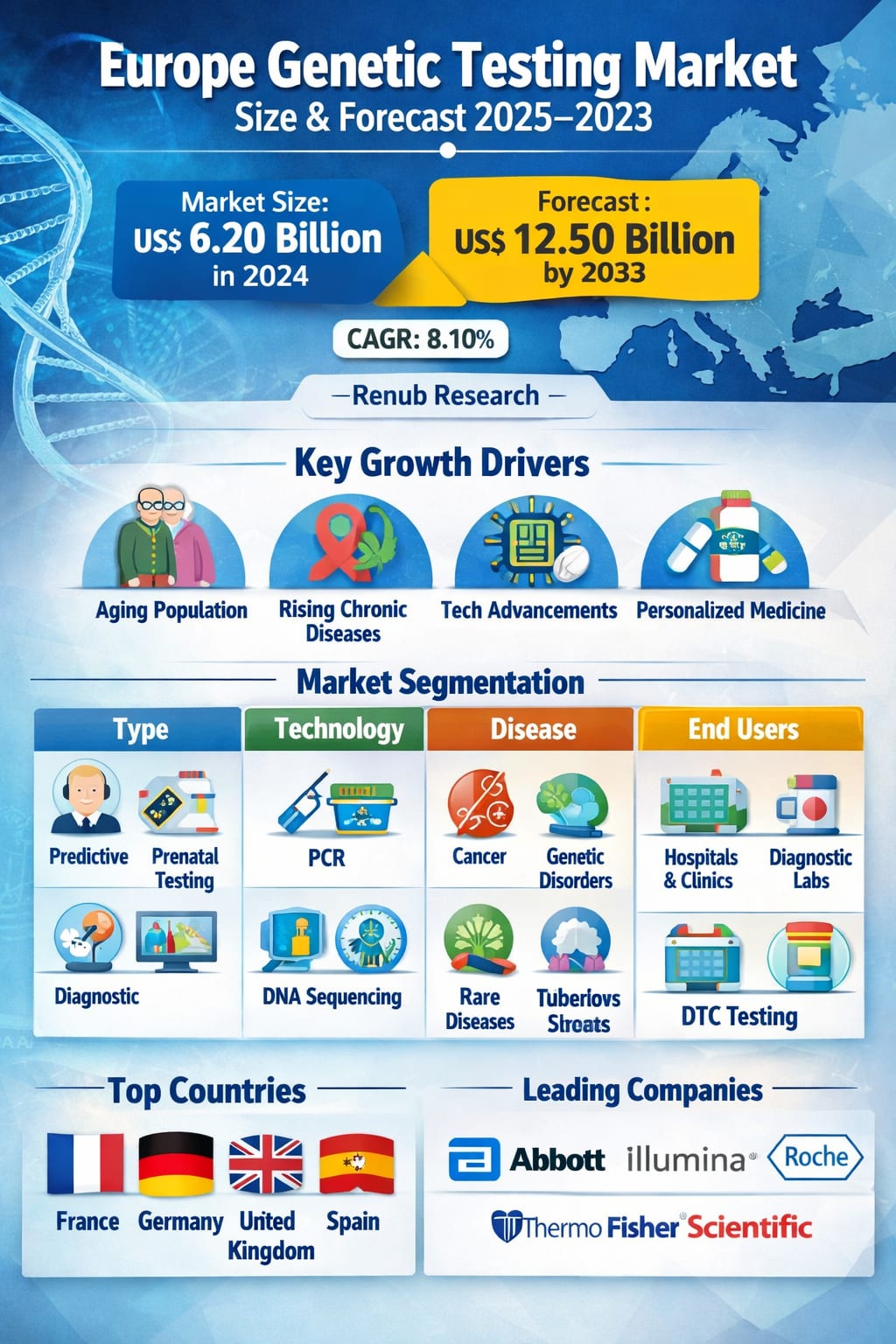
The Europe Genetic Testing Market is entering a powerful phase of transformation, driven by rapid technological progress, rising awareness about hereditary diseases, and the growing shift toward personalized medicine. According to Renub Research, the Europe Genetic Testing Market is expected to reach US$ 12.50 billion by 2033, up from US$ 6.20 billion in 2024, growing at a CAGR of 8.10% from 2025 to 2033. This strong growth trajectory reflects how genetic testing is becoming an essential pillar of modern healthcare systems across the region.
Genetic testing refers to medical tests that analyze DNA, chromosomes, or proteins to identify changes or mutations linked to diseases or health conditions. These tests play a crucial role in diagnosing genetic disorders, assessing disease risk, guiding treatment decisions, and supporting family planning. Today, genetic testing is widely used in areas such as oncology, prenatal screening, pharmacogenomics, rare disease diagnosis, and preventive healthcare. Samples are typically collected from blood, saliva, or tissue, and results are often accompanied by genetic counseling to help patients and families understand medical, ethical, and psychological implications.
Europe’s healthcare ecosystem is particularly well-positioned to benefit from genomic innovation. The region combines advanced medical infrastructure, strong public healthcare systems, active government involvement, and a robust research environment. Countries such as Germany, the United Kingdom, and France are at the forefront of integrating genetic testing into routine clinical practice, especially in cancer care, rare diseases, and prenatal diagnostics. At the same time, the rise of direct-to-consumer (DTC) genetic testing has expanded public interest, making genetic insights more accessible to everyday consumers.
Technological advances—especially in next-generation sequencing (NGS), bioinformatics, and data analytics—have dramatically reduced the cost and time required for genetic analysis. What once took months and enormous budgets can now be completed in days at a fraction of the cost. Despite this progress, challenges remain, including concerns around data privacy, reimbursement policies, and regulatory complexity across different European countries. Still, the overall direction is clear: genetic testing is moving from a specialized niche into the mainstream of European healthcare.
Market Size and Growth Outlook
Renub Research estimates that the Europe Genetic Testing Market will grow from US$ 6.20 billion in 2024 to US$ 12.50 billion by 2033, registering a CAGR of 8.10% during the forecast period from 2025 to 2033. This expansion is being fueled by several interconnected trends: rising prevalence of chronic and genetic diseases, aging populations, increasing demand for personalized therapies, and continuous innovation in genomic technologies.
Healthcare providers are increasingly relying on genetic insights to improve diagnostic accuracy, predict disease risk, and tailor treatments to individual patients. At the policy level, many European governments are supporting genomics through national strategies, funding programs, and public health initiatives. These combined forces are creating a fertile environment for sustained market growth across both clinical and consumer segments.
Key Growth Drivers
Rising Incidence of Chronic and Hereditary Diseases
One of the most important drivers of the European genetic testing market is the growing burden of chronic illnesses and inherited disorders. Cancer, cardiovascular diseases, and rare genetic conditions are placing increasing pressure on healthcare systems across Europe. Genetic testing plays a crucial role in early diagnosis, risk assessment, and treatment selection—particularly in oncology, where targeted therapies depend heavily on genetic markers.
For example, projections from European cancer databases indicate a steady rise in cancer cases over the coming decades, reinforcing the need for more precise and earlier diagnostic tools. As awareness of genetic predisposition grows among both physicians and patients, genetic testing is becoming a routine part of clinical decision-making rather than a specialized add-on. This shift is significantly boosting demand across hospitals, diagnostic laboratories, and specialized clinics.
Growing Public Awareness and Preventive Healthcare Mindset
Another major growth engine is the rising level of public awareness about genetics and preventive healthcare. Europeans are increasingly proactive about understanding their health risks, driven by better access to information, media coverage, and educational campaigns. The expansion of direct-to-consumer genetic testing has also played a role in normalizing genetic analysis among the general population.
People are no longer interested only in treating diseases after they appear; they want to predict, prevent, and manage health risks earlier in life. This mindset aligns perfectly with genetic testing, which can identify predispositions to conditions such as cancer, cardiovascular disease, and inherited disorders. Younger, tech-savvy, and health-conscious consumers are especially receptive to these services, further widening the market’s reach.
Rapid Technological Advancements in Genomics
Technology is arguably the most powerful catalyst behind the market’s growth. Innovations such as next-generation sequencing (NGS), advanced PCR techniques, microarrays, and AI-driven data analysis have transformed genetic testing in terms of speed, accuracy, and affordability. Whole-genome and whole-exome sequencing are becoming more common, enabling deeper insights into complex diseases and supporting highly personalized treatment strategies.
Collaborations between biotech companies, diagnostic firms, and research institutions are accelerating the commercialization of advanced tests. For instance, strategic partnerships and new product launches across Europe have expanded access to sophisticated diagnostics in oncology and rare disease testing. These developments are not only improving clinical outcomes but also making genetic testing more scalable and economically viable across different healthcare systems.
Challenges Facing the Market
High Cost of Advanced Genetic Testing
Despite falling prices over time, advanced genetic tests—such as whole-genome sequencing and multi-gene panels—can still be expensive for many patients and healthcare providers. Reimbursement policies vary widely across Europe, and in some countries, coverage for genetic testing remains limited. This creates barriers to access, particularly for smaller clinics and underserved populations.
High costs can delay adoption, reduce testing volumes, and widen inequalities in healthcare access. While technological progress is gradually improving affordability, cost remains a significant hurdle that the industry and policymakers must address to ensure more equitable growth.
Regulatory Complexity and Fragmentation
Europe’s regulatory landscape presents another major challenge. While overarching frameworks such as the General Data Protection Regulation (GDPR) and the In Vitro Diagnostic Regulation (IVDR) provide common standards, each country still maintains its own healthcare policies, approval pathways, and reimbursement systems. This fragmented environment makes it difficult for companies to launch and scale genetic testing services consistently across the region.
Navigating multiple regulatory systems increases operational costs, slows down market entry, and complicates cross-border collaboration. It can also discourage smaller innovators from expanding beyond their home markets. Harmonization efforts are ongoing, but regulatory complexity remains a key restraint on faster market expansion.
Country-Level Market Insights
France Genetic Testing Market
France is emerging as a major hub for genetic testing in Europe, supported by strong government initiatives, growing public awareness, and a solid research ecosystem. Programs such as “Genomic Medicine France 2025” highlight the country’s commitment to integrating genomics into routine healthcare. Next-generation sequencing technologies have improved both the accuracy and accessibility of tests, particularly in oncology, rare diseases, and prenatal diagnostics.
Preventive healthcare is gaining momentum in France, driving higher demand for genetic screening and counseling services. The rise of direct-to-consumer testing is also contributing to broader public engagement with genetics. Although concerns around data privacy and reimbursement persist, France continues to strengthen its position as a leader in Europe’s genetic testing landscape.
Germany Genetic Testing Market
Germany’s genetic testing market is benefiting from the country’s strong healthcare infrastructure, high research spending, and growing emphasis on personalized medicine. Public and private investments in genomics are accelerating innovation, while partnerships and product launches are expanding test availability.
Recent collaborations between diagnostic companies and research institutes have improved access to standardized microbiota testing, rare disease diagnostics, and oncology-focused genetic panels. With increasing applications in prenatal care, cancer treatment, and inherited disorders, Germany is expected to remain one of the most influential markets in Europe’s genetic testing sector.
United Kingdom Genetic Testing Market
The UK is a frontrunner in applying genomics at a national healthcare level. Government-backed initiatives and the integration of genetic testing into the National Health Service (NHS) have significantly boosted market growth. Nationwide programs now enable rapid genetic testing for infants and children, helping clinicians diagnose thousands of genetic conditions more quickly and initiate timely treatments.
Beyond pediatrics, genetic testing is increasingly used in cancer care, rare disease diagnosis, and prenatal screening across the UK. Continued investment in genomic research, combined with strong public awareness and policy support, positions the UK as a key driver of innovation in the European market.
Spain Genetic Testing Market
Spain’s genetic testing market is expanding steadily, supported by technological progress, rising health awareness, and growing demand for personalized medicine. Government investments in healthcare infrastructure and research are improving access to advanced diagnostics, particularly through next-generation sequencing platforms.
Preventive healthcare initiatives and the increasing use of genetic testing in oncology, neonatal screening, and rare disease management are further fueling demand. The popularity of direct-to-consumer genetic services is also helping bring genetic insights to a wider audience, strengthening Spain’s role in the regional market.
Market Segmentation Overview
By Type:
Predictive Testing
Carrier Testing
Prenatal and Newborn Testing
Diagnostic Testing
Pharmacogenomic Testing
Nutrigenomic Testing
Others
By Product:
Consumables
Equipments
Software & Services
By Technology:
PCR
DNA Sequencing
Microarrays
Others
By Disease:
Cancer
Genetic Diseases
Cardiovascular Diseases
Rare Diseases
Infectious Diseases
Others
By End User:
Hospitals & Clinics
Diagnostic Laboratories
Others
By Country:
France, Germany, Italy, Spain, United Kingdom, Belgium, Netherlands, Russia, Poland, Greece, Norway, Romania, Portugal, and Rest of Europe.
Competitive Landscape and Key Players
The European genetic testing market is highly competitive and innovation-driven. Companies are focusing on product development, strategic partnerships, geographic expansion, and technology integration to strengthen their positions. Renub Research covers all major players from four key viewpoints: company overview, key persons, recent developments and strategies, and sales analysis.
Key Players Include:
Abbott Laboratories
Danaher Corporation (Cepheid Inc.)
Illumina Inc.
Bio-Rad Laboratories Inc.
F. Hoffmann-La Roche AG
DiaSorin
Revvity Inc.
Thermo Fisher Scientific Inc.
These companies play a crucial role in shaping the market through continuous innovation in sequencing platforms, diagnostic kits, software solutions, and laboratory services.
Final Thoughts
The Europe Genetic Testing Market is clearly on a strong upward trajectory, supported by powerful trends in personalized medicine, technological innovation, and preventive healthcare. With the market projected to grow from US$ 6.20 billion in 2024 to US$ 12.50 billion by 2033 at a CAGR of 8.10%, genetic testing is set to become an even more integral part of Europe’s healthcare future.
While challenges such as high costs and regulatory complexity remain, ongoing investments, supportive government policies, and rapid scientific progress are steadily reshaping the landscape. As genetic insights move from specialized labs into everyday clinical practice and consumer health decisions, Europe is positioning itself at the forefront of the global genomics revolution—where medicine is not just reactive, but predictive, personalized, and precise.
About the Creator
Middle East & Africa Non-Lethal Weapons Market Trends & Summary
Introduction: A Shift Toward Safer Security Solutions The Middle East & Africa (MEA) region has long faced complex security challenges, ranging from political instability and civil unrest to terrorism threats and rapid urbanization. In this evolving landscape, governments and law enforcement agencies are increasingly rethinking how they maintain public order. The result is a clear shift away from purely lethal force toward non-lethal weapons—tools designed to control, deter, and disperse without causing permanent harm.
By shibansh kumar3 days ago in Trader
The Guardian Chapter V
Alexander left his Coming of Age ceremony with Cronos and the elders with as many new questions as he had answers for his old questions. Cronos had confirmed his suspicions were correct. Not only was there a link between the Beast Masters and the inhabitants of the Citadel, but it was the Citadel's fault that the Beast Masters existed in the first place. Instead of banishing the law breakers which allowed them to wreak havoc on the rest of humanity, the Citadel elders should have stripped them of their powers before they became too strong. Now Alexander would need to battle the Beast Masters and the Jikininki. It would be difficult for him to forgive the Citadel Elders because their poor decisions led to the deaths of his parents and more than half the planet's human population.
By Mark Gagnon6 days ago in Chapters



Comments
There are no comments for this story
Be the first to respond and start the conversation.