
Japan Cancer Diagnostics Market Size and Forecast 2025–2033 | Renub Research
Aging Population, Government Screening Programs, and Advanced Molecular Diagnostics Drive Steady Market Expansion in Japan

Japan Cancer Diagnostics Market Overview
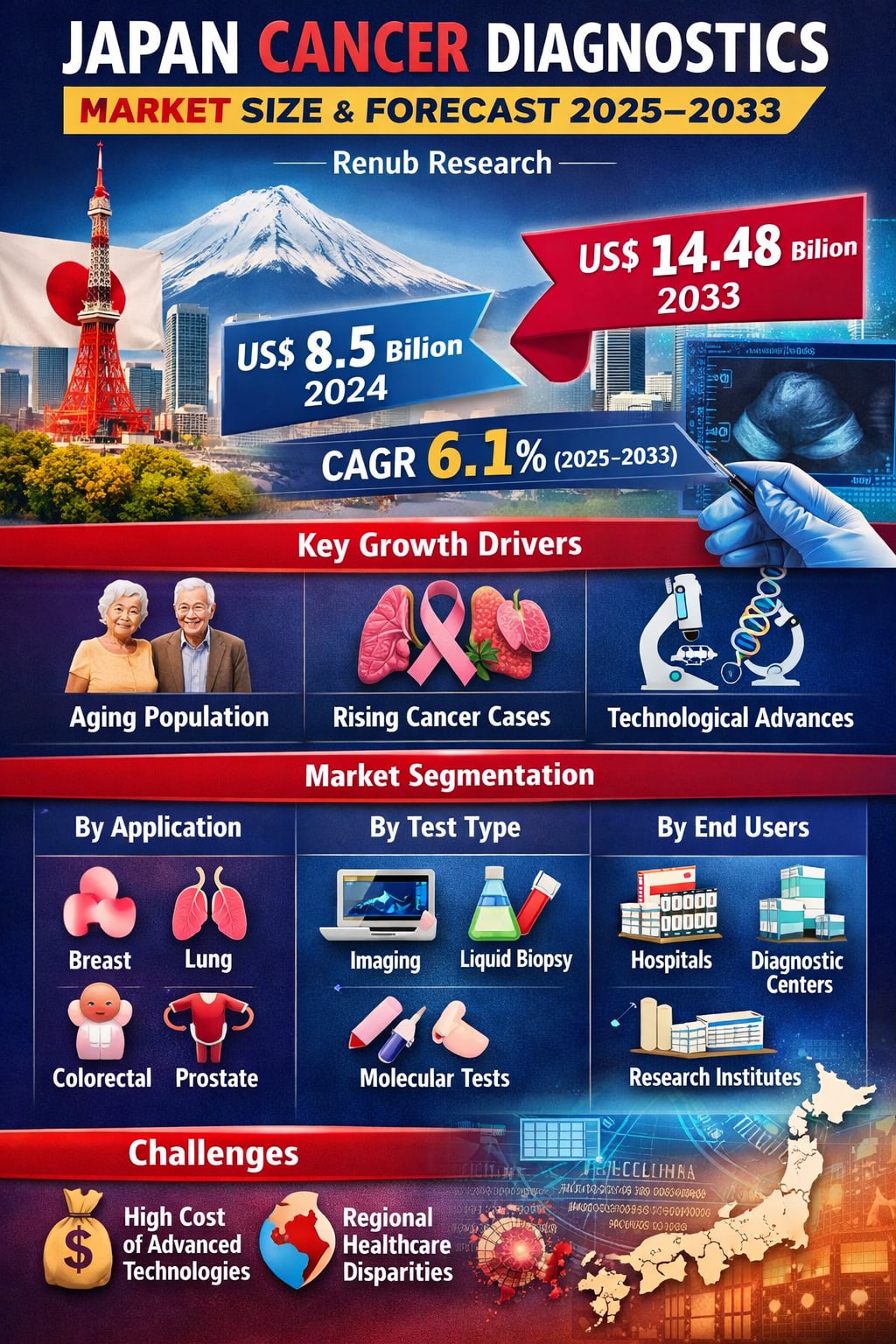
The Japan Cancer Diagnostics Market is entering a phase of sustained and strategic growth, driven by demographic shifts, rising disease burden, and rapid technological innovation. According to Renub Research, the Japan Cancer Diagnostics Market is expected to reach US$ 14.48 billion by 2033, up from US$ 8.5 billion in 2024, expanding at a compound annual growth rate (CAGR) of 6.1% from 2025 to 2033. This steady rise reflects the country’s strong healthcare infrastructure, proactive government health policies, and increasing reliance on advanced diagnostic technologies.
Cancer remains one of the leading causes of death in Japan, and the nation’s rapidly aging population has further intensified the need for early detection and accurate diagnosis. As life expectancy increases, so does the incidence of age-related diseases, including various forms of cancer such as lung, colorectal, breast, and prostate cancer. This demographic reality has made cancer diagnostics not just a medical necessity, but a strategic priority for Japan’s healthcare system.
Japan has long emphasized early detection and preventive healthcare, and this philosophy is clearly visible in its approach to cancer screening and diagnostics. Routine screenings, public awareness campaigns, and strong insurance coverage have significantly improved participation rates in diagnostic programs. As a result, demand for technologies such as imaging systems, biomarker tests, biopsies, and molecular diagnostics continues to rise across hospitals, clinics, and diagnostic centers.
At the same time, innovation is reshaping the way cancer is detected and monitored. The growing use of liquid biopsy, next-generation sequencing (NGS), immunohistochemistry, and AI-powered imaging is transforming diagnostics from a purely confirmatory process into a predictive and personalized tool. These advancements allow clinicians to detect cancer earlier, understand tumor behavior more precisely, and tailor treatment strategies to individual patients—improving outcomes while optimizing healthcare resources.
Despite these positive trends, the market also faces challenges, including the high cost of advanced diagnostic technologies and regional disparities in access to specialized care. However, continued investment in healthcare infrastructure, strong public-private collaboration, and sustained research and development efforts are expected to support long-term growth and innovation in Japan’s cancer diagnostics landscape.
Key Factors Driving the Japan Cancer Diagnostics Market Growth
Rising Cancer Prevalence
Cancer continues to be one of the most significant public health challenges in Japan. With an aging population and changing lifestyles, the number of cancer cases—particularly lung, breast, colorectal, and prostate cancers—has been steadily increasing. This growing patient pool has created a strong and consistent demand for early, accurate, and reliable diagnostic solutions.
Early detection plays a crucial role in improving survival rates and reducing treatment costs. When cancer is identified at an early stage, treatment options are more effective, less invasive, and often less expensive. This has pushed healthcare providers to invest in advanced diagnostic technologies that offer higher accuracy, faster results, and better predictive value. As awareness about the importance of early diagnosis continues to grow among both patients and healthcare professionals, the role of diagnostics in the overall cancer care pathway becomes even more central.
Moreover, the rise in lifestyle-related risk factors—such as smoking, sedentary habits, and dietary changes—has further increased the need for routine screening and continuous monitoring. This trend ensures that the demand for cancer diagnostics in Japan remains strong and resilient over the forecast period.
Government-Supported Screening Initiatives
The Japanese government plays a pivotal role in shaping the cancer diagnostics market through national screening programs and strong policy support. The Ministry of Health, Labour, and Welfare активно promotes routine screening for major cancers, including breast, cervical, colorectal, and lung cancer. These programs are largely supported by Japan’s universal health insurance system, which significantly reduces the financial burden on patients.
By lowering cost barriers and improving accessibility, these initiatives have led to higher participation rates in cancer screening programs. This, in turn, increases the volume of diagnostic tests performed each year, directly supporting market growth. Public awareness campaigns and community-based screening drives further strengthen this ecosystem by encouraging early and regular check-ups.
In addition to improving health outcomes, government-backed screening programs also help reduce the long-term economic burden of cancer by enabling earlier and more effective treatment. This creates a positive feedback loop where preventive care and diagnostics become central pillars of national healthcare strategy, reinforcing the importance of the cancer diagnostics market in Japan.
Technological Advancements in Diagnostics
Technological innovation is one of the most powerful forces driving the evolution of cancer diagnostics in Japan. The adoption of liquid biopsy, next-generation sequencing (NGS), molecular diagnostics, and AI-assisted imaging has significantly improved the precision, speed, and scope of cancer detection.
Liquid biopsy, for example, allows clinicians to detect cancer-related genetic material from a simple blood sample, reducing the need for invasive procedures and enabling more frequent monitoring. Similarly, NGS and molecular diagnostics provide detailed insights into the genetic and molecular characteristics of tumors, supporting the shift toward personalized medicine.
AI-powered imaging systems are also transforming radiology and pathology by improving image interpretation, reducing human error, and increasing diagnostic efficiency. These technologies not only enhance clinical outcomes but also help healthcare providers manage increasing workloads more effectively.
As research institutions and private companies continue to invest in R&D, these technologies are becoming more refined and, gradually, more accessible. Their growing integration into routine clinical practice is redefining the role of diagnostics in cancer care, making it a cornerstone of modern oncology in Japan.
Challenges in the Japan Cancer Diagnostics Market
High Cost of Advanced Diagnostic Technologies
One of the most significant barriers to wider adoption of cutting-edge cancer diagnostics in Japan is the high cost associated with advanced technologies. Systems such as NGS platforms, molecular diagnostic tools, and AI-driven imaging equipment require substantial investment—not only in procurement, but also in training, maintenance, and supporting infrastructure.
While large urban hospitals and specialized cancer centers are better equipped to absorb these costs, smaller hospitals and rural clinics often struggle to justify or afford such investments. This financial constraint can slow down the adoption of advanced diagnostics and limit their availability to a narrower segment of the population.
Although government subsidies and insurance coverage help reduce some of the burden, the upfront capital requirements remain a challenge. Over time, however, economies of scale, technological maturation, and policy support are expected to gradually improve affordability and accessibility.
Regional Disparities in Healthcare Access
Despite Japan’s well-developed healthcare system, regional disparities in access to advanced cancer diagnostics remain a concern. Urban areas benefit from highly specialized hospitals, advanced equipment, and a concentration of skilled professionals. In contrast, rural and remote regions often face limitations in infrastructure, workforce availability, and access to state-of-the-art diagnostic tools.
These disparities can lead to delays in diagnosis, uneven patient outcomes, and increased pressure on urban healthcare facilities as patients travel long distances for specialized care. Addressing this gap will require targeted investments in regional healthcare infrastructure, telemedicine solutions, and workforce development to ensure more equitable access to high-quality diagnostic services across the country.
Market Segmentation
By Application
The Japan cancer diagnostics market covers a wide range of cancer types, reflecting the diverse clinical needs of the population. Key application segments include:
Breast Cancer
Colorectal Cancer
Cervical Cancer
Lung Cancer
Prostate Cancer
Skin Cancer
Blood Cancer
Kidney Cancer
Liver Cancer
Pancreatic Cancer
Ovarian Cancer
Others
Among these, breast, lung, colorectal, and prostate cancers account for a significant share of diagnostic demand due to their high prevalence and established screening programs.
By Test Type
The market is segmented by a variety of diagnostic approaches, each playing a critical role in cancer detection and management:
Tumor Biomarkers Tests
Imaging
Biopsy
Liquid Biopsy
Immunohistochemistry
In Situ Hybridization
Traditional imaging and biopsy methods remain essential, but newer techniques such as liquid biopsy and molecular testing are gaining momentum due to their minimally invasive nature and high diagnostic value.
By End User
Cancer diagnostic services in Japan are delivered across multiple healthcare settings:
Diagnostic Centers
Hospitals and Clinics
Research Institutes
Others
Hospitals and clinics currently dominate the market, while diagnostic centers and research institutes play an increasingly important role in specialized testing and innovation.
Competitive Landscape and Company Analysis
The Japanese cancer diagnostics market features a strong mix of global and regional players focused on innovation, product development, and strategic partnerships. Key companies covered in the market include:
Illumina
Abbott Laboratories
Thermo Fisher Scientific, Inc.
QIAGEN N.V.
Roche Holding AG
Pfizer, Inc.
Koninklijke Philips N.V.
bioMérieux
These companies are actively investing in research and development, expanding their diagnostic portfolios, and collaborating with healthcare providers and research institutions. Their strategies typically focus on improving test accuracy, reducing turnaround times, and supporting the shift toward personalized medicine.
With continuous technological advancements and increasing demand for precise diagnostics, competition in this market is expected to remain strong, driving further innovation and quality improvements.
Japan Cancer Diagnostics Market Outlook 2025–2033
Looking ahead, the outlook for the Japan cancer diagnostics market remains highly positive. The combination of demographic trends, government support, and technological progress creates a strong foundation for sustained growth. As per Renub Research, the market’s expansion from US$ 8.5 billion in 2024 to US$ 14.48 billion by 2033 highlights the critical and growing role of diagnostics in Japan’s healthcare ecosystem.
The continued shift toward early detection, minimally invasive testing, and personalized medicine will further elevate the importance of advanced diagnostic tools. At the same time, efforts to improve regional healthcare access and manage costs will shape how quickly and broadly these innovations are adopted.
Final Thoughts
The Japan cancer diagnostics market stands at the intersection of medical necessity and technological opportunity. With cancer remaining a major public health challenge and the population continuing to age, the demand for accurate, efficient, and accessible diagnostic solutions will only intensify. Supported by strong government policies, robust healthcare infrastructure, and ongoing innovation, the market is well-positioned for steady growth through 2033.
While challenges such as high costs and regional disparities persist, the long-term trajectory points toward wider adoption of advanced diagnostics and a deeper integration of personalized medicine into everyday clinical practice. In this evolving landscape, cancer diagnostics will continue to play a central role in improving patient outcomes, optimizing healthcare resources, and shaping the future of oncology care in Japan.
About the Creator
Australia Courier, Express and Parcel (CEP) Market to Reach USD 17.7 Billion by 2033 on E-Commerce and Tech Adoption
The Australia courier, express and parcel (CEP) market is expanding steadily as digital commerce, delivery expectations, and logistics technologies evolve across the nation. According to IMARC Group, the market was valued at USD 12.8 billion in 2024 and is projected to reach USD 17.7 billion by 2033, reflecting a compound annual growth rate (CAGR) of 3.30% between 2025 and 2033.
By Rashi Sharma3 days ago in Trader



Comments
There are no comments for this story
Be the first to respond and start the conversation.