
Middle East & Africa Non-Lethal Weapons Market Trends & Summary
How Ethical Policing, Security Modernization, and Crowd Control Needs Are Reshaping Regional Defense Strategies

Introduction: A Shift Toward Safer Security Solutions
The Middle East & Africa (MEA) region has long faced complex security challenges, ranging from political instability and civil unrest to terrorism threats and rapid urbanization. In this evolving landscape, governments and law enforcement agencies are increasingly rethinking how they maintain public order. The result is a clear shift away from purely lethal force toward non-lethal weapons—tools designed to control, deter, and disperse without causing permanent harm.
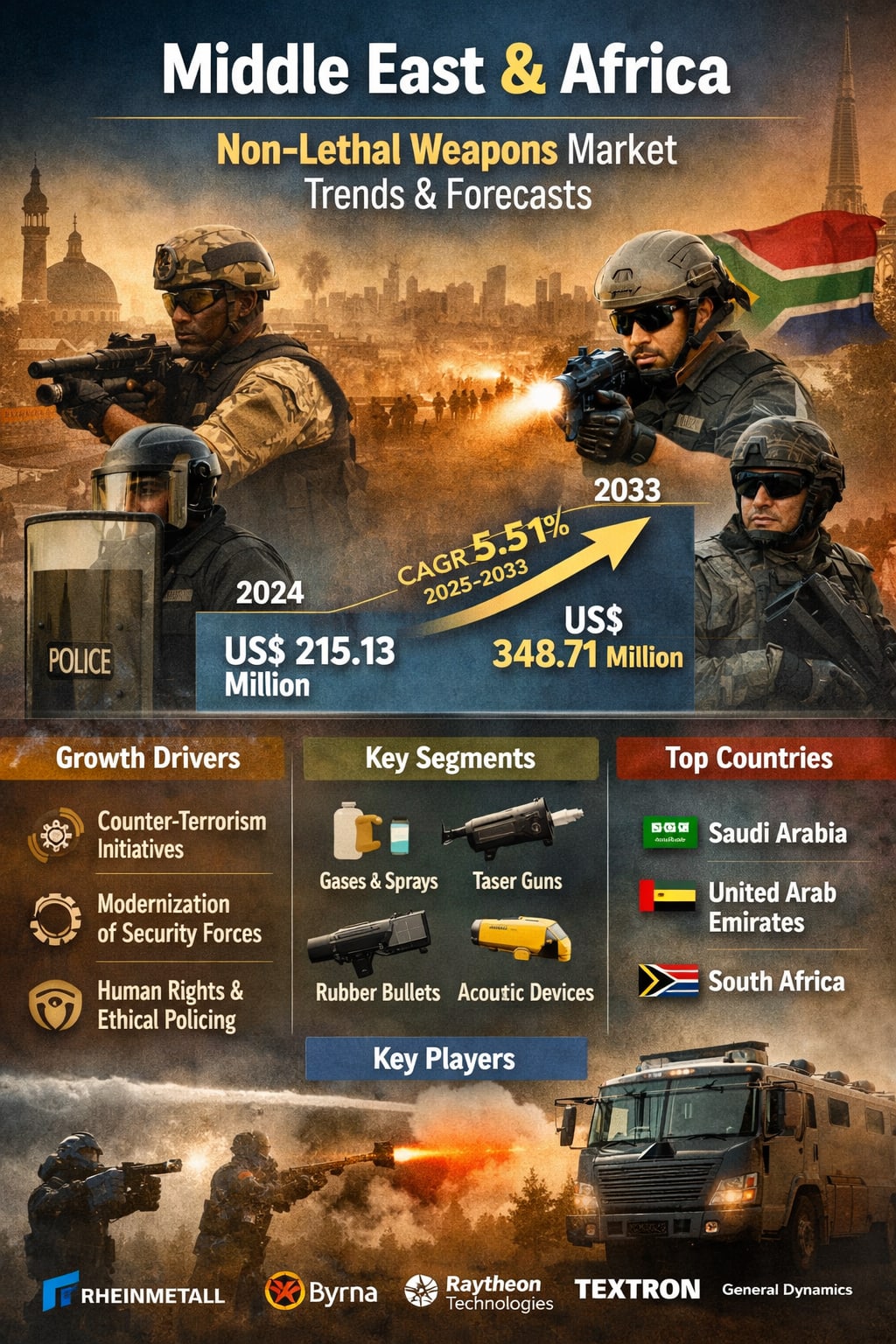
According to Renub Research, the Middle East & Africa Non-Lethal Weapons Market is projected to grow from US$ 215.13 million in 2024 to US$ 348.71 million by 2033, registering a CAGR of 5.51% from 2025 to 2033. This growth reflects not only rising security concerns, but also a broader global movement toward ethical policing, human rights compliance, and smarter crowd control strategies.
Non-lethal weapons—such as tear gas, rubber bullets, tasers, stun grenades, and acoustic or light-based systems—are now widely used to manage protests, riots, and high-risk security situations. In regions where public demonstrations, political tensions, and border security challenges are frequent, these tools offer a critical balance between maintaining order and minimizing casualties.
Market Overview: Why Non-Lethal Is Becoming Essential in MEA
The MEA non-lethal weapons market is shaped by a unique combination of security pressures, political realities, and modernization efforts. Many countries in the region face recurring civil unrest, terrorism risks, and large-scale public gatherings related to religious, political, or social events. In such scenarios, the use of conventional lethal force often leads to international criticism, legal challenges, and long-term social consequences.
Non-lethal weapons provide an alternative approach. Tools like stun guns, water cannons, rubber bullets, pepper spray, and tear gas allow security forces to disperse crowds, incapacitate suspects, and secure sensitive areas without resorting to deadly measures. This is particularly important in densely populated urban centers, where collateral damage can quickly escalate tensions.
At the same time, the region is witnessing growing investments in advanced security technologies. Acoustic devices, directed energy systems, and sophisticated electroshock weapons are increasingly being tested and deployed, especially in high-risk zones and around critical infrastructure. While budget constraints and uneven training remain challenges, the overall direction is clear: MEA governments are placing greater emphasis on safer, more controlled, and internationally acceptable methods of force.
Defense Spending and Policy Shifts: Fueling Market Growth
One of the strongest drivers behind this market’s expansion is rising defense and internal security spending. A notable example comes from Saudi Arabia, which announced plans to significantly increase its military and security expenditure as part of its long-term modernization and Vision 2030 goals. In recent years, the kingdom has emphasized local production, technological upgrades, and improved operational capabilities across its security forces.
This broader push for modernization is not limited to Saudi Arabia. Across the Middle East and parts of Africa, governments are reassessing how they equip police, military, and border security units. The focus is increasingly on tools that can manage unrest, deter violence, and protect both civilians and security personnel.
South Africa, for instance, remains a key market due to the active use of non-lethal weapons by police forces and private security companies. Rising urbanization, economic inequality, and periodic public protests have made crowd control solutions a necessity rather than a luxury. In this context, non-lethal weapons are no longer niche tools—they are becoming standard equipment in modern law enforcement arsenals.
Key Growth Drivers in the MEA Non-Lethal Weapons Market
1. Counter-Terrorism Efforts
Counter-terrorism remains a top priority across much of the Middle East and Africa. Security agencies are under constant pressure to neutralize threats quickly while minimizing civilian casualties. Non-lethal weapons such as tasers, tear gas, and acoustic devices play a crucial role in this strategy.
These tools allow forces to incapacitate suspects, control hostile crowds, and secure high-risk areas without escalating situations into deadly confrontations. In sensitive environments—such as airports, government buildings, or public events—non-lethal options provide a way to respond decisively while reducing the risk of unintended loss of life. As terrorism threats continue to evolve, the demand for flexible, scalable, and less deadly response tools is expected to rise steadily.
2. Modernization of Security Forces
Many MEA countries are in the midst of upgrading their police and military capabilities. This modernization is not just about acquiring new vehicles or surveillance systems—it also includes updating the way force is applied in public order situations.
Non-lethal weapons such as rubber bullets, tear gas, stun grenades, and electroshock devices are increasingly being integrated into standard operating procedures. These tools enhance operational effectiveness by giving officers more options in tense situations, reducing reliance on firearms, and aligning practices with international norms. As modernization programs continue, non-lethal weapons are becoming a core part of contemporary security doctrine in the region.
3. Focus on Human Rights and Ethical Policing
Human rights considerations are playing a growing role in shaping security policies across the MEA region. Governments face both domestic and international pressure to ensure that law enforcement actions are proportionate, accountable, and respectful of civilian life.
Non-lethal weapons support this shift by offering ways to manage protests, riots, and violent incidents with fewer fatalities and injuries. While no use of force is entirely risk-free, tools like pepper spray, tasers, and rubber bullets are generally seen as more humane alternatives to live ammunition. This focus on ethical policing is not just a moral issue—it also helps governments maintain public trust and reduce long-term social tensions.
Challenges Holding Back the Market
1. Lack of Training and Infrastructure
One of the biggest obstacles to wider adoption of non-lethal weapons in the MEA region is the lack of proper training and supporting infrastructure. In many countries, law enforcement personnel do not receive sufficient instruction on how to use these tools safely and effectively.
Without proper training, non-lethal weapons can be misused, leading to injuries, legal controversies, or ineffective crowd control. In addition, limited infrastructure—such as maintenance facilities, secure storage, and logistics support—can reduce the reliability and lifespan of these systems. These gaps slow down adoption and prevent security forces from fully realizing the benefits of non-lethal technologies.
2. Budget Constraints and Resource Allocation
Despite rising security needs, budget limitations remain a major challenge for many MEA countries. Defense and internal security budgets often prioritize urgent military hardware, counter-terrorism operations, or border security, leaving limited funds for non-lethal systems.
For smaller or less wealthy nations, the costs associated with procurement, training, maintenance, and upgrades can be difficult to justify in the short term. As a result, the rollout of non-lethal weapons is sometimes slower than desired, even when policymakers recognize their long-term benefits for public safety and social stability.
Country Spotlight: United Arab Emirates (UAE)
The United Arab Emirates has emerged as one of the more forward-looking markets for non-lethal weapons in the region. As part of its broader push to modernize security forces and enhance public safety, the UAE has been increasingly adopting advanced non-lethal technologies for crowd control and critical infrastructure protection.
The country’s approach reflects a desire to balance strong security with international human rights standards. Both law enforcement and military agencies are exploring a range of solutions, from direct-contact electroshock devices to more advanced directed energy and acoustic systems.
Major global defense and security companies—including Rheinmetall AG, BAE Systems plc, and Lamperd Less Lethal, Inc.—are active in supplying or developing non-lethal solutions for the UAE market. Their presence highlights the country’s role as a regional hub for advanced security technologies.
Country Spotlight: Saudi Arabia
Saudi Arabia represents one of the fastest-growing markets for non-lethal weapons in the MEA region. Driven by ongoing security concerns, large public events, and a broad modernization agenda, the kingdom is investing heavily in crowd control and internal security capabilities.
Non-lethal tools such as bean bag rounds, rubber bullets, tear gas, and tasers are increasingly being used by security forces to manage demonstrations, control unrest, and protect public spaces. The military is also exploring these technologies for specific tactical scenarios where minimizing casualties is a priority.
With continued investments in technology and training, and a strong focus on modernization under Vision 2030, Saudi Arabia is expected to remain a key growth engine for the regional non-lethal weapons market in the coming years.
Market Segmentation: How the Industry Is Structured
By Product Type:
Gases and sprays
Grenades
Bullets
Taser guns
Others
By Technology:
Chemical
Electroshock
Mechanical and kinetic
Acoustic/light
Others
By End Use:
Law enforcement
Military
Others
By Country:
South Africa
Saudi Arabia
UAE
Competitive Landscape: Key Companies in Focus
The MEA non-lethal weapons market features a mix of global defense giants and specialized security technology providers. Key players covered in the market include:
Byrna Technologies Inc.
General Dynamics Corporation
Moog Inc.
Raytheon Technologies Corporation
Rheinmetall AG
Textron Inc.
Combined Systems Inc.
These companies compete across product innovation, technology development, strategic partnerships, and regional expansion. Their offerings range from traditional crowd control munitions to advanced electroshock and directed energy systems, reflecting the growing sophistication of the market.
Final Thoughts: A Market Shaped by Responsibility and Reality
The Middle East & Africa Non-Lethal Weapons Market is no longer just a niche segment of the defense industry—it is becoming a core component of modern security strategies. With the market expected to grow from US$ 215.13 million in 2024 to US$ 348.71 million by 2033, the trajectory is clear: demand for safer, more ethical, and more flexible use-of-force options is rising across the region.
While challenges such as budget constraints, training gaps, and infrastructure limitations remain, the broader trends of security modernization, counter-terrorism needs, and human rights awareness are likely to keep driving adoption. For governments, law enforcement agencies, and defense planners, non-lethal weapons represent a practical middle ground—strong enough to maintain order, yet restrained enough to reduce long-term social and political costs.
About the Creator
Keep reading
More stories from shibansh kumar and writers in Trader and other communities.
Latin America Non-Lethal Weapons Market Trends & Summary
Introduction The Latin America Non-Lethal Weapons Market is entering a phase of steady and strategic expansion, reflecting the region’s evolving approach to public safety, law enforcement, and crowd management. According to Renub Research, the market is expected to grow from US$ 407.51 million in 2024 to US$ 652.65 million by 2033, registering a CAGR of 5.37% from 2025 to 2033. This growth trajectory highlights how governments and security agencies across Latin America are increasingly prioritizing tools that allow them to manage unrest, crime, and security threats without resorting to lethal force.
By shibansh kumara day ago in Trader
Europe Agricultural Equipment Market Size and Forecast 2025–2033
Introduction: A Market Driving Europe’s Food Security The Europe Agricultural Equipment Market stands at the heart of the continent’s food security, sustainability goals, and technological transformation. Valued at USD 46.86 billion in 2024, the market is expected to grow steadily to USD 67.68 billion by 2033, registering a CAGR of 4.17% from 2025 to 2033, according to Renub Research. This growth is not happening in isolation. It reflects a deeper structural shift in European farming—one shaped by rising labor costs, aging farmer populations, stricter environmental regulations, and the rapid adoption of precision agriculture technologies.
By Sakshi Sharma5 days ago in Trader
Australia Travel Insurance Market — Growth, Forecast & Strategic Outlook 2026 to 2034
The Australia travel insurance market continues to grow as travel activity rebounds and risk awareness among travellers rises. According to IMARC Group, the market was valued at USD 362.3 million in 2025 and is projected to reach USD 463.3 million by 2034, growing at a compound annual growth rate (CAGR) of 2.69% from 2026 to 2034. This growth reflects broader trends in tourism, business travel, and risk management behaviours among domestic and international travellers alike.
By Rashi Sharma5 days ago in Trader
The Cave Part 6
If you have ever heard a tale about yourself that you cannot remember and doubtless think is made up, you will know how I felt when Tharkin related all that the eagle had seen of me before my memories were scattered. Of far distances and traveling companions that I did not recall, camping out under the stars and making our way to the mountains with deliberate purpose. The great bird had lost contact with my party once we entered the forests, and the seven other members were not seen again by him or his brethren since.
By Jamye Sharp3 days ago in Chapters


Comments
There are no comments for this story
Be the first to respond and start the conversation.