
Chronic Obstructive Pulmonary Disease Market Size, Trends, and Global Outlook 2025–2033
Rising pollution, aging populations, and therapeutic innovation reshape the global COPD treatment landscape

Chronic Obstructive Pulmonary Disease Market Overview
Chronic Obstructive Pulmonary Disease (COPD) is one of the most serious and persistent respiratory disorders affecting millions of people worldwide. Characterized by progressive airflow limitation, COPD primarily includes chronic bronchitis and emphysema, both of which severely impair lung function over time. The disease is largely irreversible and is most commonly associated with long-term exposure to harmful particles or gases, especially tobacco smoke, air pollution, and occupational hazards.
Clinically, COPD manifests through symptoms such as chronic cough, excessive mucus production, shortness of breath, wheezing, and frequent respiratory infections. As the disease advances, patients often experience reduced physical capacity, frequent hospitalizations, and a significant decline in quality of life. Because COPD is a long-term condition, management focuses on symptom control, slowing disease progression, and preventing complications rather than achieving a complete cure.
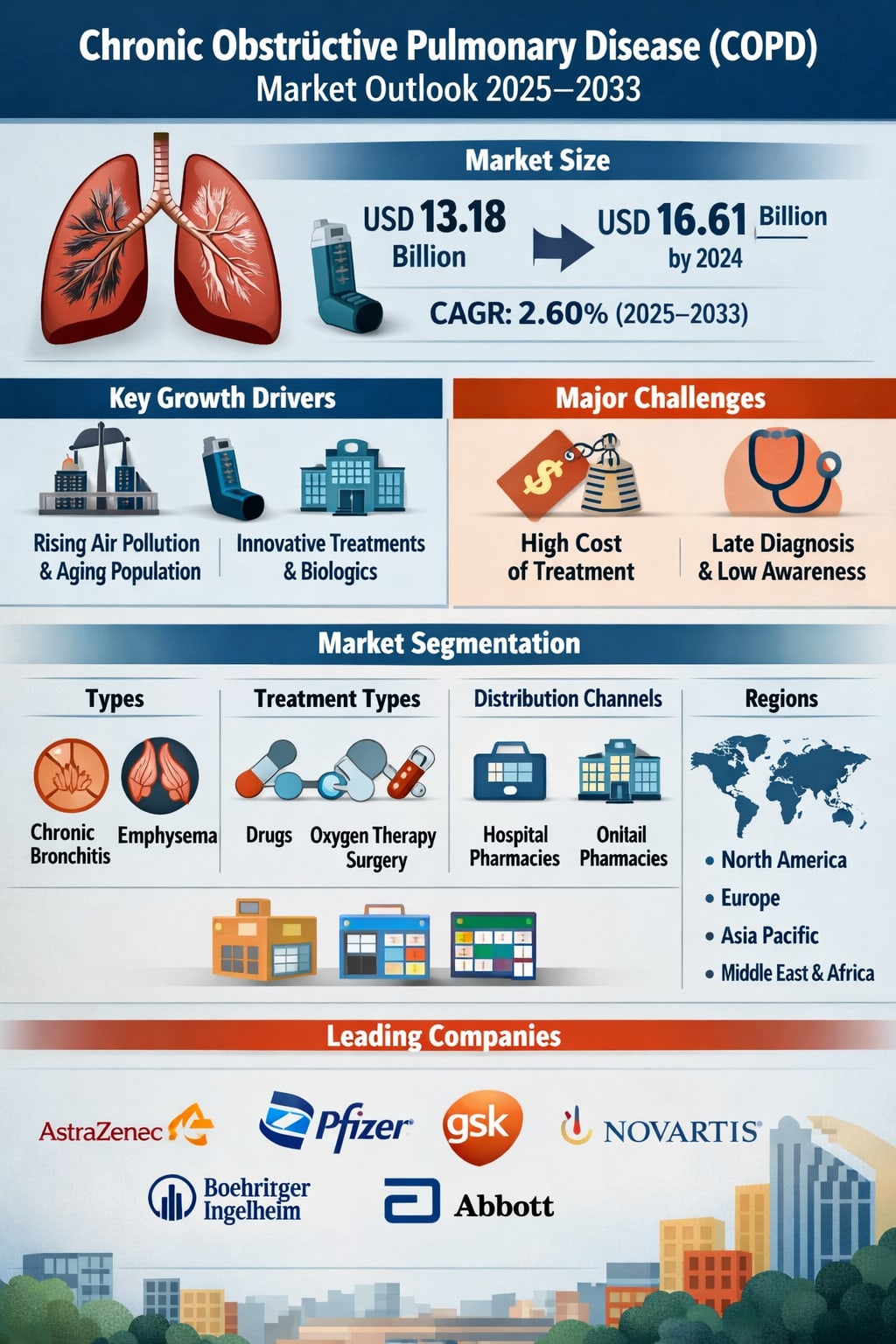
From a market perspective, the global Chronic Obstructive Pulmonary Disease market was valued at USD 13.18 billion in 2024 and is projected to reach USD 16.61 billion by 2033, growing at a CAGR of 2.60% during the forecast period from 2025 to 2033. This steady growth reflects the dual reality of rising disease prevalence and continuous innovation in treatment options. Increasing awareness, expanding diagnostic capabilities, and the development of more effective therapies are gradually transforming how COPD is managed worldwide.
What Is Driving the Growth of the COPD Market?
Rising Prevalence of COPD Worldwide
One of the most powerful drivers of the COPD market is the growing global burden of the disease. COPD is already among the leading causes of death worldwide, and its prevalence continues to rise due to a combination of environmental, demographic, and lifestyle factors. Rapid urbanization, worsening air quality, exposure to biomass fuel in developing countries, and persistent smoking habits are all contributing to higher incidence rates.
The aging global population further amplifies this trend. Since COPD is more common in older adults, countries with expanding elderly populations are witnessing a steady increase in diagnosed cases. According to global health data, COPD accounts for millions of deaths each year and represents a significant portion of chronic disease-related healthcare costs. In high-income countries, tobacco smoking is responsible for the majority of COPD cases, while in low- and middle-income countries, household air pollution and occupational exposure play a major role.
As more people are diagnosed and enter long-term treatment pathways, the demand for medications, oxygen therapy, hospital care, and advanced interventions continues to rise—directly fueling market expansion.
Advancements in Treatment Options and Drug Innovation
Another major growth engine for the COPD market is ongoing innovation in treatment strategies. Traditionally, COPD management relied heavily on bronchodilators and corticosteroids to relieve symptoms. While these remain the backbone of therapy, the treatment landscape is becoming more sophisticated and personalized.
Combination inhalers that integrate multiple active ingredients in a single device are improving convenience and patient adherence. Smart inhaler technologies, which track usage and provide real-time feedback, are also gaining traction as healthcare systems focus more on outcomes and compliance.
In parallel, biologic therapies and targeted treatments are opening new possibilities, especially for patients with specific inflammatory profiles. For example, in October 2024, Ohtuvayre—a dual selective inhibitor of phosphodiesterase 3 (PDE3) and phosphodiesterase 4 (PDE4)—gained attention for its ability to both dilate airways and reduce inflammation, highlighting how innovation is reshaping COPD care.
Such advancements not only improve patient outcomes but also expand the commercial potential of the market by introducing premium, high-value therapies.
Government and Healthcare System Initiatives
Public health policies and healthcare investments are also playing a crucial role in shaping the COPD market. Governments around the world are increasingly recognizing COPD as a major public health challenge and are implementing programs focused on early diagnosis, smoking cessation, and improved access to treatment.
Awareness campaigns, better reimbursement frameworks, and investments in respiratory care infrastructure are helping more patients receive timely and effective treatment. In many regions, policies aimed at reducing air pollution and promoting healthier lifestyles are being paired with efforts to strengthen healthcare delivery systems.
A notable example is AstraZeneca Pharma India receiving approval from the Drug Controller General of India (DCGI) to import and market Breztri Aerosphere, a triple-combination inhalation therapy for COPD, with a planned launch in early 2025. Such regulatory approvals and policy support accelerate the adoption of advanced therapies and stimulate overall market growth.
Key Challenges Facing the COPD Market
High Cost of Treatment
Despite medical progress, the high cost of COPD treatment remains a significant barrier, especially in low- and middle-income countries. Long-term medication use, oxygen therapy, frequent hospital visits, and, in severe cases, surgical interventions can place a heavy financial burden on patients and healthcare systems.
In regions with limited insurance coverage or high out-of-pocket expenses, many patients struggle to access consistent treatment. This not only affects patient outcomes but also limits the overall market potential by restricting the adoption of newer, more expensive therapies.
Lack of Early Diagnosis and Awareness
Another major challenge is underdiagnosis. COPD often develops slowly, and many patients dismiss early symptoms such as mild breathlessness or chronic cough as normal signs of aging or smoking. As a result, a large proportion of patients are only diagnosed at advanced stages, when lung damage is already significant.
Limited access to screening programs, lack of awareness among the general population, and inconsistent diagnostic practices contribute to delayed treatment. This not only worsens health outcomes but also reduces the effectiveness of early-stage interventions that could slow disease progression and improve quality of life.
Segment Insights: Understanding the Market Structure
Emphysema in the COPD Market
Emphysema, one of the primary forms of COPD, is characterized by damage to the alveoli, which reduces the lungs’ ability to exchange oxygen efficiently. The rising prevalence of smoking and exposure to air pollutants continues to drive the growth of this segment.
Treatment options include bronchodilators, inhaled corticosteroids, oxygen therapy, and in severe cases, surgical interventions such as lung volume reduction surgery. Minimally invasive techniques, including endobronchial valves, are gaining popularity as they offer symptom relief with shorter recovery times, further supporting segment growth.
COPD Drugs Market
The drug segment represents the largest and most dynamic part of the COPD market. Demand for bronchodilators, corticosteroids, and combination inhalers continues to rise as more patients are diagnosed and placed on long-term therapy.
Pharmaceutical companies are focusing on developing drugs that offer better efficacy, longer duration of action, and fewer side effects. The emergence of biologics and targeted therapies is particularly significant, as these treatments promise more personalized care and better control for specific patient groups. Supportive reimbursement policies and faster regulatory approvals are also accelerating the adoption of new medications.
COPD Surgery Market
Surgical interventions, including lung volume reduction surgery and lung transplantation, are typically reserved for patients with severe, treatment-resistant COPD. While this is a smaller segment compared to pharmaceuticals, it plays a critical role in advanced disease management.
Improvements in minimally invasive surgical techniques, better patient selection, and enhanced postoperative care are improving outcomes and expanding the number of patients who can benefit from these procedures. The growth of specialized respiratory care centers is further supporting this segment.
Hospital-Based COPD Care
Hospitals remain central to COPD management, especially for diagnosis, acute exacerbation treatment, oxygen therapy, and surgical care. As the disease burden increases and more patients present with severe symptoms, hospital-based services are experiencing rising demand.
Investments in healthcare infrastructure, improved diagnostic tools, and government support programs are strengthening this segment, particularly in emerging economies where hospital capacity is expanding.
Online Pharmacies and Digital Access
The rapid growth of online pharmacies is reshaping how COPD patients access medications. E-commerce platforms now offer inhalers, oxygen concentrators, and maintenance drugs with home delivery, improving convenience and treatment adherence.
Combined with telemedicine services, online pharmacies are making chronic disease management more accessible, especially for patients with mobility issues or those living in remote areas. Competitive pricing and subscription-based refill models are further boosting this channel’s appeal.
Regional Market Highlights
United States
The U.S. represents one of the largest COPD markets globally, driven by high disease prevalence, advanced healthcare infrastructure, and strong research activity. The adoption of biologics and smart inhaler technologies is growing, reflecting a shift toward more personalized and data-driven care.
In September 2024, the U.S. FDA approved Dupixent (dupilumab) as an add-on maintenance treatment for adults with inadequately controlled COPD with an eosinophilic phenotype, marking an important milestone in biologic therapy for COPD.
France and Europe
France benefits from a well-established healthcare system and strong government support for respiratory health programs. Smoking cessation initiatives, public awareness campaigns, and investments in advanced inhaler technologies are supporting market growth.
In July 2024, the European Medicines Agency approved Dupixent for adults with uncontrolled COPD and elevated blood eosinophils, reinforcing Europe’s growing focus on targeted and biologic therapies.
India
India’s COPD market is expanding rapidly due to rising air pollution, widespread use of biomass fuel, and persistent smoking rates. While access to healthcare remains uneven, especially in rural areas, government initiatives and the availability of affordable generic drugs are improving treatment reach.
In November 2023, Lupin Limited announced the launch of the world’s first fixed-dose triple combination drug for COPD management in India, highlighting the country’s growing role in pharmaceutical innovation.
Saudi Arabia and the Middle East
In Saudi Arabia, high smoking prevalence and environmental factors are driving COPD incidence. The government’s investments in healthcare infrastructure and digital health solutions, including telemedicine and online pharmacies, are improving access to care.
In September 2024, EVA Pharma announced the implementation of strategies focused on asthma and COPD patients in Saudi Arabia, signaling stronger regional commitment to respiratory healthcare.
Market Segmentation Snapshot
By Types:
Chronic Bronchitis
Emphysema
By Treatment Types:
Drugs
Oxygen Therapy
Surgery
Others
By Distribution Channels:
Hospital Pharmacies
Retail Pharmacies
Online Pharmacies
By Region:
North America, Europe, Asia Pacific, Latin America, Middle East & Africa
Competitive Landscape
The global COPD market is highly competitive, with leading players focusing on product innovation, strategic partnerships, and geographic expansion. Key companies include AstraZeneca, Pfizer, GlaxoSmithKline, Novartis, Astellas Pharma, Abbott Laboratories, Boehringer Ingelheim, and Almirall. These companies compete across multiple fronts, including drug development, inhaler technology, and biologic therapies, to strengthen their market positions.
Final Thoughts
The Chronic Obstructive Pulmonary Disease market is on a steady growth path, driven by rising disease prevalence, an aging population, and continuous innovation in treatment options. While challenges such as high treatment costs and underdiagnosis persist, expanding awareness, supportive government policies, and technological advancements are gradually reshaping the landscape.
With the market expected to grow from USD 13.18 billion in 2024 to USD 16.61 billion by 2033, COPD is set to remain a major focus area for healthcare systems and pharmaceutical innovators alike. As therapies become more personalized and access continues to improve, the coming decade will likely bring not only commercial growth but also meaningful improvements in the lives of millions of patients living with this chronic respiratory disease.
About the Creator
United States Handicrafts Market Size, Share, Industry Overview, Trends and Forecast 2026-2034
How the United States Handicrafts Market Is Preserving Creativity in a Mass-Produced World In a world dominated by factory production and global supply chains, handicrafts continue to hold a unique emotional and cultural value. The United States handicrafts market reflects a growing appreciation for handmade goods, local artistry, and objects that carry personal stories. While industrial manufacturing emphasizes efficiency, handicrafts highlight patience, skill, and human connection.
By Jackson Watson2 days ago in Trader
Saudi Arabia Whiskey Market Trends & Growth Outlook 2025–2033
Introduction The Saudi Arabia whiskey market presents one of the most unique and complex landscapes in the global beverage industry. Unlike most countries, Saudi Arabia operates under strict Islamic laws that prohibit the manufacture, sale, and consumption of alcoholic beverages, including whiskey. Yet, despite these restrictions, demand for whiskey and other premium spirits continues to exist beneath the surface, driven largely by expatriate communities, affluent consumers, international travel, and shifting lifestyle aspirations.
By shibansh kumar5 days ago in Trader




Comments
There are no comments for this story
Be the first to respond and start the conversation.