
Saudi Arabia Whiskey Market Trends & Growth Outlook 2025–2033
Luxury Demand, Tourism Expansion, and Changing Lifestyles Shape a Complex and Hidden Market

Introduction
The Saudi Arabia whiskey market presents one of the most unique and complex landscapes in the global beverage industry. Unlike most countries, Saudi Arabia operates under strict Islamic laws that prohibit the manufacture, sale, and consumption of alcoholic beverages, including whiskey. Yet, despite these restrictions, demand for whiskey and other premium spirits continues to exist beneath the surface, driven largely by expatriate communities, affluent consumers, international travel, and shifting lifestyle aspirations.
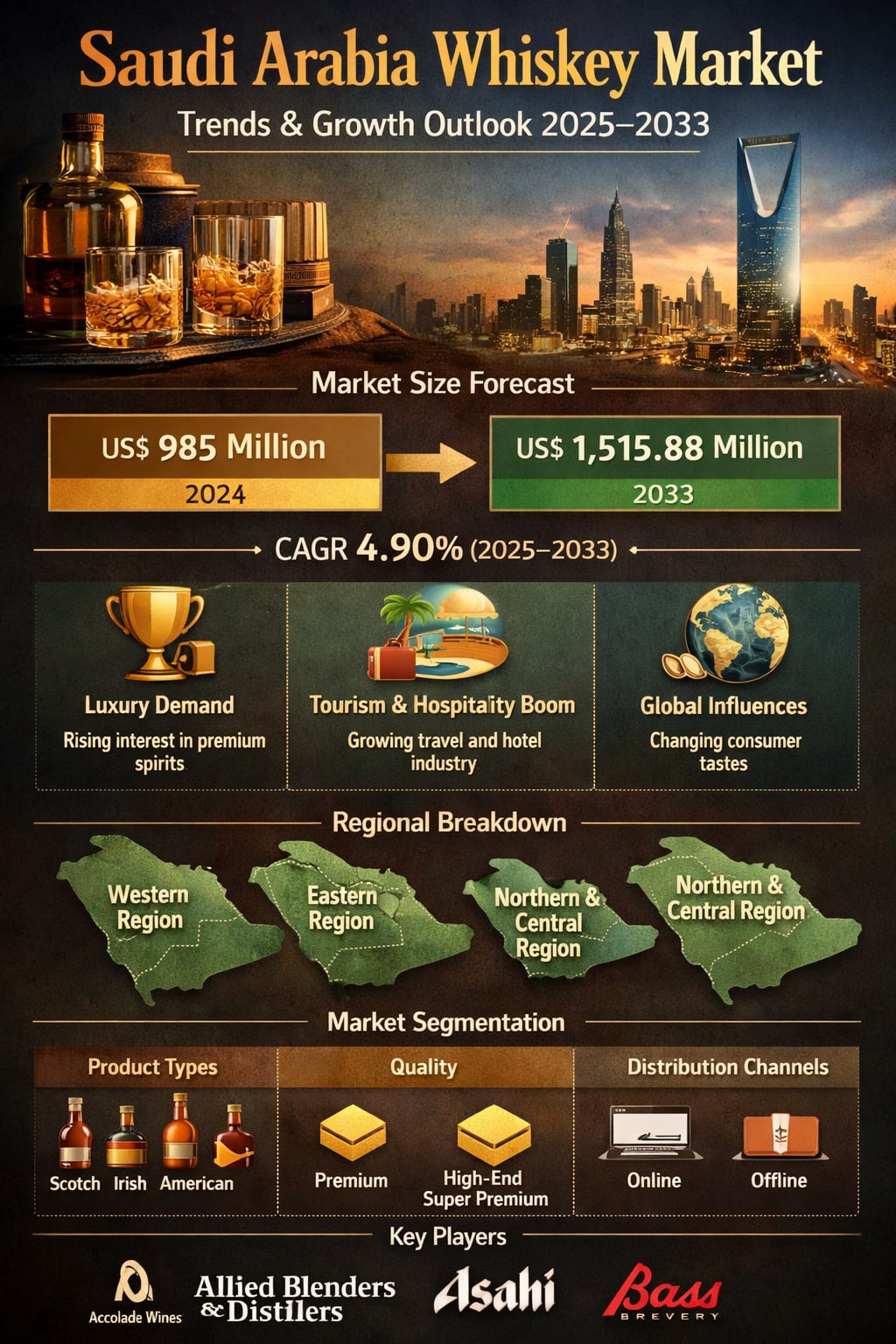
According to Renub Research, the Saudi Arabia whiskey market is expected to grow from US$ 985 million in 2024 to approximately US$ 1,515.88 million by 2033, registering a compound annual growth rate (CAGR) of 4.90% from 2025 to 2033. This projected growth reflects not only rising disposable incomes and expanding tourism, but also a broader transformation in consumer preferences toward premium and luxury experiences.
While the market remains largely unofficial and hidden due to legal and cultural constraints, it is increasingly influenced by globalization, hospitality sector growth, and Saudi Arabia’s ambitious Vision 2030 reforms. Together, these forces are reshaping consumer behavior and creating a small but steadily expanding niche for premium spirits such as whiskey.
Saudi Arabia Whiskey Industry Overview
Saudi Arabia’s strict alcohol laws have long defined the structure of its whiskey market. The production, import, distribution, and consumption of alcoholic beverages are officially prohibited, making any formal retail market impossible. As a result, whiskey consumption in the Kingdom operates almost entirely through informal, private, or black-market channels.
Despite this, demand persists. A large expatriate population—particularly from Western countries where whiskey consumption is culturally common—continues to seek access to familiar premium spirits. In addition, a segment of wealthy Saudi consumers, influenced by international travel and global lifestyle trends, shows growing curiosity toward luxury beverages, including high-end whiskey.
The expansion of the travel, tourism, and hospitality sectors under Vision 2030 has also subtly changed the environment. Saudi Arabia is increasingly positioning itself as a global tourism and business destination, hosting international events, exhibitions, and high-profile visitors. This global exposure has indirectly increased awareness and interest in premium international brands, including spirits, even if consumption remains discreet and limited.
It is important to note that, because the market operates outside official channels, precise consumption and sales data are difficult to verify. However, Renub Research’s projections indicate that the underlying demand base is expanding, supported by rising wealth, lifestyle changes, and the country’s broader economic transformation.
Market Size and Growth Outlook
The Saudi Arabia whiskey market’s growth outlook reflects a combination of economic, social, and cultural factors. With the market valued at US$ 985 million in 2024 and projected to reach US$ 1,515.88 million by 2033, the expected 4.90% CAGR suggests steady, long-term expansion rather than rapid or explosive growth.
This moderate pace is understandable given the legal and cultural constraints. However, several structural drivers are supporting this upward trend:
Rising disposable incomes among affluent consumers
Growth of the tourism and hospitality sectors
Increasing exposure to global food and beverage culture
A growing preference for premium and luxury lifestyle products
Expanding expatriate population in key urban and industrial regions
Together, these factors are helping to sustain demand for premium spirits such as whiskey, even within a highly regulated and culturally sensitive environment.
Growth Drivers for the Saudi Arabia Whiskey Market
Changing Consumer Preferences and Global Influence
Saudi consumers, particularly younger and more globally connected individuals, are increasingly influenced by international trends in food, beverages, and lifestyle. Social media, overseas education, international travel, and exposure to global entertainment have all contributed to a broader awareness of premium brands and luxury experiences.
Even though alcohol remains prohibited, curiosity about international spirits, cocktail culture, and premium beverages has grown. Industry observers note that global brands are paying closer attention to Middle Eastern markets, including Saudi Arabia, due to the region’s expanding hospitality sector and rising luxury consumption.
This shift in mindset does not necessarily translate into open or widespread consumption, but it does create a steady undercurrent of demand, especially among expatriates and high-income consumers who are willing to pay a premium for exclusive and high-quality products.
Rapid Expansion of Tourism and Hospitality
Saudi Arabia’s Vision 2030 strategy places tourism and hospitality at the center of economic diversification. The country has invested heavily in new hotels, resorts, entertainment zones, cultural festivals, and international events. Tourist arrivals have surged, and Saudi Arabia has positioned itself as one of the fastest-growing tourism destinations globally.
As the hospitality sector expands, so does the influence of international standards of service, dining, and leisure. While alcohol remains officially prohibited, the presence of global visitors and international business travelers continues to shape expectations around premium experiences, indirectly supporting demand for high-end beverages, including whiskey, in private or unofficial settings.
This tourism-driven transformation is expected to remain a long-term growth engine for luxury consumption across multiple categories, including premium spirits.
Rising Demand for Premium and Luxury Experiences
Another key driver is the growing appetite for premium and super-premium products among affluent consumers. In many sectors—from fashion and automobiles to dining and travel—Saudi Arabia has seen a strong shift toward high-end and luxury offerings.
Whiskey, especially premium and rare varieties, fits naturally into this broader trend of aspirational and status-driven consumption. For wealthy individuals and expatriates, premium whiskey represents not just a beverage, but a symbol of sophistication, exclusivity, and global taste.
Although access remains limited and discreet, willingness to pay for high-quality and exclusive products continues to support market value growth.
Challenges Facing the Saudi Arabia Whiskey Market
Social and Cultural Constraints
The most significant challenge remains Saudi Arabia’s strong religious and cultural norms, which prohibit alcohol consumption. These norms shape public attitudes, consumer behavior, and government policy, leaving no room for a visible or legally recognized whiskey market.
As a result, there is limited public discussion, marketing, or education around whiskey and other spirits. This restricts brand-building, consumer awareness, and the development of a structured industry ecosystem.
Lack of Legal and Regulatory Framework
Because alcohol is illegal, there is no formal regulatory framework governing the import, distribution, or sale of whiskey. This creates a major barrier for any legitimate business activity and prevents international brands from operating openly in the market.
The absence of legal channels also means that the market remains fragmented, opaque, and difficult to measure accurately. For investors and global companies, this regulatory uncertainty significantly limits the scope for direct participation or expansion.
Regional Overview of the Saudi Arabia Whiskey Market
By region, the Saudi Arabia whiskey market is segmented into the Northern & Central Region, Western Region, Eastern Region, and Southern Region.
Eastern Region
The Eastern Region stands out due to its strong industrial base, higher concentration of expatriates, and proximity to international trade routes. These factors contribute to relatively higher exposure to global lifestyles and premium products.
While alcohol remains prohibited, underground demand for whiskey is supported by foreign professionals and affluent consumers. The region’s higher income levels and international business presence make it one of the more active, albeit discreet, markets for premium spirits.
Western Region
The Western Region, which includes major cities such as Jeddah and the holy city of Mecca, benefits from heavy international footfall due to tourism, religious pilgrimages, and trade. Although religious sensitivities are especially strong in this region, the sheer volume of international visitors and expatriates creates latent demand for premium spirits.
This demand is largely met through unofficial channels and remains hidden, but the region’s cosmopolitan character and economic activity make it an important part of the overall market landscape.
Northern & Central Region
The Northern and Central Region, including Riyadh, is the political and administrative heart of the country. It is also home to a growing number of business travelers, diplomats, and expatriates. High disposable incomes and a concentration of luxury consumption support demand for premium lifestyle products, including high-end beverages, even if consumption remains private.
Southern Region
The Southern Region has comparatively lower levels of international exposure and luxury consumption. As a result, whiskey demand here is more limited and largely confined to small, niche consumer groups.
Market Segmentation
By Product Type
American Whiskey
Irish Whiskey
Scotch Whiskey
Canadian Whiskey
Others
Among these, Scotch and American whiskey tend to dominate global premium perceptions and are generally the most sought-after in high-end segments.
By Quality
Premium
High-End Premium
Super Premium
The market is clearly skewed toward premium and super-premium categories, reflecting the niche, luxury-oriented nature of demand.
By Distribution Channel
Online
Offline
In practice, both channels operate informally, with access typically based on private networks and discreet sourcing rather than open retail.
Competitive Landscape
Key players analyzed in the market include:
Accolade Wines
Alko
Allagash Brewing Company
Allied Blenders & Distillers
Arkell’s Brewery
Anchor Brewing Company
Asahi Breweries
Bass Brewery
These companies are evaluated based on company overviews, key personnel, recent developments, and revenue performance. While direct operations in Saudi Arabia remain limited due to regulations, many of these brands benefit indirectly from global brand recognition and premium positioning.
Final Thoughts
The Saudi Arabia whiskey market is unlike any other in the world—shaped by strict legal restrictions, strong cultural norms, and yet, steadily growing undercurrents of demand driven by wealth, globalization, tourism, and changing lifestyles. With the market projected to grow from US$ 985 million in 2024 to US$ 1,515.88 million by 2033, the long-term trajectory points to gradual but consistent expansion.
While the market will likely remain discreet and highly regulated for the foreseeable future, the broader forces of economic diversification, premiumization, and global integration suggest that demand for high-end spirits such as whiskey will continue to exist and slowly strengthen. For now, Saudi Arabia’s whiskey market remains a niche, complex, and closely watched segment—one that reflects the country’s wider transformation at the crossroads of tradition and modernization.
About the Creator
Keep reading
More stories from shibansh kumar and writers in Trader and other communities.
North America Frozen and Canned Seafood Market Size and Forecast 2025–2033
Introduction: A Market Built on Convenience and Consistency The North America frozen and canned seafood market has steadily positioned itself as a reliable pillar of the region’s food industry. In 2024, the market was valued at around USD 24.26 billion and is projected to reach approximately USD 26.84 billion by 2033, growing at a compound annual growth rate (CAGR) of 1.14% between 2025 and 2033. While this growth rate may appear modest compared to some fast-moving food categories, it reflects the stability and resilience of a market that serves everyday consumer needs.
By shibansh kumar3 days ago in Trader
Philippines Engineering Services Outsourcing Market 2026: Global Talent, Digital Engineering & Business Transformation
Philippines Engineering Services Outsourcing Market Overview The Philippines engineering services outsourcing (ESO) market is gaining strong traction as global enterprises increasingly look for cost-efficient, high-quality engineering talent to support digital transformation, product development, and infrastructure modernization. Traditionally known for business process outsourcing (BPO), the Philippines has steadily expanded its footprint into higher-value engineering services, including design, product lifecycle management, simulation, embedded systems, and digital engineering support. The Philippines engineering services outsourcing market size was valued at USD 38,435.69 Million in 2025 and is projected to reach USD 1,30,462.52 Million by 2034, growing at a compound annual growth rate of 14.54% from 2026-2034.
By Manisha Dixitabout 6 hours ago in Trader
Low Voltage Switchgear Market Size, Share And Forecast Report
📊 Low Voltage Switchgear Market Overview, Trends & Insights 🧠 Overview The Low Voltage Switchgear Market comprises electrical distribution equipment used to control, protect, and isolate electrical circuits and equipment operating at low voltages (generally below 1,000 V). Low voltage switchgear plays a critical role in ensuring safe and reliable electricity distribution across residential, commercial, industrial and utility installations. The market’s growth is propelled by infrastructure development, rising energy consumption, grid modernization initiatives, and increased demand for smart and digital electrical systems.
By James Smith7 days ago in Trader
The Lesions of Devotion
Every day I set myself down on the freshly cut lawn and strip myself bare. I take my guitar and finger the frets and pick at the strings, listening for dissonance. My life is dissonance. I twist the tuning pegs until each string sounds bright. Then I kneel, calves pointing behind me, kneecaps facing forward. All exposed to the breeze. I close my eyes and play the melody.
By Paul Stewart3 days ago in Fiction



Comments
There are no comments for this story
Be the first to respond and start the conversation.