
Philippines Logistics Market: Supply Chain Expansion, E-Commerce Growth & Trade Connectivity
How infrastructure upgrades, digital logistics and global trade dynamics are strengthening the Philippines logistics sector

Philippines Logistics Market Overview
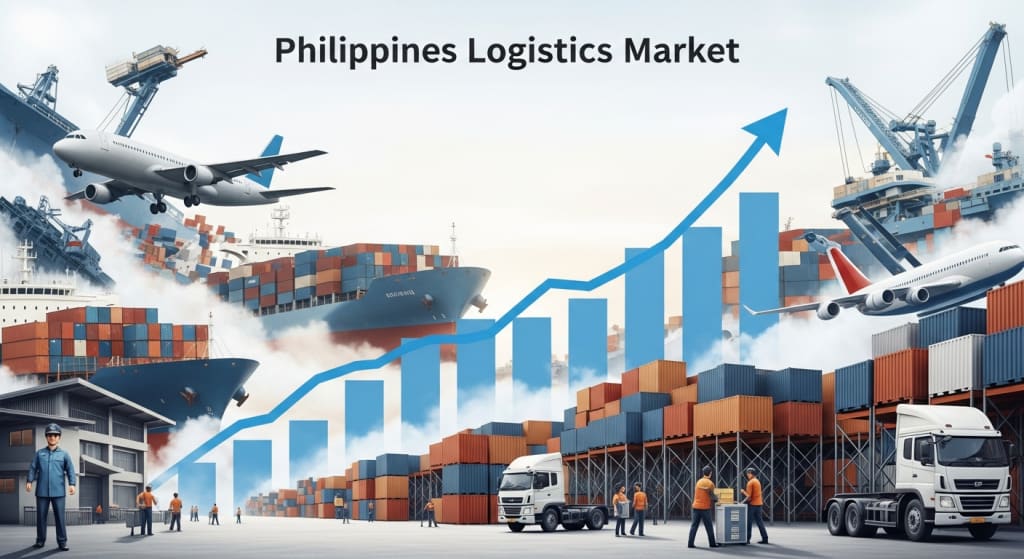
The Philippines logistics market growth is a vital component of the country’s economic infrastructure, facilitating the movement of goods across domestic regions and international links while underpinning trade efficiency, e-commerce fulfilment and supply chain resilience. The Philippines logistics market size reached USD 30.0 Billion in 2024. Looking forward, IMARC Group expects the market to reach USD 40.0 Billion by 2033, exhibiting a growth rate (CAGR) of 3.6% during 2025-2033. This steady growth reflects rising demand driven by expanding e-commerce activities, investments in transportation and warehousing infrastructure, and government efforts to improve trade logistics performance within Southeast Asia.
As the Philippines continues to urbanise, digitalise and integrate more seamlessly into global supply chains, its logistics sector serves as both an economic barometer and an enabler of commercial activity — supporting industries from manufacturing and retail to food & beverages and information technology hardware.
What’s Driving Market Growth
E-Commerce Acceleration & Last-Mile Demand
The rapid rise of e-commerce in the Philippines is a major driver for logistics growth. With online retail expanding rapidly — driven by mobile internet usage and digital payment adoption — logistics providers are scaling warehousing, parcel delivery, and last-mile capabilities to meet spikes in order volumes and rapid delivery expectations. Enhanced logistics capacity enables merchants to reach broader geographies and satisfy consumer expectations for speed and reliability.
Infrastructure Investments & Connectivity Projects
Government programmes targeting road, port and airport upgrades are reducing freight bottlenecks, improving inter-island connectivity, and strengthening multimodal transport networks. Investments under national infrastructure initiatives — including enhancements to key cargo ports and highway systems — improve efficiency for freight movements and support international trade links that are critical for both inbound imports and outbound exports.
Trade Expansion & Regional Integration
The Philippines’ trade relationships with major Asia-Pacific economies — including China, Japan and ASEAN partners — underpin higher cross-border shipment volumes. These trade dynamics increase demand for freight forwarding, customs-cleared logistics services and supply chain solutions that help companies navigate regulatory environments and optimise cost efficiency. Digital documentation and streamlined customs processes further support trade growth.
Technology Adoption & Digital Logistics Platforms
Logistics companies are increasingly integrating digital tools — such as real-time tracking, route optimisation software, warehouse automation, IoT sensors, and data analytics — to enhance operational visibility and service reliability. These technologies support faster, more predictable deliveries, reduce inefficiencies, and help logistics firms differentiate offerings in increasingly competitive segments such as courier, express and parcel delivery.
What the Opportunities Are
Cold Chain Logistics Expansion
There is significant opportunity to invest in cold storage and temperature-controlled transport services to support the food, pharmaceutical and healthcare sectors. As consumer demand for fresh food, frozen goods, vaccines and specialised pharmaceuticals grows, enhanced cold chain capacity becomes a strategic differentiator.
Last-Mile Delivery Innovation
Providers that enhance last-mile services through smart routing, crowd-sourced delivery networks, locker pickup points and AI-powered logistics platforms can capture higher demand, particularly from digital commerce channels seeking faster delivery experience.
Green & Sustainable Logistics
Eco-friendly logistics — including electric delivery fleets, energy-efficient warehouses, and reduced packaging waste — responds to rising environmental expectations among consumers and businesses. Sustainable practices also reduce operating costs over time and align with corporate ESG commitments.
Public-Private Infrastructure Collaboration
Partnerships between industry players and government agencies to enhance port efficiency, inland connectivity and customs processes can unlock capacity constraints and create shared investment models that elevate the country’s logistics performance index.
Recent News and Developments in Philippines Logistics Market
Jul 2025: Logistics providers expanded automated warehouse facilities and sorting systems in key urban logistics hubs to handle surges in e-commerce shipments and improve order processing speeds — reflecting heightened emphasis on tech-enabled fulfilment.
Sep 2025: Major courier and parcel delivery firms announced network enhancements and route optimisation partnerships, utilising digital tracking and AI routing tools to reduce delivery times and boost reliability across metropolitan and regional routes.
Nov 2025: Industry analysts reported that inter-port freight throughput increased year-on-year, supported by upgrades in cargo handling infrastructure and expanded seaway capacity — strengthening the Philippines’ ability to handle international shipment volumes.
Why should You Know About Philippines Logistics Market?
You should know about this market because logistics is the arterial system of commerce and trade, directly influencing how goods move across borders, how businesses manage costs and how consumers access products — whether through retail stores or digital channels. E-commerce growth, infrastructure investments and technology adoption are creating structural opportunities that enhance service capabilities, competitiveness and economic integration.
For investors, the logistics sector offers exposure to broad demand fundamentals, recurring service revenues, digital transformation trajectories and strategic infrastructure touchpoints. Logistics companies that innovate with green technologies, AI-enabled platforms and last-mile delivery solutions are poised to capture accelerated growth and build durable competitive positioning.
For businesses and policymakers, understanding how segmentation, infrastructure dynamics and market drivers converge helps inform decisions on supply chain strategies, trade facilitation, investment models and regulatory support that optimise efficiency and future-ready operations.
About the Creator
Keep reading
More stories from Manisha Dixit and writers in Trader and other communities.
Australia Subscription E-Commerce Market: Consumer Convenience, Recurring Revenue & Digital Growth
Australia Subscription E-Commerce Market Overview The Australia subscription e-commerce market is undergoing rapid transformation as businesses and consumers embrace recurring purchase models, personalised delivery experiences and digital-first shopping behaviours. Subscription e-commerce refers to online retail models where consumers opt into regular, automated delivery of products or services — ranging from everyday essentials like groceries and personal care items to niche offerings such as pet boxes, curated fashion and lifestyle memberships. The Australia subscription e-commerce market size reached USD 5.56 Billion in 2024. Looking forward, IMARC Group expects the market to reach USD 125.64 Billion by 2033, exhibiting a growth rate (CAGR) of 41.40% during 2025-2033. This strong growth reflects shifting consumer preferences toward convenience, personalised experiences and frictionless fulfilment supported by advanced digital platforms.
By Manisha Dixita day ago in Trader
Dow Jones Industrial Average: How Recent Market Trends Are Shaping Investor Opportunities
The Dow Jones Industrial Average is more than just a number on a financial chart. It reflects the health of major U.S. companies and often signals the direction of the overall market. Recently, the Dow Jones Industrial Average has shown significant upward movement, drawing attention from investors and analysts alike.They will explore the factors behind this growth and how it could impact your investment decisions.
By hamza mirzaabout 11 hours ago in Trader
Eon Prime Intelligent Alliance Office: Global Economy at a Turning Point
The global economy stands at a pivotal crossroads. Following years of unprecedented disruption—from the COVID-19 pandemic to geopolitical fragmentation, technological acceleration, and climate-related shocks—the world economic system is undergoing structural transformation rather than cyclical adjustment. The Eon Prime Intelligent Alliance Office (EPIAO), as an independent strategic research body dedicated to long-horizon global analysis, has conducted a comprehensive assessment of current economic conditions, emerging trends, and systemic risks shaping the international order.
By Eon Prime Intelligent Alliance Officeabout 19 hours ago in Trader



Comments
There are no comments for this story
Be the first to respond and start the conversation.