
Digital Payment Market Size and Forecast 2025–2033: The Global Shift Toward a Cashless Economy
From mobile wallets to digital commerce, how technology, policy, and consumer behavior are reshaping the future of payments worldwide

Introduction: A World That Pays in Clicks, Not Cash
The way the world pays is changing faster than ever before. From tapping a phone at a café to sending money across borders in seconds, digital payments have moved from being a convenience to becoming a daily necessity. What was once considered a tech-forward alternative to cash is now the backbone of modern commerce, banking, and even government services.
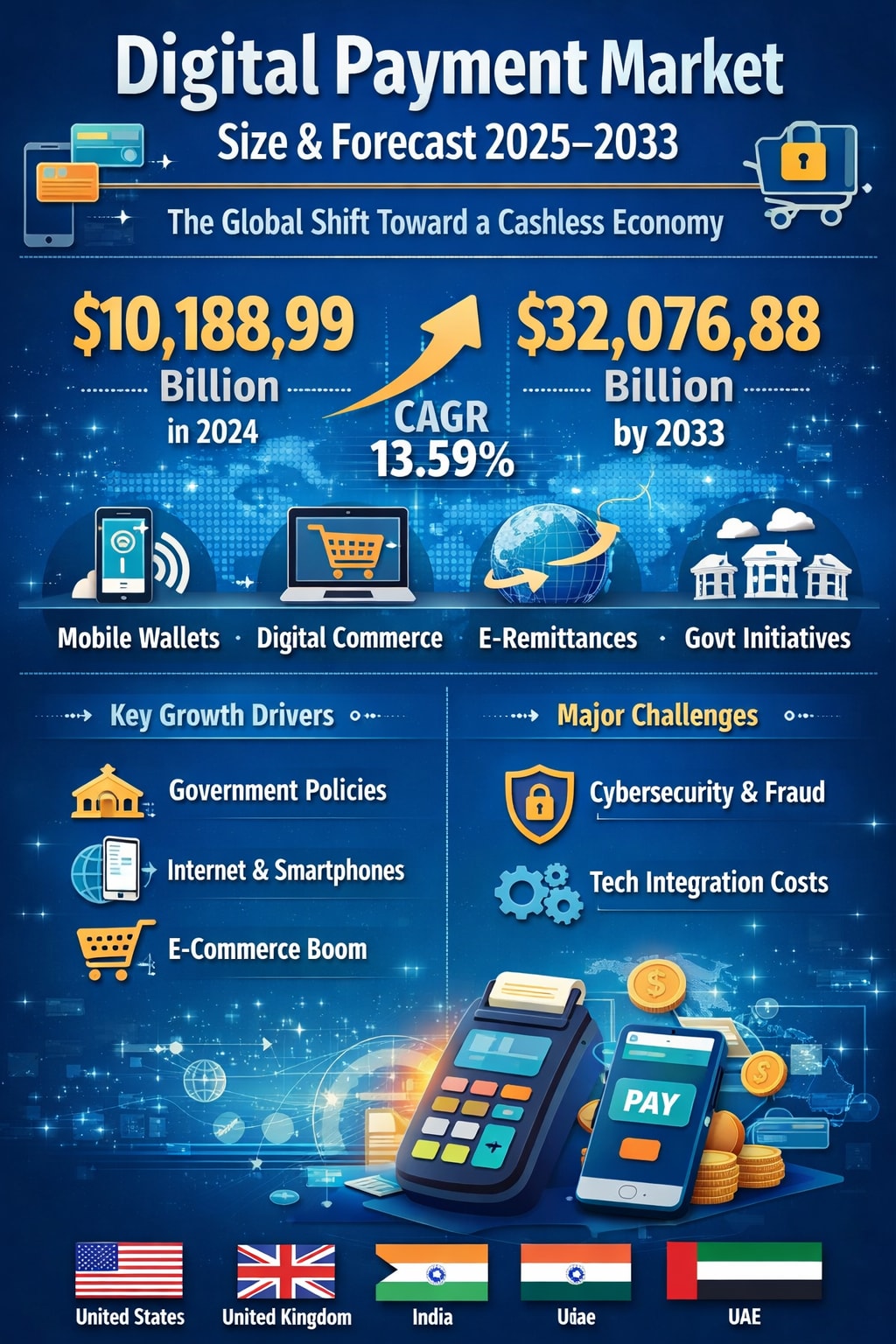
According to Renub Research, the Digital Payment Market is expected to reach US$ 32,076.88 billion by 2033, up from US$ 10,188.99 billion in 2024, growing at a CAGR of 13.59% from 2025 to 2033. This explosive growth is being driven by rising internet penetration, increasing smartphone usage, supportive government policies, the global boom in e-commerce, and a strong shift in consumer preference toward faster and more convenient payment methods.
In simple terms, the world is steadily moving toward a cashless economy—and digital payments are leading the charge.
Global Digital Payment Market Overview
Over the past decade, the global digital payment sector has undergone a remarkable transformation. What began as basic online banking and card payments has evolved into a complex ecosystem that includes mobile wallets, peer-to-peer (P2P) transfers, contactless payments, digital commerce platforms, and cross-border digital remittances.
Digital payments allow consumers and businesses to conduct financial transactions using electronic devices, mobile applications, and internet-based platforms. The appeal is obvious: speed, convenience, security, and accessibility. Whether it is paying utility bills, shopping online, booking travel, or sending money to family, digital payment solutions have become deeply embedded in everyday life.
The rapid expansion of e-commerce has played a crucial role in this growth. Online shopping depends heavily on reliable and secure digital payment systems, and as global e-commerce volumes rise, so does the demand for seamless digital transactions. In the United States, for instance, the US Census Bureau reported that e-commerce sales accounted for 14.7% of total retail revenues in Q4 2022. Digital wallets—led by platforms such as Amazon Pay, Apple Pay, Google Pay, and PayPal—have already surpassed credit cards in some segments and are expected to make up around one-third of regional e-commerce spending in the near future.
Governments and financial institutions are also actively promoting digital payments to improve transparency, reduce cash dependency, and boost financial inclusion. At the same time, emerging technologies like blockchain and digital currencies are adding new layers of innovation, especially in cross-border transactions and transparency. Despite challenges related to cybersecurity, privacy, and regulation, the market continues to expand at an impressive pace, driven by both established giants like Visa, Mastercard, and PayPal and innovative newcomers.
Key Growth Drivers of the Digital Payment Market
1. Government Initiatives and Supportive Policies
One of the strongest forces behind the growth of digital payments is government support. Across the world, policymakers are recognizing the economic and social benefits of digital transactions, including greater transparency, reduced tax evasion, improved efficiency, and enhanced financial inclusion.
Many governments are investing in digital infrastructure, creating favorable regulatory environments, and launching initiatives that encourage both consumers and businesses to adopt cashless payment methods. In several countries, public services, subsidies, and welfare payments are now being distributed digitally, further normalizing the use of digital payment platforms.
These efforts not only increase transaction volumes but also build public trust in digital payment systems, which is essential for long-term adoption.
2. Changing Consumer Preferences for Speed and Convenience
Modern consumers value speed, simplicity, and frictionless experiences—and digital payments deliver exactly that. With just a few taps on a smartphone, users can pay bills, transfer money, or complete online purchases without visiting a bank or standing in line.
Beyond convenience, many digital payment platforms offer additional features such as expense tracking, instant notifications, budgeting tools, and transaction histories, making them even more attractive to users. Service providers are also focusing heavily on user-friendly interfaces, helping bring even less tech-savvy consumers into the digital payment ecosystem.
The rapid growth of e-commerce further amplifies this trend, as smooth and reliable digital payment systems are essential for a positive online shopping experience.
3. Rising Internet Penetration and Smartphone Usage
The global surge in internet access and smartphone adoption has been a game-changer for digital payments. Smartphones have effectively become portable wallets, enabling users to make payments anytime and anywhere.
This accessibility has encouraged not only consumers but also small businesses and informal merchants to adopt digital payment methods. In many regions, payment systems are now integrated into social media platforms and popular apps, making digital transactions a natural part of everyday online interactions.
As connectivity continues to improve, especially in emerging markets, the digital payment user base is expected to expand even further.
Challenges Facing the Digital Payment Market
1. Cybersecurity and Fraud Risks
While digital payments offer convenience, they also come with significant security challenges. The growing volume of digital transactions makes payment systems attractive targets for hackers, fraudsters, and cybercriminals.
Threats such as data breaches, identity theft, phishing, and payment fraud can undermine consumer trust and result in substantial financial and reputational losses for service providers. To counter these risks, companies must invest heavily in advanced encryption, multi-factor authentication, and robust cybersecurity infrastructure.
Maintaining strong security standards will remain a top priority as the market continues to grow.
2. Technological Integration and Cost Barriers
For many businesses—especially small and medium-sized enterprises (SMEs)—integrating modern digital payment systems with existing legacy infrastructure can be both complex and expensive.
Upgrading systems often requires investments in new software, hardware, staff training, and ongoing maintenance. For companies with limited resources, these costs can slow down adoption. Additionally, ensuring seamless integration between old and new systems requires technical expertise that not all organizations possess.
These challenges can act as temporary barriers, particularly in developing markets and among smaller businesses.
Regional Market Insights
United States Digital Payment Market
The United States is one of the world’s most mature and advanced digital payment markets. With widespread smartphone and internet usage, digital payments dominate sectors such as retail, e-commerce, and peer-to-peer transfers.
Major players like Visa, Apple Pay, Google Pay, and PayPal lead the market, offering fast, convenient, and secure payment solutions. Government initiatives supporting innovation and financial inclusion have further strengthened the ecosystem. However, challenges such as cybersecurity threats and data privacy concerns remain important areas of focus.
Despite these issues, the US market continues to grow as consumers and businesses increasingly embrace cashless transactions.
United Kingdom Digital Payment Market
The UK has seen rapid adoption of contactless payments, mobile wallets, and online banking. Digital payments are now common across retail, transportation, and e-commerce sectors.
Alongside traditional players like Visa and Mastercard, platforms such as PayPal, Apple Pay, and Google Pay are widely used. Supportive regulatory frameworks and government efforts to promote financial inclusion have helped accelerate this shift. While cybersecurity and regulatory changes pose ongoing challenges, the UK market is expected to maintain strong growth momentum.
India Digital Payment Market
India is one of the fastest-growing digital payment markets in the world, driven by government initiatives, rising smartphone usage, and a tech-savvy population. The Digital India campaign and the launch of UPI (Unified Payments Interface) have transformed the payment landscape.
The Reserve Bank of India’s Digital Payments Index (DPI) reached 304.06 in September, up from 270.59 in March, highlighting the rapid expansion of digital payments across the country. Platforms like Paytm, PhonePe, and Google Pay dominate the market, with strong adoption in both urban and rural areas.
Despite challenges related to cybersecurity and infrastructure gaps in some regions, India’s digital payment ecosystem continues to grow at an impressive pace.
United Arab Emirates Digital Payment Market
The UAE’s push toward a cashless society and its highly connected population have fueled rapid growth in digital payments. Initiatives such as the Dubai Smart City project, combined with high smartphone and internet penetration, have accelerated adoption.
Mobile wallets, contactless payments, and online banking are especially popular in retail, e-commerce, and hospitality. Global players like Apple Pay and Samsung Pay, along with regional providers such as Payit and Beam, are shaping the market. While cybersecurity remains a concern, the UAE market is expected to continue expanding as digital transformation accelerates.
Digital Payment Market Segmentation
By Type
Digital Commerce
Digital Remittances
Mobile POS Payments
By Offering
Cards
ACH Transfer
Digital Wallet
Other Payment Modes
By End User
BFSI
Retail & E-Commerce
Transportation & Logistics
Healthcare
Telecom & IT
Media & Entertainment
Others
Regional Coverage
North America: United States, Canada
Europe: France, Germany, Italy, Spain, United Kingdom, Belgium, Netherlands, Turkey
Asia-Pacific: China, Japan, India, Australia, South Korea, Thailand, Malaysia, Indonesia, New Zealand
Latin America: Brazil, Mexico, Argentina
Middle East & Africa: South Africa, Saudi Arabia, United Arab Emirates
Company Analysis
Key players covered in the market include:
ACI Worldwide Inc.
Aliant Payment Systems Inc.
Amazon.com Inc.
American Express Company
Apple Inc.
Fiserv Inc.
Mastercard Incorporated
Novetti Group Limited
PayPal Holdings Inc.
Visa Inc.
These companies are analyzed across overview, key leadership, recent developments and strategies, product portfolios, and financial insights, highlighting the competitive and innovative nature of the market.
Final Thoughts: The Future Is Clearly Digital
The global digital payment market is no longer just a fintech success story—it is a fundamental pillar of the modern digital economy. With the market projected to grow from US$ 10,188.99 billion in 2024 to US$ 32,076.88 billion by 2033, the scale of this transformation is hard to ignore.
Driven by technology, government support, changing consumer behavior, and the unstoppable rise of e-commerce, digital payments are reshaping how the world transacts. While challenges like cybersecurity and integration costs remain, ongoing innovation and investment are steadily addressing these concerns.
As more consumers and businesses move away from cash and toward seamless digital experiences, one thing is clear: the future of payments is fast, connected, and undeniably digital.
About the Creator
Tom Shane
Tom Shane is a content writer specializing in SEO-driven blogs, product descriptions, and thought leadership. He crafts engaging, research-backed content that connects with audiences and drives results.
Britannia Industries Shares Jump 5% After Strong Q3 Results, Profit Rises 17% YoY
. Introduction Britannia Industries shares rallied sharply in market trading after the FMCG major reported a strong set of third-quarter earnings. The company posted a 17% year-on-year increase in net profit, reaching ₹582 crore, while revenue rose by 10%, beating market expectations. The upbeat performance boosted investor confidence, sending Britannia’s stock up nearly 5% and making it one of the top gainers in the consumer goods space.
By Hammad Nawaza day ago in Trader
Australia Ferrous Scrap Recycling Market Set to Surge as Sustainable Steel Demand and Policy Support Intensify
The Australia ferrous scrap recycling market reached USD 4.6 Million in 2025 and is forecast to grow to USD 7.6 Million by 2034, expanding at a CAGR of 5.85% during 2026–2034.
By Rashi Sharma4 days ago in Trader



Comments
There are no comments for this story
Be the first to respond and start the conversation.