
Japan Transcatheter Heart Valve Replacement Market Size and Forecast 2025–2033
Aging Demographics, Innovation in Cardiac Care, and Policy Support Drive Japan’s Rapidly Expanding TAVR Landscape

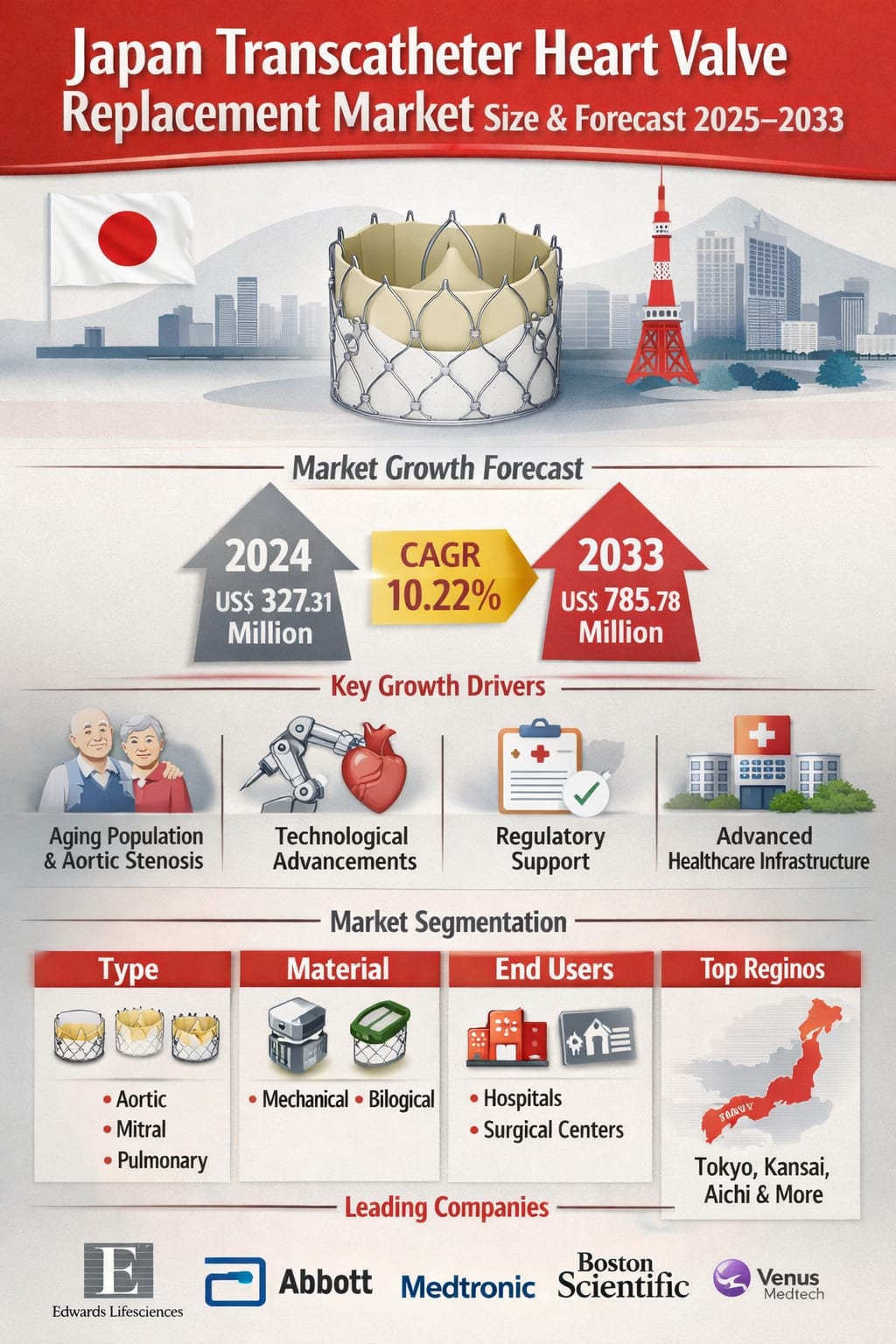
Japan Transcatheter Heart Valve Replacement Market Outlook
The Japan Transcatheter Heart Valve Replacement (TAVR) Market is expected to reach US$ 785.78 million by 2033, rising from US$ 327.31 million in 2024, growing at a CAGR of 10.22% from 2025 to 2033. This robust expansion reflects Japan’s rapidly aging population, the increasing prevalence of aortic stenosis and other valvular heart diseases, continuous technological advancements, supportive reimbursement frameworks, and a healthcare system that is highly receptive to minimally invasive innovations.
Japan has one of the highest life expectancies in the world, and with longevity comes a higher incidence of age-related cardiovascular conditions. Among these, aortic stenosis stands out as a major clinical challenge. Traditionally, open-heart surgical valve replacement was the standard of care, but many elderly or high-risk patients were not ideal candidates for invasive surgery. Transcatheter heart valve replacement has fundamentally changed this treatment landscape by offering a less invasive, safer, and faster-recovery alternative.
Over the past decade, TAVR has evolved from a niche therapy for inoperable patients into a mainstream treatment option for high-risk and increasingly intermediate-risk patient groups. In Japan, strong clinical evidence, growing physician confidence, and favorable regulatory decisions have accelerated this transition. As a result, TAVR is now a critical pillar of the country’s structural heart disease treatment strategy and a fast-growing segment within the broader cardiovascular device market.
Japan Transcatheter Heart Valve Replacement Industry Overview
Japan’s TAVR industry is shaped by three powerful forces: demographics, technology, and healthcare policy. The country’s aging population is creating sustained demand for advanced cardiac care solutions that minimize surgical trauma and shorten hospital stays. At the same time, leading global and regional medical device companies are introducing next-generation transcatheter valves with improved durability, better deliverability, and lower complication rates.
From a healthcare system perspective, Japan benefits from a well-developed hospital network, high diagnostic penetration, and strong clinical research capabilities. Many major hospitals now operate hybrid operating rooms that combine surgical and catheter-based capabilities, making them ideally suited for TAVR procedures. These facilities enable multidisciplinary heart teams—comprising interventional cardiologists, cardiac surgeons, anesthesiologists, and imaging specialists—to collaborate effectively and deliver optimized patient outcomes.
Regulatory authorities in Japan, including the Pharmaceuticals and Medical Devices Agency (PMDA) and the Ministry of Health, Labour, and Welfare (MHLW), have also played a key role. While maintaining strict safety and efficacy standards, they have introduced more flexible and faster pathways for innovative, life-saving devices. This approach has allowed patients earlier access to new-generation TAVR systems and has encouraged manufacturers to prioritize Japan as a strategic market for product launches.
Despite its strong growth outlook, the industry still faces challenges such as high device and procedure costs and a shortage of highly trained specialists in some regions. Nevertheless, ongoing investments in training, infrastructure, and clinical research are steadily addressing these constraints. Overall, the Japan TAVR market is positioned for sustained expansion throughout the forecast period, driven by both clinical need and systemic support.
Key Factors Driving the Japan Transcatheter Heart Valve Replacement Market Growth
Increasing Physician Knowledge and Education
One of the most important growth drivers in Japan’s TAVR market is the rapid expansion of physician expertise. Over the past several years, Japanese interventional cardiologists and cardiac surgeons have gained extensive experience in performing complex structural heart procedures. This progress has been supported by specialized training programs, many of which are conducted in collaboration with leading international cardiovascular centers.
These programs emphasize not only procedural techniques but also patient selection, imaging interpretation, device handling, and post-procedural care. The use of simulation-based training, proctorship models, and international fellowships has further strengthened clinical confidence. As procedural success rates have improved and complication rates have declined, more hospitals and physicians have embraced TAVR as a reliable and effective treatment option. This growing clinical confidence is directly translating into higher procedure volumes and broader adoption across Japan.
Support from Regulations for Innovation
Japan’s regulatory environment has become increasingly supportive of medical device innovation, particularly in high-impact areas such as cardiovascular care. The PMDA and MHLW have introduced expedited review pathways and conditional early approvals for devices that demonstrate strong clinical potential. This approach has significantly reduced the time required for next-generation TAVR systems to reach the Japanese market.
At the same time, regulators continue to enforce rigorous post-market surveillance and data collection requirements, ensuring that patient safety remains a top priority. This balanced framework—combining speed with oversight—has made Japan an attractive market for global device manufacturers and has encouraged continuous innovation in transcatheter valve technologies. As a result, patients benefit from earlier access to improved devices, while the market benefits from faster technology cycles and stronger competitive dynamics.
Growing Knowledge and Prompt Diagnosis
Public and professional awareness of valvular heart diseases, especially aortic stenosis, is steadily increasing across Japan. Nationwide health initiatives, improved access to echocardiography, and greater vigilance among primary care physicians and cardiologists have all contributed to earlier diagnosis.
Early detection is critical because it allows timely intervention before patients progress to advanced stages of disease. With greater awareness of the benefits of minimally invasive therapies, more patients are being referred for TAVR evaluations at appropriate stages of their condition. Media coverage, patient advocacy groups, and community health programs are also helping to educate the public about treatment options. This shift toward proactive diagnosis and management is expanding the eligible patient pool and supporting long-term market growth.
Challenges in the Japan Transcatheter Heart Valve Replacement Market
Expensive Procedure and Equipment Expenses
Despite its clinical advantages, TAVR remains a costly procedure. The transcatheter heart valve systems themselves are expensive, and the procedure requires advanced infrastructure such as hybrid operating rooms, high-end imaging systems, and specialized support equipment. Although Japan’s national health insurance system provides reimbursement, the overall cost burden can still strain hospital budgets.
Large urban and academic hospitals are generally better positioned to absorb these costs, but smaller regional or community hospitals often face financial constraints. This disparity can limit the geographic spread of TAVR services and contribute to unequal access for patients in less urbanized areas. While economies of scale and technological maturation may gradually reduce costs, pricing remains a significant barrier to wider adoption in the near term.
Limited Skilled Workforce
TAVR is a complex, team-based procedure that requires highly specialized skills. A typical TAVR team includes interventional cardiologists, cardiac surgeons, imaging experts, anesthesiologists, and trained nursing staff. While major medical centers in cities like Tokyo and Osaka have built strong TAVR programs, many regional areas still face shortages of experienced professionals.
Training new specialists takes time, and Japan’s aging medical workforce adds another layer of complexity to workforce planning. Although government initiatives, academic programs, and industry partnerships are helping to expand the talent pool, the pace of workforce development may lag behind the growing demand for TAVR procedures. Addressing this gap will be essential for ensuring equitable access and sustaining long-term market growth.
Japan Transcatheter Heart Valve Replacement Market Regional Analysis
Japan’s TAVR market is currently concentrated in major urban and industrial regions, where advanced healthcare infrastructure and specialized expertise are more readily available. However, gradual expansion into other prefectures is underway as awareness, training, and investment increase.
Tokyo Transcatheter Heart Valve Replacement Market
Tokyo represents the largest and most advanced TAVR market in Japan. The city is home to many of the country’s leading academic hospitals and cardiovascular centers, most of which are equipped with state-of-the-art hybrid operating rooms and advanced imaging facilities. These institutions perform high volumes of TAVR procedures and often serve as early adopters for new device technologies, including both balloon-expandable and self-expanding valves.
Tokyo’s dense concentration of skilled specialists, strong research culture, and close collaboration with regulatory bodies and device manufacturers make it a national benchmark for TAVR innovation and clinical outcomes. The city also plays a key role in clinical trials and post-market studies, further reinforcing its leadership position.
Kansai Transcatheter Heart Valve Replacement Market
The Kansai region, including Osaka, Kobe, and Kyoto, is another major hub for TAVR in Japan. The region’s leading hospitals and university medical centers have invested heavily in structural heart programs and advanced procedural infrastructure. Kansai is particularly active in clinical evaluation of new-generation valve systems, often working closely with both domestic and international manufacturers.
Physician training initiatives and regional knowledge-sharing networks are helping to expand expertise beyond the largest centers. While adoption rates remain slightly behind Tokyo, Kansai’s strong healthcare ecosystem and large patient base provide significant room for continued growth, especially in secondary cities and surrounding areas.
Aichi Transcatheter Heart Valve Replacement Market
Aichi Prefecture, centered around Nagoya, is emerging as a key growth region for TAVR. Nagoya’s well-developed medical infrastructure, combined with a growing elderly population, is driving increasing demand for minimally invasive cardiac procedures. Specialized cardiac centers and well-equipped hospitals are playing an important role in expanding access to TAVR in this region.
Partnerships between healthcare providers and device manufacturers have also facilitated the introduction of advanced valve technologies, improving both procedural outcomes and patient access. As awareness and diagnostic activity continue to rise, Aichi is expected to maintain a steady growth trajectory within the national TAVR market.
Other important regions contributing to market expansion include Kanagawa, Saitama, Hyogo, Chiba, Hokkaido, Fukuoka, and Shizuoka, where gradual improvements in infrastructure and training are supporting broader adoption.
Market Segmentation
By Type
Transcatheter Aortic Valve Replacement
Transcatheter Mitral Valve Replacement
Transcatheter Pulmonary Valve Replacement
By Material
Mechanical Valves
Biological Valves
By End User
Hospitals
Ambulatory Surgical Centers
Others
By Cities
Tokyo
Kansai
Aichi
Kanagawa
Saitama
Hyogo
Chiba
Hokkaido
Fukuoka
Shizuoka
Competitive Landscape and Company Analysis
The Japan TAVR market is highly competitive and characterized by the presence of leading global medical device companies alongside innovative regional players. All key players are covered in the market analysis, including detailed reviews of their business overviews, key personnel, recent developments, SWOT analyses, revenue performance, and strategic positioning.
Major companies operating in the market include:
Edwards Lifesciences
Abbott Laboratories
Medtronic Plc
LivaNova PLC
Boston Scientific Corporation
Artivion, Inc.
MicroPort Scientific Corporation
Venus Medtech (Hangzhou) Inc.
These companies are активно investing in research and development to enhance valve durability, improve delivery systems, and reduce complication rates. Strategic collaborations with hospitals, research institutions, and regulatory bodies are also common, reflecting the importance of clinical evidence and physician training in driving market success.
Final Thoughts
Japan’s Transcatheter Heart Valve Replacement market is entering a decisive growth phase. With the market projected to expand from US$ 327.31 million in 2024 to US$ 785.78 million by 2033, the strong 10.22% CAGR underscores both the clinical importance and commercial potential of TAVR in the country.
Demographic trends, technological innovation, supportive regulation, and increasing clinical expertise are aligning to create a highly favorable environment for sustained expansion. While challenges related to cost and workforce availability remain, ongoing investments in infrastructure, training, and innovation are steadily addressing these barriers.
In the coming years, TAVR is expected to play an even more central role in Japan’s cardiovascular care ecosystem—improving patient outcomes, reducing the burden of invasive surgery, and redefining how structural heart diseases are treated across one of the world’s most advanced healthcare systems.
About the Creator
Tom Shane
Tom Shane is a content writer specializing in SEO-driven blogs, product descriptions, and thought leadership. He crafts engaging, research-backed content that connects with audiences and drives results.
CBA Shares Jump as Profit Beats Market Expectations
CBA Shares Jump as Profit Beats Market Expectations Shares of Commonwealth Bank of Australia (CBA) recorded a strong upward move after the country’s largest lender posted profits that exceeded market expectations. The better-than-expected financial performance boosted investor confidence and pushed CBA shares higher in early trading, reinforcing the bank’s position as one of the most resilient players in Australia’s financial sector.
By Hammad Nawazabout 10 hours ago in Trader
Nazara Technologies Limited: A Leader in Gaming and Digital Entertainment
Introduction Nazara Technologies Limited has emerged as a prominent player in the global gaming and digital entertainment space. Based in India, the company has expanded rapidly into mobile gaming, esports, and gamified learning platforms. With a focus on innovation and global expansion, Nazara is positioning itself as a key player in the evolving digital economy.
By Hammad Nawaz7 days ago in Trader
📢 Raise Your Voice Thread: 02/05/2026
Our “Raise Your Voice Threads” are hosted most alternating Thursdays at 12PM ET to offer creators more avenues to uncover exceptional stories on Vocal. As we are continuously searching for fresh creators and inspiring stories, this thread provides an opportunity to exchange and discuss the stories that have moved and motivated us on Vocal.
By Raise Your Voice by Vocal6 days ago in Resources




Comments
There are no comments for this story
Be the first to respond and start the conversation.