
Australia Smart Agriculture Market — Growth, Forecast & Strategic Insights
Technological innovation and sustainability drive farm efficiency and resilience in Australia’s rapidly evolving agriculture sector.

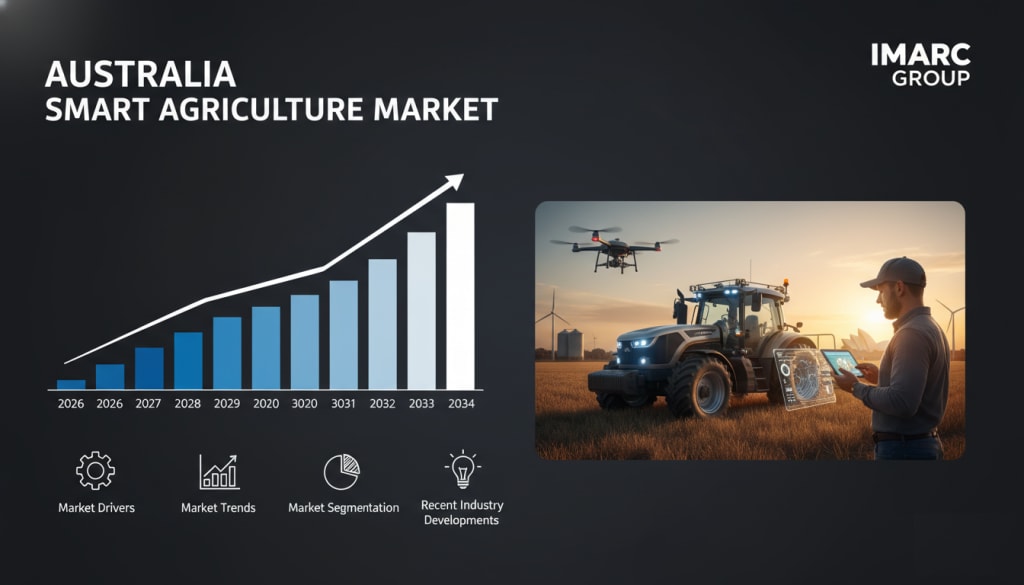
The Australia smart agriculture market is witnessing robust expansion as agricultural stakeholders increasingly embrace digital technologies to enhance productivity, sustainability, and resource efficiency. According to IMARC Group, the market was valued at USD 345.35 million in 2025 and is forecast to reach USD 1,037.45 million by 2034, growing at a compound annual growth rate (CAGR) of 13.00% during 2026–2034.
Smart agriculture integrates advanced technologies — including GPS based precision farming, drones, IoT sensors, data analytics, and automated machinery — to support data driven farm decision making and sustainable resource management. These solutions are gaining traction across diverse agricultural operations, from crop cultivation and livestock monitoring to greenhouse management, as farmers seek to address climate variability, labor shortages, and water scarcity while improving yields.
Why the Market Is Growing So Rapidly
1. Rising Adoption of Precision Farming Technologies
Precision farming is the dominant segment within the smart agriculture market, accounting for approximately 48% share in 2025. This reflects widespread deployment of GPS guidance systems, variable rate application technologies, and real time crop monitoring tools that enable data driven decisions and optimize input use across farming operations.
By tailoring irrigation, fertilization, and pest management to specific field conditions, precision farming enhances yield outcomes and promotes sustainable resource use — critical benefits in an era of climate uncertainty.
2. Growing Integration of IoT and Sensor Technologies
Hardware offerings — including IoT sensors, drones, GPS devices, and automated irrigation systems — accounted for around 63% of the market in 2025, underscoring the foundational role of physical technology infrastructure in smart agriculture adoption.
These technologies enable comprehensive field data collection, giving farmers insight into soil moisture, nutrient levels, crop health, and environmental conditions that inform timely and accurate interventions.
3. Government Support and Funding Initiatives
Government programs and funding schemes are integral to driving smart agriculture uptake in Australia. Federal and state level initiatives — including climate smart agriculture funding and innovation programs — are helping farmers invest in technology and adapt to environmental challenges.
Public support reduces cost barriers, especially for medium scale farms that are increasingly adopting smart solutions to balance productivity gains with financial viability.
4. Addressing Climate Variability and Water Scarcity
Australia’s agricultural sector faces significant climate pressures, including prolonged droughts and unpredictable rainfall. Smart agriculture technologies — such as soil moisture sensors and automated irrigation controllers — assist farmers in managing water use more efficiently and adapting to climate risks.
By optimizing water allocation and planning for environmental variability, technology adoption enhances farm resilience and reduces input waste.
5. Labor Efficiency and Automation
Persistent labor shortages in rural agricultural regions have accelerated the adoption of automation and connected systems that reduce dependence on manual labor. Autonomous machinery and robotic tools — such as autonomous tractors and robotic weeders — help perform repetitive tasks with precision, improving operational efficiency and allowing farms to manage larger areas with fewer personnel.
What the Opportunities Are
1. Precision Water Management Solutions
Solutions that optimize water use through smart irrigation and soil monitoring systems present significant opportunities, especially as climate pressures intensify across Australia.
2. Expansion of Drone and Aerial Monitoring Services
Advanced drone technologies equipped with multispectral and thermal imaging sensors can revolutionize crop monitoring, early stress detection, and precise application services.
3. AI Powered Decision Support Tools
Artificial intelligence and machine learning tools that analyze multi source data and deliver predictive insights for planting, pest control, and resource allocation offer high value for large and medium scale farms.
4. Connectivity and Data Platforms for Rural Regions
Investments in connectivity infrastructure and cloud based analytics platforms can unlock smart agriculture adoption in remote and underserved agricultural zones.
5. Integrated Smart Greenhouse and Livestock Monitoring
Tailored solutions for greenhouse automation and livestock monitoring — including environmental control and animal health analytics — show strong growth potential as producers seek yield stability and quality improvements.
6. Collaborative R&D and Innovation Hubs
Partnerships among agritech startups, universities, government bodies, and technology providers can accelerate product development, training, and sector innovation.
7. Export Focused Smart Farming Solutions
As global demand for sustainably produced agricultural goods rises, Australian smart farming technologies and expertise can be positioned for export opportunities in Asia Pacific and other markets.
Recent News & Developments in Australia Smart Agriculture Market
• July 2025: Government Climate Smart Agriculture Investment: The Australian Government announced more than USD 76 million in climate smart agriculture funding, aimed at supporting farmers’ adoption of resilient practices and smart technologies. This initiative boosts precision water management, soil health improvements, and sustainable farm operations, reinforcing long term productivity in the face of environmental variability.
• September 2025: Academic Innovation Hub Launch: Western Sydney University launched the ARC Training Centre for Smart & Sustainable Horticulture, a national collaboration focused on advancing horticultural technologies, sustainability, and industry partnerships. The centre aims to equip researchers and industry professionals with skills to integrate smart farming solutions into commercial horticulture.
• November 2025: Technology Adoption Milestone: SwarmFarm Robotics operated over 250 autonomous robots across millions of acres in Western Australia — a significant scale up in field automation for tasks like spraying, weed control, and crop monitoring. These deployments highlight how autonomous machines enhance productivity and address labor shortages while maintaining precise farm operations.
Why Should You Know About the Australia Smart Agriculture Market?
The Australia smart agriculture market represents a pivotal shift in how agricultural production systems evolve toward sustainability, resilience, and technology driven performance. For investors, the double digit CAGR and expanding use of precision technologies offer compelling opportunities in agritech, hardware, software, and automation services. For farmers and agribusinesses, smart agriculture solutions help optimize resources, reduce operating costs, and adapt to climate variability while increasing yields. For policy makers, embracing and supporting digital agriculture advances aligns with national food security goals, rural economic development, and environmental sustainability objectives.
About the Creator
Amélie Belle
Hi, I’m Amélie Belle—27, New York writer, lover of quiet moments and honest words. I share poetry and reflections on love, healing, and life’s small miracles. If my writing makes you feel seen, I’m exactly where I’m meant to be.
Keep reading
More stories from Amélie Belle and writers in Trader and other communities.
Australia Grocery Retail Market — Growth, Forecast & Strategic Outlook
The Australia grocery retail market continues to grow steadily as both traditional retail and digital channels adapt to evolving consumer needs. According to IMARC Group, the market reached USD 54.3 billion in 2025 and is forecast to expand to USD 79.2 billion by 2034, exhibiting a compound annual growth rate (CAGR) of 4.16% during 2026–2034.
By Amélie Belleabout 17 hours ago in Trader
Dow Jones Industrial Average Trends: What the Latest Surge Means for Investors
The Dow Jones Industrial Average has recently surged, reaching levels that are making investors take notice. Many are wondering if this growth is sustainable or if a market shift is coming. Understanding the trends behind this rise can help investors make smarter decisions and plan their strategies effectively.
By John.doe7988 days ago in Trader
Super Bowl LX Recap: A Team Called Hawks
Sixty. The Super Bowl turned 60! Still amazes me that this was the sixtieth Super Bowl played in NFL history. It seems like yesterday that I watched Super Bowl XXVII, the first SB I ever watched. The QB who won Super Bowl XXVII has since called a few SBs, and will call next year's game, but that's another story. Super Bowl LX took place at Levi's Stadium in Santa Clara, California, the home stadium of the San Francisco 49ers. However, it was one of their division foes who represented the NFC, as the Seattle Seahawks faced off against the New England Patriots.
By Clyde E. Dawkins3 days ago in Unbalanced


Comments
There are no comments for this story
Be the first to respond and start the conversation.