
Australia Reverse Logistics Market Grows Steadily as E-Commerce and Sustainability Drive Backward Flows
Market set to expand from USD 14.24 billion in 2025 to USD 21.45 billion by 2034 on rising returns, recycling and advanced tech adoption.

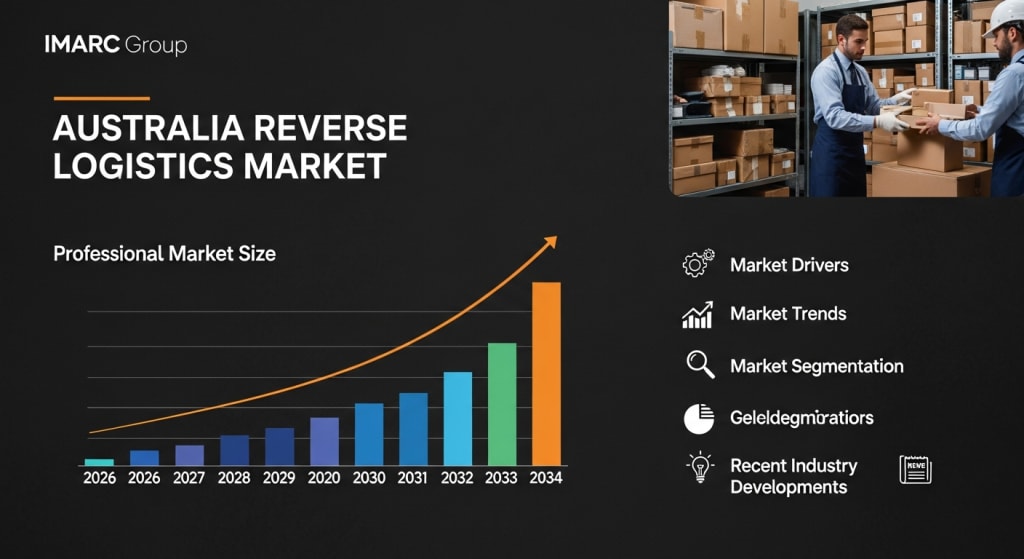
The Australia Reverse Logistics Market is on a clear path of steady expansion as businesses adapt to rising return volumes and sustainability imperatives. According to IMARC Group data, the market reached USD 14,241.2 million in 2025 and is projected to grow to USD 21,448.0 million by 2034, representing a compound annual growth rate (CAGR) of 4.66% during 2026–2034.
Reverse logistics — the process of moving goods from their typical final destination for returns, repair, remanufacture, recycling, or disposal — has become a strategic imperative in Australia’s broader supply chain ecosystem. As consumer expectations for seamless returns rise alongside increasing regulatory pressure for environmental stewardship, companies are investing more in processes, infrastructure, and technologies that make reverse flows efficient and cost-effective.
Request a Sample Report with Latest 2026 Data & Forecasts:
Why the Market Is Growing So Rapidly
A key driver of reverse logistics growth in Australia is the rapid expansion of e-commerce and online retailing. As more Australians shop online, return volumes have surged — particularly in sectors like fashion, electronics, and consumer goods, where sizing, product dissatisfaction or defects frequently trigger returns. Retailers have responded by enhancing reverse logistics operations to manage inspection, restocking, refurbishment, or recycling efficiently, reducing both costs and customer friction.
In parallel, environmental regulations and sustainability initiatives are compelling businesses to rethink product lifecycles. Extended producer responsibility (EPR) frameworks and circular economy policies are pushing manufacturers and retailers to take back end-of-life products and minimize landfill waste. These regulatory imperatives are increasing adoption of reverse logistics processes that emphasize recycling, reuse, and responsible disposal — a trend that resonates with eco-conscious consumers and policymakers alike.
Technology adoption is another powerful growth catalyst. Australian logistics players are integrating advanced systems such as artificial intelligence (AI), machine learning (ML), Internet of Things (IoT), and blockchain to improve visibility, traceability, and decision-making in reverse flows. These technologies enable real-time tracking of returns, automated quality checks, predictive demand insights, and optimization of routing and inventory — all of which drive efficiency and reduce operational costs.
AI-driven systems, for example, can assess returned goods and determine the most economical disposition — whether that’s resale, refurbishment, recycling, or disposal — improving recovery rates and reducing waste. Blockchain enhances transaction transparency — particularly valuable for warranty claims and recall coordination — while warehouse robotics and automation speed up sorting and processing, reducing manual labour intensity.
Finally, changing consumer expectations and corporate priorities are shaping how reverse logistics is managed. Many Australian consumers now expect flexible, fast, and hassle-free returns as part of the purchase experience. Companies that deliver seamless returns processes not only protect brand reputation but also foster loyalty — especially important in competitive retail landscapes where customer experience differentiates market leaders.
Market Segmentation Highlights
IMARC Group’s analysis categorizes the Australia reverse logistics market across several important dimensions:
• Return Type: Recalls, commercial returns, repairable returns, end-of-use returns, end-of-life returns.
• Service: Transportation, warehousing, reselling, replacement management, refund authorization, and other services.
• End User: E-commerce, automotive, pharmaceutical, consumer electronics, retail, luxury goods, and reusable packaging.
• Regions: Australia Capital Territory & New South Wales, Victoria & Tasmania, Queensland, Northern Territory & Southern Australia, and Western Australia.
These segments reflect the diversity of reverse logistics scenarios — from high-volume commercial returns to specialized handling of end-of-life or high-value items requiring refurbishment or recycling.
What the Opportunities Are
1. E-Commerce Returns Management: As online shopping grows, scalable solutions for return processing, inspection, and resale offer direct cost savings and service quality improvements.
2. Technology-Powered Efficiency: Investments in AI, IoT, and automation can dramatically reduce handling costs, boost throughput, and provide analytics that optimize decision-making across reverse flows.
3. Circular Economy Services: Companies that build capabilities for remanufacturing, recycling and sustainable disposition can differentiate themselves and capture value from end-of-life products.
4. Third-Party Logistics Partnerships: Outsourcing reverse logistics to specialized 3PLs with expertise and infrastructure can help businesses reduce capital expenditure while accessing best-in-class processes.
5. Regulatory Compliance Solutions: Offering compliance-focused services (e.g., handling e-waste, packaging take-back) can position providers as indispensable partners for manufacturers and retailers facing increasing environmental obligations.
6. Service Diversification: Expanding offerings to include refurbishment, replacement management and refund authorizations can boost service value and deepen client relationships.
7. Regional Expansion: Tailoring solutions to specific state-level requirements or consumer preferences within Australia can help providers win market share in under-served areas.
Recent News & Developments in Australia Reverse Logistics Market
• January 2025: The Australian federal government announced new circular economy guidelines aimed at increasing product recovery and recycling requirements for manufacturers and retailers. The policy enhances extended producer responsibility (EPR) frameworks, accelerating demand for reverse logistics services that support compliance and reporting obligations. Regulatory clarity is expected to stimulate investment in sustainable return infrastructure.
• March 2025: A major logistics provider launched an AI-enhanced reverse logistics platform that integrates real-time tracking, automated quality assessment and predictive routing for returns. The rollout — supported by multi-million AUD funding — aims to improve operational efficiency for retail clients and reduce turnaround times for returns processing across major urban centres.
• July 2025: Industry data revealed that reverse logistics volumes in the Australian e-commerce sector increased by 12% year-on-year during the first half of 2025, driven by higher return rates in categories like fashion and consumer electronics. This milestone underscores growing consumer expectations around returns convenience and reinforces the importance of robust reverse logistics capabilities for competitive players.
Why Should You Know About Australia Reverse Logistics Market?
The Australia reverse logistics market sits at the intersection of consumer expectations, sustainability imperatives, and technological transformation. With the market expected to grow from USD 14.24 billion in 2025 to USD 21.45 billion by 2034, companies that strategically invest in reverse flow capabilities — particularly those that provide sustainable, tech-driven solutions — will be well positioned to capture value.
For investors and supply chain leaders, reverse logistics presents opportunities not just in cost reduction but also in revenue generation — through resale, refurbishment and circular economy services. Policymakers focused on waste reduction and environmental outcomes will continue to influence market dynamics, reinforcing the value of compliant and transparent reverse logistics systems.
In an economy increasingly shaped by digital commerce and sustainability goals, reverse logistics is evolving from a cost centre into a strategic asset — one that strengthens resilience, enhances customer satisfaction, and contributes to broader environmental targets.
About the Creator
Rashi Sharma
I am a market researcher.
Keep reading
More stories from Rashi Sharma and writers in Trader and other communities.
Australia Freeze Dried Food Market: From Shelf-Stable Snacks to Sustainable Nutrition
The Australia freeze dried food market is experiencing steady expansion as consumers increasingly prioritise convenience, nutrition, and sustainability in their food choices. According to the latest IMARC Group analysis, the market size reached USD 64.0 million in 2025 and is forecast to grow to USD 111.4 million by 2034, reflecting a CAGR of 6.35% over the 2026–2034 period.
By Rashi Sharma3 days ago in Trader
Swedbank AB (publ): The Surprising Strategies Behind Its Rapid Rise
Swedbank AB (publ) has amazed the financial world with its rapid rise. Many people are curious about how this bank achieved such strong growth in a short time. They will uncover the strategies that make Swedbank AB (publ) stand out and explain why it continues to attract investors and customers.
By hamza mirza3 days ago in Trader
IBM Share Price Surges: What Every Investor Should Know Today
The IBM share price has been rising steadily, drawing the attention of both new and seasoned investors. Many people focus only on short-term price movements, but understanding the underlying reasons behind this surge can reveal hidden opportunities. They will explore the key factors driving the IBM share price and what investors should know to make informed decisions.
By hamza mirza4 days ago in Trader
Self Help: Grifters' Gospel
On Self-Help, Snake Oil, and the Illusion of Change Psychology professionals and students can be imagined on two opposite sides of a line called self-help books: likely a larger group opposes pop-science and step-by-step manuals filled with talk of success, journaling, and not giving a f**k; others love them, but they aren’t many.
By Avocado Nunzella BSc (Psych) -- M.A.P 4 days ago in BookClub


Comments
There are no comments for this story
Be the first to respond and start the conversation.