
Australia Non-Invasive Prenatal Testing Market Size & Forecast 2025–2033
Rising maternal age, rapid genomic innovation, and a strong healthcare ecosystem are reshaping prenatal screening across Australia.

Australia Non-Invasive Prenatal Testing Industry Overview
Australia’s healthcare landscape is undergoing a quiet but profound transformation, and at the center of it is non-invasive prenatal testing (NIPT). Once considered a premium or optional screening tool, NIPT is increasingly becoming a routine part of prenatal care for thousands of expectant parents across the country. The shift reflects not only technological progress in genetic screening but also changing social realities—most notably, the rising average age of mothers and a growing emphasis on early, accurate, and safe prenatal diagnostics.
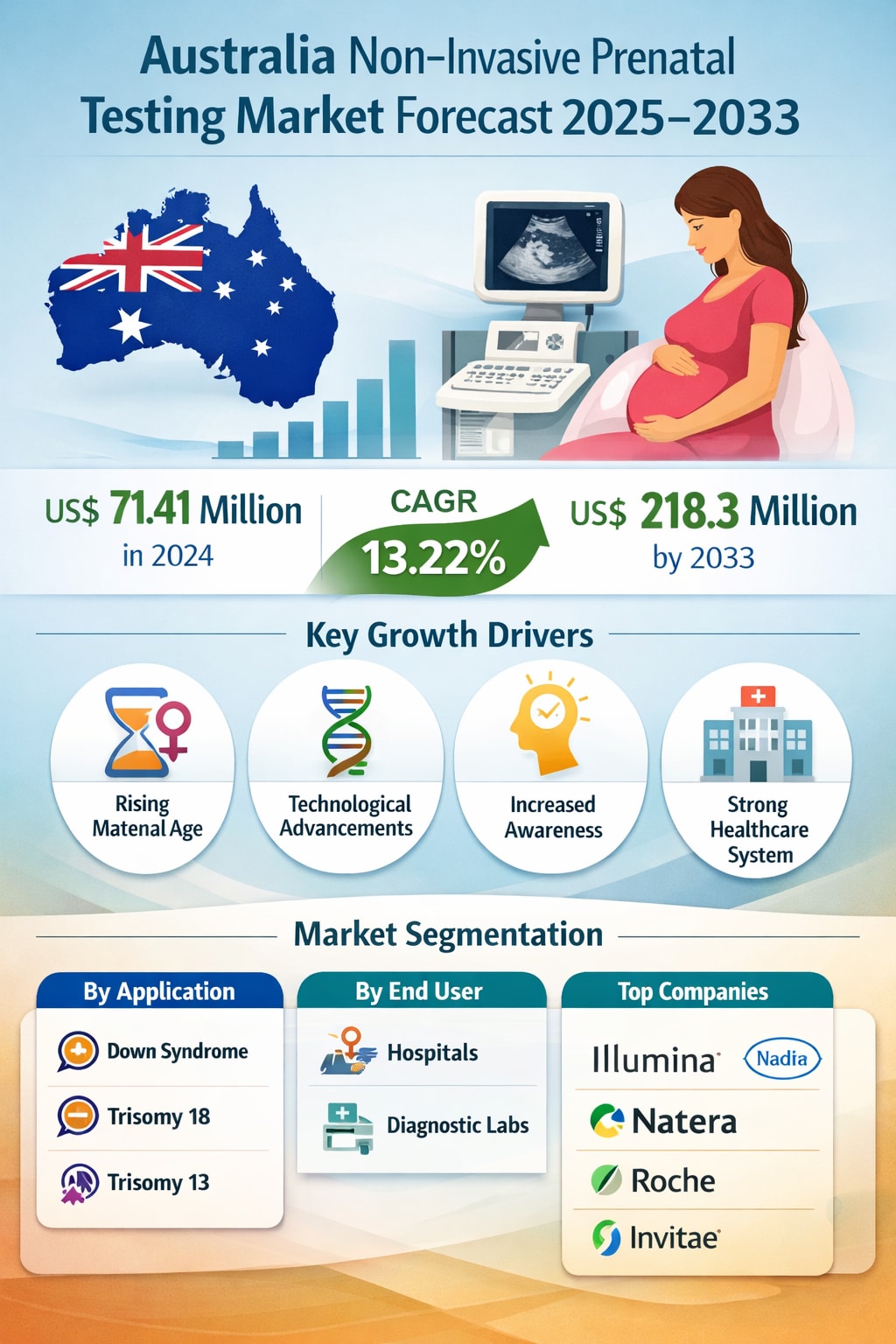
According to Renub Research, the Australia Non-Invasive Prenatal Testing Market is expected to grow from US$ 71.41 million in 2024 to US$ 218.3 million by 2033, registering a strong CAGR of 13.22% from 2025 to 2033. This impressive growth trajectory underscores how rapidly NIPT is moving from a niche offering to a mainstream healthcare service.
At its core, NIPT analyzes small fragments of fetal DNA circulating in the mother’s blood to screen for chromosomal abnormalities such as Down syndrome (Trisomy 21), Edwards syndrome (Trisomy 18), and Patau syndrome (Trisomy 13), among others. Unlike traditional invasive procedures such as amniocentesis or chorionic villus sampling (CVS), NIPT poses no risk to the fetus, making it an attractive and safer option for both patients and clinicians.
In recent years, Australia’s strong healthcare infrastructure, combined with increasing public awareness and supportive clinical guidelines, has accelerated the adoption of NIPT. Public and private hospitals, along with diagnostic laboratories, are steadily integrating these tests into standard prenatal screening pathways. For many expectant parents—especially those in higher-risk categories due to advanced maternal age—NIPT now represents peace of mind, early clarity, and better-informed decision-making.
However, as promising as the growth story is, the market also faces real-world challenges. Issues around cost, reimbursement, and access in rural and remote areas continue to shape how evenly the benefits of NIPT are distributed across the country. Even so, with continuous technological improvements and policy-level efforts to broaden access, the sector appears firmly positioned for long-term expansion.
Market Size and Growth Outlook
The numbers tell a compelling story. As per Renub Research, Australia’s NIPT market is on track to more than triple in value over the next decade—from US$ 71.41 million in 2024 to US$ 218.3 million by 2033. A 13.22% CAGR places this segment among the faster-growing niches within the broader diagnostics and genetic testing industry.
Several structural trends are working in favor of this growth:
A steady increase in maternal age across Australia
Greater clinical confidence in the accuracy and reliability of NIPT
Expanding availability of testing services through hospitals and diagnostic labs
Ongoing technological innovation in sequencing and bioinformatics
Rising consumer demand for early, non-invasive, and safer prenatal screening options
Together, these factors are reshaping prenatal care from a reactive model to a more proactive, precision-driven approach, where risks can be identified earlier and managed more effectively.
Why NIPT Is Gaining Ground in Australia
One of the biggest reasons behind NIPT’s growing popularity is its clinical and emotional value proposition. Traditional invasive tests, while diagnostically definitive, carry a small but real risk of miscarriage. For many families, that risk—however small—is deeply unsettling. NIPT, by contrast, offers high accuracy with zero procedural risk, using only a standard blood draw from the mother.
In addition, results can be obtained earlier in pregnancy, allowing parents and healthcare providers more time to understand the findings, consider next steps, and plan appropriate care. This early insight is particularly important in a healthcare environment that increasingly prioritizes personalized medicine and informed choice.
Australia’s healthcare system, known for its strong clinical standards and emphasis on evidence-based practice, has been relatively quick to recognize these benefits. As a result, NIPT is no longer seen merely as a premium add-on, but as a valuable screening tool that complements existing prenatal care pathways.
Growth Drivers for the Australia Non-Invasive Prenatal Testing Market
1. Public Awareness Campaigns
Public awareness initiatives have played a critical role in normalizing and promoting NIPT across Australia. Through educational programs, healthcare provider outreach, and media campaigns, expectant parents are becoming increasingly informed about the benefits of early genetic screening.
These campaigns emphasize key advantages such as safety, accuracy, and reliability, especially when compared to older invasive methods. As awareness grows, more parents are proactively requesting NIPT, not just those in high-risk categories. This shift toward preventive and informed healthcare decision-making is significantly boosting demand for NIPT services nationwide.
2. Better Access in Rural and Regional Areas
Historically, advanced prenatal testing options were more accessible in major cities, leaving rural and remote communities at a disadvantage. That gap is slowly narrowing. Investments in healthcare infrastructure, along with the expansion of telemedicine and mobile health services, are making NIPT more reachable for patients outside metropolitan areas.
Regional hospitals and clinics are increasingly partnering with diagnostic laboratories to offer sample collection locally, even if the analysis is done centrally. This improved access is not only expanding the market but also contributing to more equitable maternal healthcare outcomes across Australia.
3. Advancements in Screening Technology
Technological progress is arguably the strongest engine behind the NIPT market’s growth. Innovations in next-generation sequencing (NGS) and bioinformatics have significantly improved test accuracy, reduced error rates, and enhanced data interpretation.
As these technologies mature, costs are gradually coming down, turnaround times are improving, and the range of detectable conditions is expanding. This makes NIPT not only more appealing to clinicians but also more accessible to a broader segment of the population. In effect, technology is transforming NIPT from a specialized test into a scalable, mainstream diagnostic solution.
Challenges in the Australia Non-Invasive Prenatal Testing Market
1. High Cost of Testing
Despite its advantages, cost remains a major barrier for many expectant parents. NIPT is not always fully covered by public health insurance, and for families without private insurance, the out-of-pocket expense can be significant.
This financial hurdle can lead some parents to either skip screening altogether or opt for less accurate, more invasive alternatives. For the market to reach its full potential, broader reimbursement policies or cost-reduction strategies will be crucial.
2. Awareness Gaps in Remote Areas
While awareness is rising overall, knowledge gaps persist in rural and remote regions. Limited access to healthcare education, fewer specialist providers, and geographic isolation can all contribute to lower adoption rates of NIPT in these areas.
Addressing this disparity will require targeted outreach, better integration of telehealth services, and continued public health education efforts. Ensuring equitable access is not just a social imperative—it’s also essential for sustaining long-term market growth.
Australia Non-Invasive Prenatal Testing Market Segmentation
The market is segmented based on component, application, and end user, reflecting the diverse ecosystem that supports NIPT services.
By Component:
Instruments
Kits and Reagents
Services
While instruments and reagents form the technological backbone of NIPT, services—including sample processing, analysis, and reporting—represent a significant and growing share of the value chain.
By Application:
Down Syndrome (Trisomy 21)
Edwards Syndrome (Trisomy 18)
Patau Syndrome (Trisomy 13)
Turner Syndrome
Other Applications
Among these, Down syndrome screening remains the most common and widely adopted use case, though the scope of testing continues to expand as technology advances.
By End User:
Hospitals
Diagnostic Laboratories
Diagnostic labs play a central role in test processing and analysis, while hospitals are increasingly serving as the primary point of patient interaction and sample collection.
Competitive Landscape and Company Analysis
The Australian NIPT market is shaped by the presence of several major global players, each bringing advanced technologies, strong R&D capabilities, and extensive distribution networks. Key companies operating in this space include:
Eurofins Scientific
F. Hoffmann-La Roche Ltd
Invitae Corporation
Illumina Inc.
Natera Inc.
Centogene NV
Qiagen
These companies compete on factors such as test accuracy, turnaround time, technology platforms, pricing, and clinical support services. Continuous innovation and strategic partnerships are central to maintaining competitive advantage in this rapidly evolving market.
A notable industry development occurred in July 2022, when the Australian company Genetic Technologies Limited announced its expansion into the European and Indian markets through the acquisition of EasyDNA, a U.S.-based company. Moves like this highlight how Australian players are not only strengthening their domestic position but also seeking growth opportunities on the global stage.
Strategic Trends Shaping the Future
Looking ahead, several trends are likely to define the next phase of the NIPT market in Australia:
Broader test panels covering more genetic conditions
Greater integration of AI and advanced bioinformatics in data interpretation
Continued efforts to reduce costs and improve reimbursement coverage
Expansion of telehealth-enabled testing models
Stronger focus on patient education and genetic counseling services
Together, these trends point toward a future where NIPT is not just a screening tool, but a core component of personalized prenatal care.
Final Thoughts
The Australia Non-Invasive Prenatal Testing Market is on a clear and compelling growth path. With the market projected by Renub Research to rise from US$ 71.41 million in 2024 to US$ 218.3 million by 2033 at a CAGR of 13.22%, NIPT is fast becoming one of the most dynamic segments of the country’s diagnostics industry.
Driven by rising maternal age, rapid technological advancements, increasing public awareness, and a strong healthcare ecosystem, NIPT is reshaping how prenatal care is delivered in Australia. While challenges around cost and access remain, ongoing innovation and policy-level support are likely to narrow these gaps over time.
In the bigger picture, NIPT represents more than just a growing market—it reflects a broader shift toward safer, earlier, and more personalized healthcare. As Australia continues to embrace proactive and precision-driven medical approaches, non-invasive prenatal testing is set to play an increasingly central role in shaping the future of maternal and fetal health.
About the Creator
Australia Outdoor Advertising Market — Growth, Forecast & Strategic Outlook 2026–2034
The Australia outdoor advertising market is experiencing steady expansion as brands leverage physical media to enhance visibility, engage audiences, and complement digital campaigns. According to IMARC Group, the market reached USD 1,207.7 million in 2025 and is projected to grow to USD 1,914.4 million by 2034, exhibiting a compound annual growth rate (CAGR) of 5.09% during 2026–2034. This growth reflects investment in both traditional and digital out-of-home (OOH) formats — including billboards, transport ads, street furniture, and other outdoor placements — across urban and regional landscapes.
By Amélie Belle6 days ago in Trader




Comments
There are no comments for this story
Be the first to respond and start the conversation.