
Australia Dust Control Solutions Market: Rising Demand for Cleaner, Safer Industrial Environments
Driven by stricter safety regulations, expanding construction and mining activities, and advanced technologies, the Australia dust control solutions market is forecast to grow from USD 360.44 million in 2025 to USD 520.02 million by 2034 at a 4.16% CAGR.

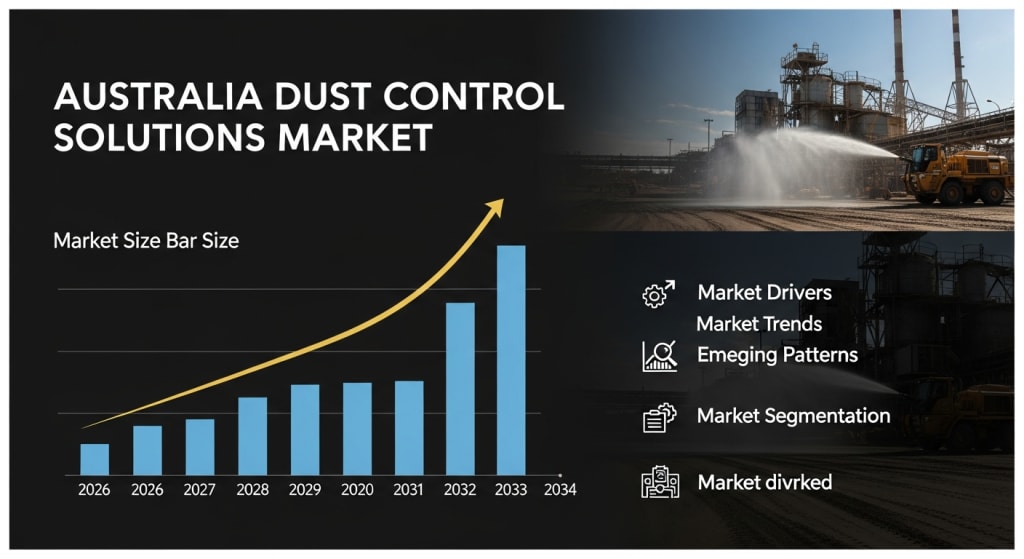
The Australia dust control solutions market is gaining momentum as industries across the nation prioritise air quality, occupational safety and environmental compliance. According to the latest IMARC Group research, the market generated USD 360.44 million in 2025 and is projected to reach USD 520.02 million by 2034, expanding at a compound annual growth rate (CAGR) of 4.16% between 2026 and 2034.
Dust control solutions encompass a broad range of technologies — from wet scrubbers and dry collectors to cellular monitoring systems — that prevent the release of airborne particulates in industrial and construction environments. The increasing prioritisation of worker health, tighter regulatory frameworks around crystalline silica exposure, and the growth of resource extraction and infrastructure sectors underpin this demand.
Why the Market Is Growing So Rapidly
1. Strengthened Safety and Environmental Regulations
Regulatory agencies in Australia have intensified requirements governing dust exposure, especially where crystalline silica is involved. New mandates extend protections to hundreds of thousands of workers in construction, mining, civil tunnelling, and maintenance operations, compelling companies to adopt advanced suppression systems and monitoring technologies to remain compliant.
2. Mining Sector Dust Challenges
Australia’s resource rich landscape — with significant mining activities in states like Western Australia and Queensland — creates substantial dust management challenges. Mining operations generate particulates during ore extraction, processing, and haulage, driving widespread adoption of robust dust control strategies and solutions tailored to high particulate environments.
3. Construction and Infrastructure Growth
Major construction initiatives across the country — including metro expansions, airport developments, renewable energy zones, and road networks — produce significant dust emissions. These projects consistently demand dust suppression equipment and services to protect workers and minimise impact on surrounding communities, particularly in urban and suburban zones.
4. Awareness of Occupational Health Hazards
Growing awareness of the long term health effects associated with inhaling particulate matter, such as silicosis and other respiratory diseases, has prompted industry leaders to invest aggressively in dust control measures. Worker health programmes and industry collaborations further push adoption of suppression and monitoring technologies.
5. Technological Advancements in Solutions
Innovations such as IoT enabled dust sensors, real time monitoring platforms, automated suppression systems and data analytics are reshaping how industries manage airborne particulates. These technologies offer improved compliance tracking, performance benchmarking and operational efficiency, raising adoption rates across sectors.
What the Opportunities Are
1. Wet Dust Control Technologies
Wet systems — such as high pressure spray units and wet scrubbers — dominate the market, offering superior performance for capturing fine particulates. Continued innovation in water efficient and eco friendly wet solutions presents significant growth potential as industries seek both effectiveness and sustainability.
2. Automated Monitoring and Data Analytics
Solutions that combine dust suppression hardware with IoT sensors and cloud based analytics can provide clients with real time environmental insights, predictive maintenance flags, and compliance dashboards, creating a premium service offering.
3. Sustainable Chemical Suppressants
Development of biodegradable, non toxic dust suppression formulations that reduce water usage and environmental impact can appeal to companies with strong environmental, social and governance (ESG) goals.
4. Customised Application Specific Solutions
Tailoring systems for industry specific needs — from mining haul roads to construction sites and processing plants — allows providers to command higher margins and build long term client relationships.
5. Workforce Training and Safety Programmes
Offering training on safe operation, maintenance and regulatory compliance tied to dust control equipment can become a valuable add on service, enhancing adoption and customer retention.
6. Regional Market Expansion
Targeted strategies in high growth regions such as ACT & NSW (urban infrastructure), Queensland (mining and quarrying), and Victoria & Tasmania (transport upgrades) can unlock incremental market share.
7. After Sales Support and Lifecycle Services
Robust after sales networks — including installation support, spare parts, and maintenance contracts — can generate recurring revenue and deepen customer engagement.
Recent News & Developments in Australia Dust Control Solutions Market
March 2025: Government Regulation & Safety: Australia implemented expanded workplace particulate exposure standards that extend protections to more than 600,000 workers across mining and construction sectors. These measures require detailed risk assessments, air monitoring programmes, and silica control plans to be in place at high risk sites, increasing demand for compliant dust control technologies.
July 2025: Product Innovation: Mideco launched the “Bat Booth”, a compact de dusting system capable of removing up to 88% of respirable dust from workers’ clothing in under 10 seconds. This innovation improves personal exposure management and illustrates the trend toward high efficiency, user centric dust control tools in industrial settings.
September 2025: Commercial Technology Advancement: RST Solutions introduced DEM Hydroboost Pro, a moisture optimising dust suppression solution for mining operations that maximises dust control while conserving water. This product addresses both environmental challenges and operational cost pressures in arid mining regions.
Why Should You Know About the Australia Dust Control Solutions Market?
The Australia dust control solutions market occupies a strategic intersection of industrial activity, worker safety and environmental stewardship. With growth projected from USD 360.44 million in 2025 to USD 520.02 million by 2034 at a 4.16% CAGR, the market reflects sustained industrial investment, stronger regulatory compliance and rising safety expectations across sectors.
For investors, this sector offers exposure to durable demand driven by essential operational needs and regulatory requirements. For equipment suppliers and solution providers, there’s a clear opportunity to innovate with smart, sustainable and application specific offerings. And for policymakers and safety advocates, enhancing dust control capabilities supports both public health outcomes and environmental quality objectives. Understanding these trends is critical for stakeholders aiming to capitalise on growth while advancing safer, cleaner industrial practices in Australia.
About the Creator
Amélie Belle
Hi, I’m Amélie Belle—27, New York writer, lover of quiet moments and honest words. I share poetry and reflections on love, healing, and life’s small miracles. If my writing makes you feel seen, I’m exactly where I’m meant to be.
Keep reading
More stories from Amélie Belle and writers in Trader and other communities.
Australia Intravenous Solution Market: Critical Care Growth Driven by Healthcare Needs
The Australia intravenous solution market plays an essential role in the nation’s healthcare infrastructure, underpinning fluid therapy, nutritional support, medication delivery and hydration across hospitals, clinics and home care settings. According to the latest IMARC Group analysis, the market was valued at USD 326.20 million in 2025 and is projected to reach USD 479.28 million by 2034, growing at a compound annual growth rate (CAGR) of 4.37% from 2026 to 2034.
By Amélie Belle3 days ago in Trader
Super Bowl LX Recap: A Team Called Hawks
Sixty. The Super Bowl turned 60! Still amazes me that this was the sixtieth Super Bowl played in NFL history. It seems like yesterday that I watched Super Bowl XXVII, the first SB I ever watched. The QB who won Super Bowl XXVII has since called a few SBs, and will call next year's game, but that's another story. Super Bowl LX took place at Levi's Stadium in Santa Clara, California, the home stadium of the San Francisco 49ers. However, it was one of their division foes who represented the NFC, as the Seattle Seahawks faced off against the New England Patriots.
By Clyde E. Dawkins3 days ago in Unbalanced


Comments
There are no comments for this story
Be the first to respond and start the conversation.