
Australia Dental Diagnostics and Surgical Equipment Market Size and Forecast 2025–2033
Aging Population, Digital Dentistry, and Minimally Invasive Procedures Drive a High-Tech Transformation of Australia’s Oral Healthcare Industry

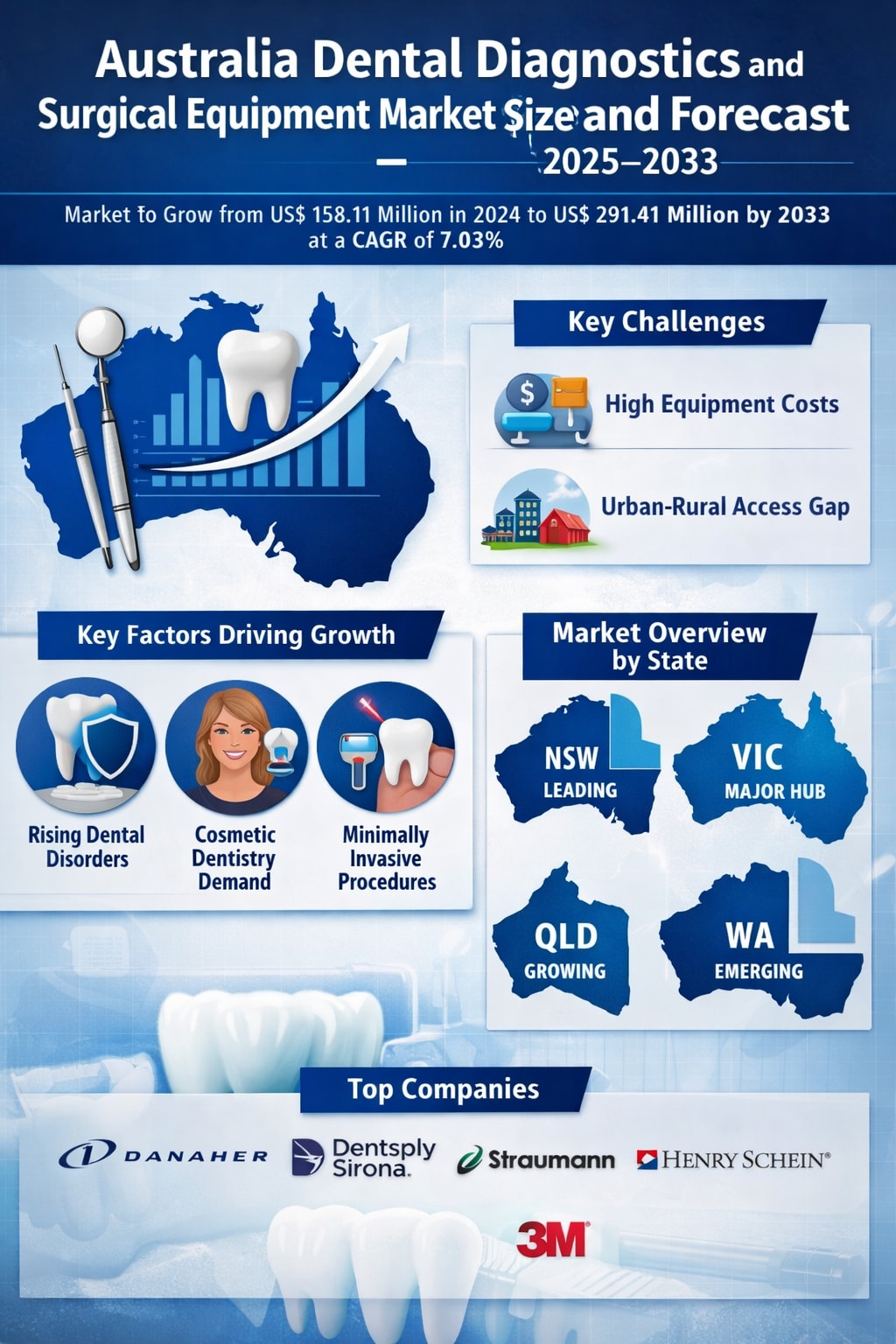
Australia Dental Diagnostics and Surgical Equipment Market: A High-Growth Healthcare Segment
The Australia Dental Diagnostics and Surgical Equipment Market is entering a strong growth phase, supported by rising awareness of oral health, rapid technological adoption, and a steadily aging population. According to Renub Research, the market is expected to grow from US$ 158.11 million in 2024 to US$ 291.41 million by 2033, registering a compound annual growth rate (CAGR) of 7.03% from 2025 to 2033.
This impressive expansion reflects a broader shift in Australia’s healthcare system toward precision diagnostics, digital workflows, and minimally invasive dental treatments. Modern dentistry is no longer limited to basic tools and conventional procedures. Instead, clinics and hospitals are increasingly investing in digital X-rays, intraoral scanners, CAD/CAM systems, laser dentistry tools, and advanced surgical equipment to improve accuracy, efficiency, and patient comfort.
The growing demand for dental implants, restorative procedures, orthodontics, and cosmetic treatments is a key factor behind this momentum. As Australia’s population continues to age, the prevalence of tooth loss, periodontal diseases, and complex oral conditions is rising, making advanced diagnostic and surgical solutions more essential than ever.
At the same time, patients today are more informed and more demanding. They expect faster treatments, better outcomes, and less discomfort, pushing dental professionals to adopt cutting-edge technologies that can deliver higher-quality care while streamlining clinical workflows.
Industry Overview: Technology Reshaping Australian Dentistry
Australia’s dental diagnostics and surgical equipment industry is being reshaped by digital transformation. The integration of 3D imaging, digital radiography, CAD/CAM systems, and laser-based procedures is fundamentally changing how dentists diagnose, plan, and perform treatments.
Advanced diagnostic tools now allow clinicians to detect oral conditions at much earlier stages, improving treatment success rates and reducing long-term costs for patients. Technologies such as cone-beam computed tomography (CBCT), intraoral scanners, and digital impression systems have significantly improved diagnostic precision and treatment planning.
On the surgical side, laser dentistry and minimally invasive instruments are helping reduce pain, bleeding, and recovery time, making dental visits more comfortable and less intimidating for patients. This shift is particularly important in a market like Australia, where patient experience and quality of care play a major role in clinic selection.
Australia’s well-established healthcare infrastructure, supportive regulatory environment, and widespread dental insurance coverage further accelerate the adoption of advanced equipment. Both public and private dental care providers are continuously upgrading their facilities to remain competitive and meet evolving patient expectations.
Major global and domestic companies are also strengthening their presence through new product launches, partnerships, and technology upgrades, ensuring that innovation remains at the core of the market’s long-term growth story.
Key Factors Driving Market Growth
1. Rising Prevalence of Dental Disorders
One of the most important growth drivers for the Australian dental diagnostics and surgical equipment market is the increasing burden of oral diseases. Conditions such as dental caries, periodontal disease, and oral health complications related to aging are becoming more common.
Studies indicate that around 30% of Australian adults suffer from gum disease, and nearly one in three people over the age of 15 have untreated dental decay. In addition, tens of thousands of hospitalizations each year are linked to preventable oral health issues, highlighting the need for better diagnostics, earlier intervention, and more effective treatment tools.
This rising disease burden is pushing clinics and hospitals to invest in high-precision diagnostic systems and modern surgical equipment that can improve detection rates, enhance treatment outcomes, and reduce complications.
2. Growing Demand for Cosmetic Dentistry
Cosmetic dentistry is no longer a niche segment in Australia—it has become a mainstream healthcare and lifestyle choice. Procedures such as teeth whitening, veneers, crowns, bridges, and dental implants are seeing strong demand, particularly in major cities like Sydney, Melbourne, and Brisbane.
Technologies such as CAD/CAM systems, digital smile design, and 3D imaging are transforming cosmetic dentistry by allowing highly personalized, accurate, and visually predictable treatments. Patients can now preview their results before treatment begins, which increases confidence and acceptance of advanced procedures.
This trend is significantly boosting demand for digital imaging systems, milling machines, scanners, and precision surgical tools, making cosmetic dentistry a powerful growth engine for the broader dental equipment market.
3. Rising Popularity of Minimally Invasive Procedures
Modern patients prefer treatments that are less painful, faster, and involve shorter recovery times. As a result, minimally invasive dental procedures are rapidly gaining popularity across Australia.
Technologies such as dental lasers, air abrasion systems, and advanced endodontic tools are replacing many traditional drilling and cutting techniques. These innovations help preserve natural tooth structure, reduce bleeding and swelling, and improve overall patient comfort.
Australia’s strong regulatory and clinical standards also encourage the adoption of safer, more precise, and patient-friendly technologies, further supporting market growth.
Challenges Facing the Market
High Cost of Advanced Equipment
Despite strong growth prospects, the high cost of advanced dental equipment remains a significant barrier, especially for small and medium-sized clinics. Technologies such as 3D imaging systems, CAD/CAM units, and laser-based surgical tools require substantial upfront investment, along with ongoing costs for maintenance, software updates, and staff training.
For clinics in regional and remote areas, these costs can be particularly difficult to justify due to lower patient volumes and tighter budgets. As a result, some practices delay or avoid upgrading their equipment, which can slow the overall pace of technology adoption across the country.
Urban–Rural Access Gap
Another major challenge is the unequal distribution of advanced dental technologies between urban and rural areas. While metropolitan regions enjoy access to state-of-the-art clinics and equipment, many rural and remote communities still rely on older or basic dental tools.
Geographic isolation, infrastructure limitations, and difficulties in attracting skilled professionals all contribute to this gap. Bridging this divide will require targeted investments, policy support, and innovative service delivery models such as mobile clinics and tele-dentistry.
State-Wise Market Overview
New South Wales (NSW)
New South Wales leads the Australian dental diagnostics and surgical equipment market, driven by a high concentration of dental clinics, hospitals, and specialist practices, particularly in Sydney. The state shows strong adoption of digital imaging, CAD/CAM systems, and laser dentistry tools, supported by both public and private investments in healthcare infrastructure.
Victoria
Victoria is another major contributor, with Melbourne serving as a hub for advanced dental care and research. The presence of leading universities and research institutions supports early adoption of AI-assisted diagnostics, intraoral scanners, and digital workflows. Both metropolitan and regional areas are seeing steady upgrades in dental infrastructure.
Queensland
Queensland’s market is growing steadily, fueled by population growth and rising demand in cities such as Brisbane, Gold Coast, and Sunshine Coast. Clinics are increasingly adopting digital radiography, CAD/CAM systems, and dental lasers, while outreach programs aim to improve access in regional areas.
Other States and Territories
Western Australia, South Australia, the Australian Capital Territory, Tasmania, and the Northern Territory are also contributing to market growth, though adoption rates are generally higher in urban centers compared to rural regions.
Recent Industry Developments
The Australian dental equipment industry continues to benefit from global innovation and strategic investments. In July 2024, Danaher Corporation announced the opening of two new laboratories certified by the College of American Pathologists (CAP) and Clinical Laboratory Improvement Amendments (CLIA), including one in Mascot, Australia, strengthening the country’s role in collaborative research.
In March 2024, Dentsply Sirona introduced new products such as the X-Smart Pro endodontic system, highlighting ongoing innovation in endodontic and surgical technologies.
Market Segmentation Overview
By Type
Dental Systems and Equipment
Dental Chairs
Hand Pieces
Light Cure Equipment
Scaling Units
CAD/CAM Systems
Dental Lasers
Soft Tissue Lasers
Hard Tissue Lasers
Dental Radiology Equipment
Extraoral Radiology Equipment
Intraoral Radiology Equipment
Other Types
By Treatment
Orthodontic
Endodontic
Periodontic
Prosthodontic
By End User
Hospitals
Clinics
By State
New South Wales
Victoria
Queensland
Western Australia
South Australia
Australian Capital Territory
Tasmania
Northern Territory
Competitive Landscape
The Australian market features strong participation from global leaders, including:
Danaher Corporation
Straumann
Henry Schein, Inc.
Dentsply Sirona
Zimmer Holdings Inc.
Patterson Companies, Inc.
3M Corporation
Envista Holdings Corporation
These companies compete through product innovation, technology upgrades, partnerships, and strategic expansions, ensuring a dynamic and competitive market environment.
Final Thoughts
The Australia Dental Diagnostics and Surgical Equipment Market is on a clear upward trajectory, projected to grow from US$ 158.11 million in 2024 to US$ 291.41 million by 2033 at a CAGR of 7.03%. This growth is being powered by aging demographics, rising oral health awareness, expanding cosmetic dentistry, and rapid technological innovation.
While challenges such as high equipment costs and rural access disparities remain, the long-term outlook is highly positive. As digital dentistry, minimally invasive procedures, and precision diagnostics continue to reshape clinical practice, Australia’s dental sector is set to become more efficient, more patient-centered, and more technologically advanced than ever before.
For investors, manufacturers, and healthcare providers alike, this market represents a compelling opportunity at the intersection of healthcare, technology, and patient experience—one that is poised for sustained growth throughout the forecast period.
About the Creator
Our Song
Evening has given way to night. Gently, I settle next to you on the comfortable, old love seat and reach for your hand. You snatch it away, again. It cuts me to the quick, but I hide the pain, understanding that the reaction is but part of your demented state. Since the accident, your presence here in our cozy home has been clouded by a haze I can't see. Nevertheless, I feel the frigidity of your expressions and it serves as an excruciating reminder of the immeasurable distance between us.
By Dana Crandell5 days ago in Fiction


Comments
There are no comments for this story
Be the first to respond and start the conversation.