
Australia Artificial Intelligence Market — Growth, Forecast & Strategic Outlook
Robust investment, data proliferation, and cross-sector adoption are driving Australia’s AI revolution.

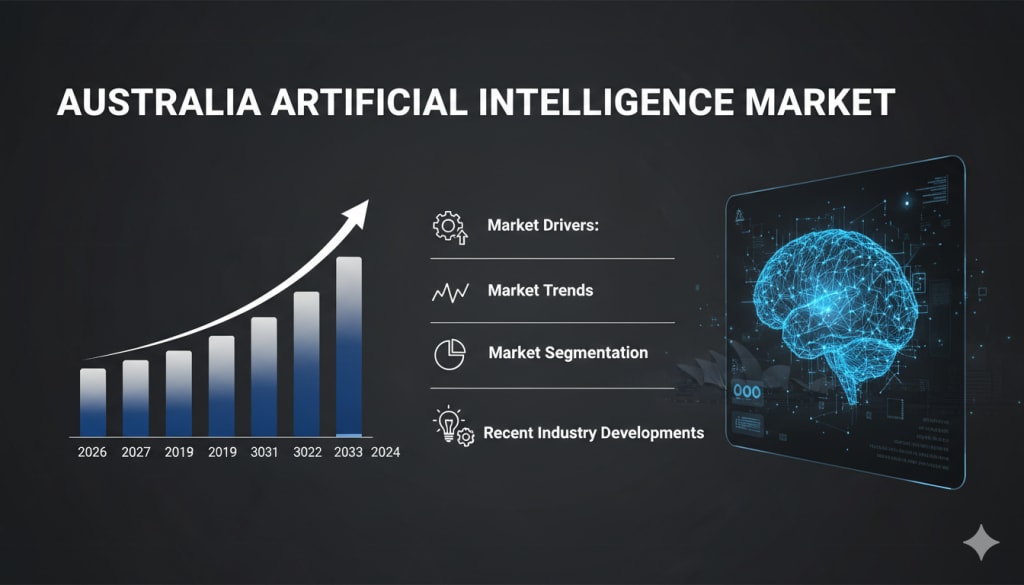
The Australia artificial intelligence market has solidified its position as one of the nation’s most dynamic technology segments, underpinned by increasing digitalization and enterprise adoption. According to IMARC Group, the market reached USD 2,387.1 million in 2025 and is projected to expand to USD 8,017.3 million by 2034, growing at a compound annual growth rate (CAGR) of 14.41% from 2026 to 2034.
This strong growth reflects Australia’s strategic embrace of AI across industries such as healthcare, manufacturing, financial services, retail, and transportation. Artificial intelligence — spanning machine learning, natural language processing, computer vision, and other technologies — is rapidly transforming business operations, decision-making frameworks, and customer experiences. IMARC’s detailed segmentation shows that the market is shaped by multiple offerings (hardware, software, services), technologies, systems, and end-use industries, revealing a mature yet expanding landscape.
Why the Market Is Growing So Rapidly
1. Government Support and Strategic Investment
Government initiatives are a cornerstone of AI adoption in Australia. Federal and state governments have been actively funding AI research, encouraging public-private partnerships, and developing frameworks that support responsible and ethical deployment of AI technologies. These efforts reduce barriers to adoption for enterprises and foster a national ecosystem that prioritizes innovation and competitiveness on a global scale.
By supporting infrastructure, research grants, and regulatory readiness, government involvement signals stability and long-term commitment — key factors encouraging businesses to invest in AI solutions that can transform their operations.
2. Explosion of Digital Data
The accelerating proliferation of data from digital technologies — including connected devices, social media platforms, enterprise systems, and IoT sensors — creates the raw material AI systems need to deliver value. Vast quantities of structured and unstructured data empower AI algorithms to learn, refine, and provide insights across functions such as predictive maintenance, consumer behavior analysis, and risk analytics.
This abundance of data not only improves accuracy and outcomes but also enables new use cases in real time, reinforcing the value proposition of AI solutions across sectors.
3. Advances in Machine Learning and Analytics
Continuous improvement in machine learning models, computational power, and analytics frameworks expands what is possible with AI. Enhanced algorithms enable more sophisticated pattern recognition, forecasting, autonomous decision-making, and real-time optimization. These capabilities are especially valuable in sectors like healthcare — for diagnostic support — and in finance — for fraud detection and personalized services.
As research pushes the boundaries of what AI can achieve, adoption accelerates beyond pilot projects into mission-critical deployments.
4. Cross-Sector Enterprise Adoption
Australian businesses increasingly recognize AI’s potential to streamline operations, enhance customer experiences, and unlock new revenue streams. From intelligent automation in manufacturing facilities to personalized marketing in retail, AI is shifting from experimental to essential technology.
Organizations are investing in AI platforms that integrate with core systems, enabling real-time decision-making, predictive insights, and operational efficiencies that were previously unattainable.
5. Growing Demand for Smart, Scalable Systems
Demand for scalable and adaptable technologies that support digital transformation has never been higher. AI systems — from decision support engines to hybrid cognitive applications — are becoming indispensable tools for organizations aiming to stay competitive in rapidly evolving markets.
This demand drives not only technology adoption but also investment in complementary capabilities such as cloud infrastructure, edge computing, and advanced analytics frameworks.
What the Opportunities Are
1. Healthcare Innovation
AI presents a major opportunity in medical diagnostics, treatment optimization, and hospital operations. With an aging population and rising demand for personalized care, AI applications can improve outcomes while reducing costs.
2. Manufacturing Efficiency
In manufacturing, AI-driven automation and predictive analytics enhance productivity, reduce downtime, and streamline supply chains — offering measurable competitive advantages.
3. Financial Services Transformation
Banks and financial institutions can leverage AI to detect fraud, automate customer service, and inform investment strategies, elevating both security and user experience.
4. Retail and Customer Engagement
AI-powered personalization and predictive demand forecasting can transform retail operations. By understanding consumer behavior more deeply, retailers can optimize inventories and enhance marketing precision.
5. Transportation and Logistics Optimization
AI’s ability to analyze real-time data improves logistics planning, route optimization, and fleet management, directly impacting operational costs and delivery performance.
6. Smart Cities and Urban Planning
Urban authorities can harness AI for traffic management, energy optimization, and public safety — laying the foundation for smarter, more sustainable cities.
7. Workforce Upskilling and Talent Development
As AI adoption increases, so does demand for specialized skills in machine learning, data science, and AI implementation. Educational programs and training platforms have an opportunity to bridge this skills gap.
Recent News & Developments in Australia Artificial Intelligence Market
• January 2025: Government Regulatory Action — The Australian government unveiled enhancements to its national AI strategy, focusing on ethical usage frameworks and data protection standards. This initiative aims to attract global tech partnerships by providing clear compliance guidelines, encouraging investment, and ensuring public trust in AI solutions across sectors. Early industry feedback highlights increased confidence among enterprise adopters.
• June 2025: Company Expansion — A major technology infrastructure provider announced a multi-million-dollar investment in a next-generation AI hub in Melbourne, including an “AI Factory” and innovation center designed to accelerate R&D. The facility will support thousands of high-value tech jobs and provide enterprises with access to advanced AI testing environments and analytics platforms, bolstering the local AI ecosystem.
• September 2025: Adoption Milestone — Industry analyses revealed that AI deployment across Australian enterprises grew by double digits year-on-year, with significant uptake in healthcare and finance. Organizations reported measurable efficiency gains from AI implementations, such as reduced processing times and improved accuracy in predictive tasks, reinforcing the market’s upward trajectory and tangible business value.
Why Should You Know About the Australia Artificial Intelligence Market?
The Australia artificial intelligence market is far more than a technology sector — it is a strategic engine for national innovation, productivity, and competitive advantage. For investors, the segment’s strong CAGR and diversified application base indicate durable long-term value. Businesses that integrate AI into their core operations stand to unlock significant efficiencies, improve customer engagement, and create new revenue streams. For policy makers, AI represents both an opportunity and a responsibility: to guide ethical deployment, invest in capability building, and position Australia as a global leader in responsible AI innovation.
Understanding the dynamics of this market is essential for anyone aiming to navigate the future of technology-enabled growth in Australia.
About the Creator
Rashi Sharma
I am a market researcher.
Keep reading
More stories from Rashi Sharma and writers in Trader and other communities.
Australia Dried Fruits and Nuts Market — Growth, Forecast & Opportunities
The Australia dried fruits and nuts market has emerged as one of the fastest-growing segments within the broader Australian food and snack landscape. According to the latest market research by IMARC Group, the market was valued at USD 1,359.2 million in 2025 and is projected to grow to USD 2,385.6 million by 2034, achieving a compound annual growth rate (CAGR) of 6.45% during 2026-2034.
By Rashi Sharmaa day ago in Trader
Australia Outdoor Advertising Market — Growth, Forecast & Strategic Outlook 2026–2034
The Australia outdoor advertising market is experiencing steady expansion as brands leverage physical media to enhance visibility, engage audiences, and complement digital campaigns. According to IMARC Group, the market reached USD 1,207.7 million in 2025 and is projected to grow to USD 1,914.4 million by 2034, exhibiting a compound annual growth rate (CAGR) of 5.09% during 2026–2034. This growth reflects investment in both traditional and digital out-of-home (OOH) formats — including billboards, transport ads, street furniture, and other outdoor placements — across urban and regional landscapes.
By Amélie Belleabout 15 hours ago in Trader
BTC USD Surge: How to Predict the Next Big Price Move
The BTC USD market is fast-moving and full of surprises. Traders are always searching for clues about the next price jump or drop. While experts share tips, some important truths remain hidden. In this article, we reveal insights about BTC USD that can help you stay ahead of the curve and make smarter trading decisions.
By hamza mirza7 days ago in Trader



Comments
There are no comments for this story
Be the first to respond and start the conversation.