
Asia-Pacific Telemedicine Market Size and Forecast 2025–2033
From Virtual Consults to AI-Powered Care: How Telemedicine Is Redefining Healthcare Across Asia-Pacific

Introduction: A Digital Healthcare Revolution in Motion
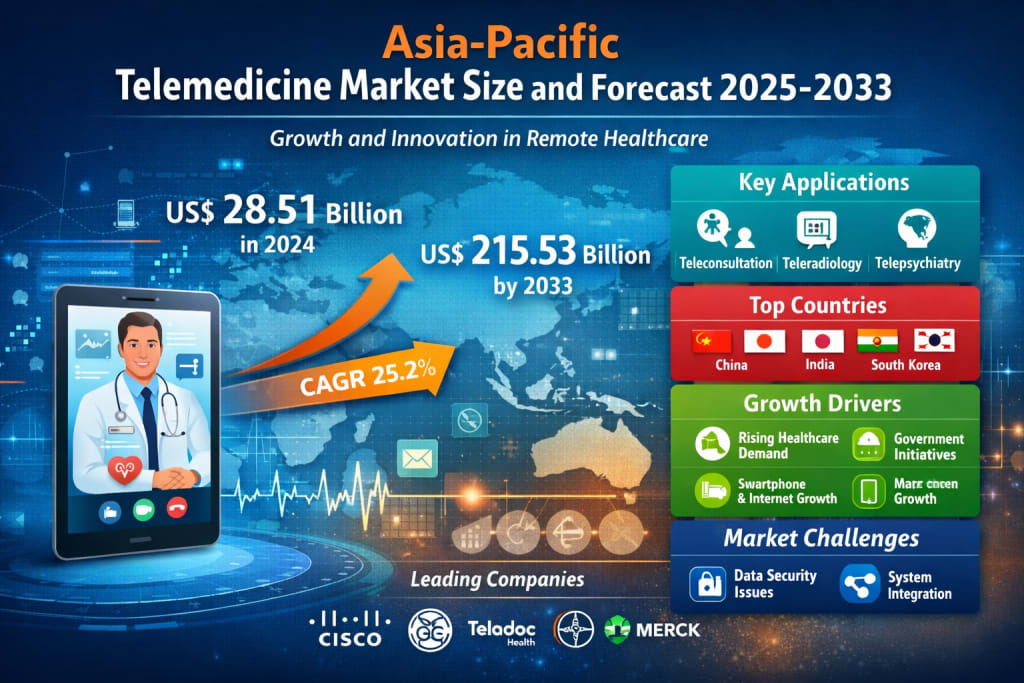
The Asia-Pacific region is witnessing one of the most dramatic transformations in modern healthcare history. Telemedicine—once considered a niche or emergency solution—has rapidly evolved into a core pillar of healthcare delivery across both developed and emerging economies. According to Renub Research, the Asia-Pacific Telemedicine Market is expected to reach US$ 215.53 billion by 2033, rising sharply from US$ 28.51 billion in 2024, registering a robust CAGR of 25.2% from 2025 to 2033.
This extraordinary growth is being fueled by a powerful mix of rising healthcare demand, expanding digital infrastructure, increasing smartphone penetration, and government-backed digital health initiatives. From China’s smart healthcare push to India’s National Digital Health Mission and Australia’s mature telehealth ecosystem, the region is rapidly embracing virtual care as a practical, scalable, and cost-effective solution.
Telemedicine today goes far beyond simple video consultations. It now includes teleradiology, telepsychiatry, telecardiology, teledermatology, telepathology, remote patient monitoring, AI-assisted diagnostics, and even telesurgery. For a region as vast and diverse as Asia-Pacific—marked by dense megacities, remote islands, mountainous terrains, and rural populations—telemedicine is not just an innovation; it is becoming a necessity.
Asia-Pacific Telemedicine Market Overview
The Asia-Pacific telemedicine market has expanded rapidly in recent years, driven by the need for accessible, efficient, and scalable healthcare solutions. The region’s massive population, fast urbanization, and uneven distribution of healthcare infrastructure have made digital healthcare delivery a strategic priority.
Countries such as China, India, Japan, South Korea, and Australia are leading the charge with significant investments in digital health platforms, cloud-based healthcare systems, and AI-powered medical tools. Governments across the region are actively promoting telehealth adoption to reduce hospital burden, improve rural healthcare access, and control rising healthcare costs.
Market players are continuously innovating with virtual consultation platforms, remote diagnostics, wearable device integration, and mobile health applications. Cloud computing and data analytics are making healthcare more personalized and proactive, while AI is enhancing diagnostic accuracy and clinical decision-making.
However, the market still faces challenges. Uneven internet connectivity, fragmented regulations, interoperability issues, and data privacy concerns continue to slow adoption in certain areas. Despite these hurdles, the long-term outlook remains extremely positive. Rising healthcare awareness, growing digital literacy, and increasing healthcare expenditure are expected to keep the market on a strong upward trajectory.
The Role of Chronic Diseases and Preventive Care
One of the strongest drivers behind telemedicine adoption in Asia-Pacific is the rising burden of chronic diseases such as diabetes, cardiovascular disorders, respiratory illnesses, and hypertension. Managing these conditions requires regular monitoring, follow-ups, and lifestyle guidance—services that are ideally suited to telemedicine platforms.
For example, in India alone, cardiovascular diseases affect tens of millions of people and account for a significant share of total mortality. Similar trends are visible across China, Southeast Asia, and developed markets like Japan and South Korea. Telemedicine enables continuous care, remote monitoring, and early intervention, reducing hospital visits while improving long-term outcomes.
As healthcare systems shift from reactive treatment to preventive and value-based care, telemedicine is becoming a critical enabler of this transformation.
Growth Drivers for the Asia-Pacific Telemedicine Market
1. Rising Healthcare Demand
The Asia-Pacific region is facing mounting pressure on its healthcare systems due to population growth, rapid aging, and urban lifestyle changes. The number of elderly patients is rising sharply in countries like Japan, China, and South Korea, while chronic diseases are becoming more prevalent across both urban and semi-urban populations.
Telemedicine helps bridge the gap between limited healthcare resources and growing patient needs by offering remote consultations, digital follow-ups, and continuous care management. This not only reduces the burden on hospitals but also improves access for patients in underserved and rural areas.
2. Government Initiatives and Policy Support
Government support has been a major catalyst for telemedicine adoption across the region. India’s National Digital Health Mission (NDHM) aims to create a unified digital health ecosystem, while China’s “Internet Plus Healthcare” strategy promotes the integration of AI, big data, and 5G into medical services.
Countries like Australia, Japan, and South Korea have introduced favorable reimbursement policies and regulatory frameworks to encourage telehealth usage. These initiatives are helping normalize telemedicine as a mainstream healthcare service rather than an emergency alternative.
3. Expanding Smartphone and Internet Penetration
The rapid spread of smartphones and affordable internet access has transformed how people access healthcare. In countries such as India, Indonesia, the Philippines, and Vietnam, millions of users now rely on mobile apps for consultations, prescriptions, and health tracking.
This digital accessibility has removed traditional barriers of distance, cost, and infrastructure, making healthcare more inclusive. As digital literacy improves and 5G networks expand, telemedicine adoption is expected to accelerate even further.
Challenges in the Asia-Pacific Telemedicine Market
Data Privacy and Security Concerns
Telemedicine platforms handle highly sensitive patient data, including medical records, diagnostic images, and personal information. The Asia-Pacific region, however, has diverse and often fragmented data protection regulations, making compliance complex for providers operating across multiple countries.
Cybersecurity risks, data breaches, and concerns over cloud storage transparency remain key issues. Building strong encryption systems, standardized compliance frameworks, and transparent data policies will be crucial for sustaining user trust.
Integration with Traditional Healthcare Systems
Many hospitals and clinics in the region still rely on legacy IT systems that are not fully compatible with modern telehealth platforms. The lack of standardized electronic health records (EHRs) and interoperability frameworks creates operational inefficiencies.
Additionally, healthcare professionals require training and workflow adjustments to effectively integrate virtual care with in-person treatment. Without seamless integration, telemedicine risks becoming a parallel system rather than a fully embedded part of healthcare delivery.
Country-Wise Market Insights
China
China’s telemedicine market is expanding rapidly due to strong government backing, rising healthcare demand, and advanced digital infrastructure. The “Internet Plus Healthcare” initiative has encouraged widespread adoption of online consultations, AI-assisted diagnostics, and remote monitoring services.
Major technology companies are heavily investing in telehealth platforms, integrating big data and AI to improve care delivery. While regulatory complexity and data privacy remain challenges, telemedicine is firmly positioned as a core component of China’s digital healthcare future.
Japan
Japan’s aging population and shortage of healthcare professionals are driving strong demand for telemedicine. Government policies supporting digital health reimbursement and integration have accelerated adoption, especially in rural areas.
Teleconsultations, remote diagnostics, and home-based monitoring are becoming increasingly common. Although regulatory and integration challenges persist, Japan’s telemedicine market is expected to grow steadily as technology becomes more embedded in routine care.
India
India represents one of the fastest-growing telemedicine markets in the region. With over 820 million internet users, including a massive rural user base, digital healthcare platforms are transforming access to medical services.
Initiatives like eSanjeevani, along with the NDHM and Telemedicine Practice Guidelines, have created a structured foundation for nationwide telehealth adoption. Services such as teleconsultation, teleradiology, telepathology, and e-pharmacy are gaining strong traction, especially in underserved regions.
South Korea
South Korea’s advanced digital infrastructure, high smartphone penetration, and tech-savvy population make it a strong market for telemedicine. Government support during and after the COVID-19 period significantly boosted adoption.
Telepsychiatry, teleradiology, and virtual consultations are now widely used, particularly for preventive care and chronic disease management. Continued innovation and policy support are expected to drive further growth.
Asia-Pacific Telemedicine Market Segmentation
By Type
Product
Services
By Application
Teleconsultation
Telepathology
Telecardiology
Telesurgery
Teleradiology
Teledermatology
Telepsychiatry
Others
By End User
Hospital
Diagnostic Center
Ambulatory Surgical Center
Specialty Center
Others
By Country
China
Japan
India
South Korea
Thailand
Malaysia
Indonesia
Australia
New Zealand
Rest of Asia Pacific
Competitive Landscape
The Asia-Pacific telemedicine market is highly competitive and innovation-driven. Key players are focusing on platform expansion, AI integration, cloud-based solutions, and strategic partnerships to strengthen their market positions.
Major companies covered in the market include:
Cisco Systems
General Electric Company
Eli Lilly and Company
Bayer AG
Honeywell International Inc.
Merck & Co., Inc.
Teladoc Health, Inc.
Twilio Inc.
These players are evaluated across four key dimensions: Overview, Key Persons, Recent Developments, and Revenue, reflecting a dynamic and fast-evolving competitive environment.
The Road Ahead: From Optional to Essential
The Asia-Pacific telemedicine market is no longer in an experimental phase—it is moving rapidly toward becoming a core healthcare infrastructure component. With the market projected to grow from US$ 28.51 billion in 2024 to US$ 215.53 billion by 2033, the scale of transformation is nothing short of historic.
As governments, healthcare providers, and technology companies continue to collaborate, telemedicine will play a crucial role in improving access, reducing costs, and enhancing the quality of care across the region. The future points toward hybrid healthcare models, where digital and in-person care work seamlessly together to deliver more efficient, patient-centered outcomes.
Final Thoughts
The Asia-Pacific telemedicine market stands at the intersection of healthcare necessity and digital innovation. Driven by demographic pressures, technological progress, and supportive policies, the sector is set to reshape how healthcare is delivered to billions of people.
While challenges around data security, regulation, and system integration remain, the long-term trajectory is clear: telemedicine is transitioning from a convenience to a cornerstone of modern healthcare in Asia-Pacific. For investors, policymakers, healthcare providers, and technology companies alike, this market represents one of the most compelling growth stories of the coming decade.
About the Creator
Sakshi Sharma
Content Writer with 7+ years of experience crafting SEO-driven blogs, web copy & research reports. Skilled in creating engaging, audience-focused content across diverse industries.
Keep reading
More stories from Sakshi Sharma and writers in Trader and other communities.
GCC Egg Powder Market Trends & Summary (2025–2033)
Introduction: A Small Ingredient with Big Market Impact The Gulf Cooperation Council (GCC) egg powder market may not always make headlines, but it is quietly becoming one of the most important supporting pillars of the region’s modern food ecosystem. According to Renub Research, the GCC Egg Powder Market is expected to reach US$ 61.24 million by 2033, up from US$ 38.47 million in 2024, growing at a compound annual growth rate (CAGR) of 5.30% from 2025 to 2033.
By Sakshi Sharmaabout 13 hours ago in Trader
I Don't Need My Phone... Wait, Is That Actually True?
My parents gave me my first cell phone when I was twelve years old. It wasn't a fancy iPhone or anything, not even close. Just a simple black flip phone for when I needed to call or text them after school.
By Madison "Maddy" Newtona day ago in Humans



Comments
There are no comments for this story
Be the first to respond and start the conversation.