
United States School Furniture Market Trends & Summary 2025
How Ergonomics, Sustainability, and Smart Classrooms Are Reshaping America’s Learning Spaces

Introduction: Furniture as the Silent Partner in Education
When people think about education reform in the United States, the conversation usually revolves around curriculum updates, digital learning platforms, teacher training, or policy changes. Rarely does classroom furniture steal the spotlight. Yet, desks, chairs, storage units, and lab benches quietly shape how students sit, focus, collaborate, and ultimately learn.
The United States School Furniture Market is no longer just about filling classrooms with basic desks and chairs. It is now a dynamic, innovation-driven industry responding to new teaching methods, digital integration, sustainability goals, and a growing awareness of student health and comfort.
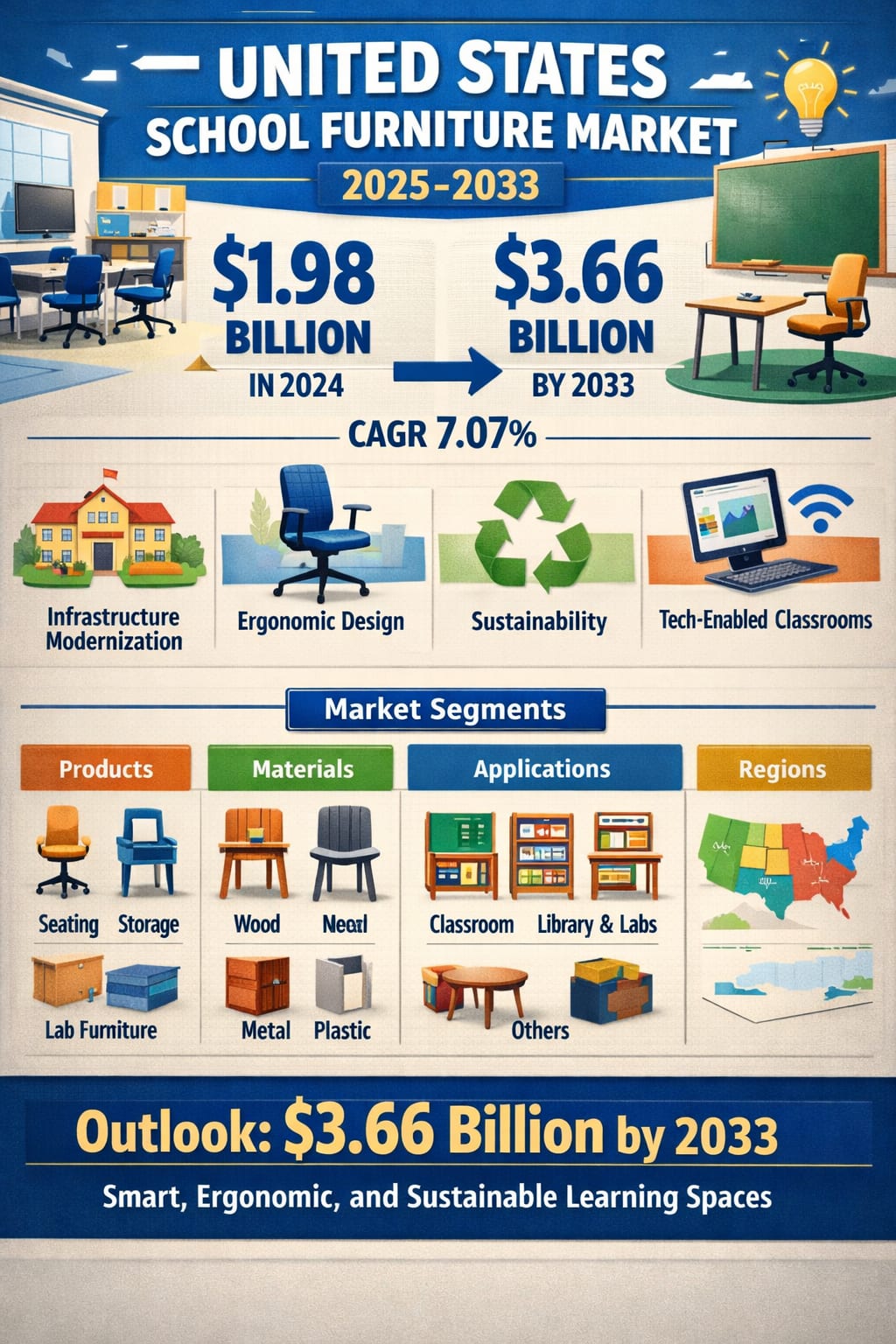
According to Renub Research estimates, the U.S. School Furniture Market was valued at US$ 1.98 billion in 2024 and is projected to reach US$ 3.66 billion by 2033, growing at a CAGR of 7.07% from 2025 to 2033. This steady growth reflects a deeper shift in how schools view learning environments—not as static rooms, but as flexible, student-centered ecosystems designed to support modern education.
From smart classrooms and collaborative learning spaces to eco-friendly materials and ergonomic designs, school furniture is becoming a strategic investment rather than a routine purchase.
Market Snapshot: Strong Growth Driven by Modernization
The numbers tell a clear story. With a market size of US$ 1.98 billion in 2024 and a forecast of US$ 3.66 billion by 2033, the U.S. school furniture sector is on a strong upward trajectory. A 7.07% CAGR over the forecast period highlights consistent demand fueled by multiple long-term trends:
Ongoing school infrastructure modernization
Rising emphasis on ergonomics and student well-being
Growing adoption of technology-enabled classrooms
Increasing preference for sustainable and durable materials
Expansion of flexible and collaborative learning models
Unlike many traditional furniture markets, school furniture benefits from relatively stable demand cycles. Every year, new students enter the system, facilities age, teaching methods evolve, and safety or comfort standards are updated. All of this ensures a continuous need for replacement, upgrades, and new installations across public and private institutions.
Understanding School Furniture: More Than Just Desks and Chairs
School furniture includes a wide range of products—chairs, desks, tables, storage racks, lab furniture, teacher workstations, and specialized learning fixtures—all designed to support learning, comfort, and organization.
In the United States, this furniture has evolved far beyond the rigid, one-size-fits-all wooden desks of the past. Today’s classrooms increasingly feature:
Adjustable and ergonomic seating
Mobile and modular desks for group activities
Technology-friendly workstations with cable management and device support
Collaborative layouts that encourage discussion and teamwork
Durable, easy-to-maintain materials suitable for high-traffic environments
Research and practical experience both show that well-designed furniture improves posture, reduces fatigue, and enhances student focus. Comfortable students are more attentive, more engaged, and less distracted by physical discomfort. In this sense, furniture is no longer just a background element—it is an active contributor to learning outcomes.
Key Growth Drivers Shaping the Market
1. Rising Investment in Educational Infrastructure
One of the strongest growth engines for the U.S. school furniture market is increased spending on school infrastructure modernization. Across the country, both government bodies and private institutions are upgrading classrooms to meet contemporary learning standards.
A notable example is the Supporting America’s School Infrastructure (SASI) program, under which the U.S. Department of Education awarded nearly $37 million in new funds over five years to multiple state governments in late 2023. Programs like this signal a long-term commitment to improving learning environments, which naturally boosts demand for new furniture solutions.
As schools integrate smart boards, digital devices, and collaborative learning setups, they need furniture that supports technology use, flexible layouts, and frequent reconfiguration of classroom spaces.
2. Growing Focus on Ergonomics and Student Comfort
Students spend a significant portion of their day sitting in classrooms—often six to seven hours daily, according to occupational health research. Poorly designed furniture can lead to discomfort, poor posture, and long-term health issues, all of which negatively affect learning performance.
This awareness is pushing schools to invest in:
Ergonomic chairs with proper back support
Height-adjustable desks for different age groups
Sit-stand workstations to encourage movement
Multi-purpose seating that supports various teaching styles
Some state governments are also moving toward stricter ergonomic standards for public school furniture, further accelerating adoption. The result is a market shift away from purely cost-driven purchases toward health-focused, performance-oriented furniture solutions.
3. Sustainability and Green Initiatives
Sustainability is no longer a niche concern—it is becoming a core procurement criterion for many U.S. school districts. Institutions increasingly prefer furniture made from:
Recycled or recyclable materials
Sustainably sourced wood
Low-emission coatings and adhesives
Durable components that extend product life cycles
Manufacturers are responding with eco-friendly designs, biodegradable plastics, and energy-efficient production processes. This not only aligns with environmental goals but also helps schools meet internal sustainability targets and public expectations.
The push for greener campuses is turning school furniture into a visible symbol of an institution’s commitment to responsible, future-oriented education.
Market Challenges: Cost and Supply Chain Pressures
High Costs of Quality and Customization
While advanced, ergonomic, and technology-integrated furniture offers clear benefits, it also comes with higher upfront costs. Budget constraints—especially in public and rural schools—can limit the adoption of premium or customized solutions.
Modular designs, adjustable systems, and tailored classroom layouts often require significant investment, making affordability a key challenge for widespread implementation.
Supply Chain Disruptions and Raw Material Shortages
Like many manufacturing sectors, the school furniture industry has faced supply chain disruptions and volatile raw material prices. Wood, metal, and plastic costs have fluctuated, while shipping delays and labor shortages have affected production timelines.
These issues have led to longer delivery cycles and higher costs, creating uncertainty for both suppliers and educational institutions planning large-scale upgrades.
Segment Insights: Where the Demand Is Coming From
Seating Furniture: The Largest and Most Dynamic Segment
Seating furniture—including chairs, stools, and benches—plays a central role in classroom comfort and posture support. Schools are increasingly choosing:
Ergonomic, adjustable chairs
Modular seating for group work
Mobile seating solutions for flexible layouts
Accessibility-focused designs for inclusive classrooms
The rise of active and collaborative learning models is also driving interest in standing desks and movement-friendly seating, making this segment one of the most innovation-driven areas of the market.
Storage Furniture: Smart, Mobile, and Space-Saving
Storage solutions such as lockers, cabinets, shelves, and mobile storage units are essential for organizing books, devices, and personal belongings. With growing student numbers and limited classroom space, schools are turning to:
Modular storage systems
Mobile units for flexible use
Smart storage with digital locks
Space-efficient designs that maximize room utility
Efficient storage is no longer just about organization—it is about optimizing learning space in increasingly crowded schools.
Material Trends: Wood and Metal Still Dominate
Wood Furniture:
Wood remains popular due to its durability, visual appeal, and sustainability. Modern schools often use plywood and MDF to balance cost, strength, and environmental considerations. Wooden desks, chairs, and cabinets continue to be a staple in both traditional and modern classrooms.
Metal Furniture:
Metal is valued for its strength, longevity, and resistance to wear and corrosion. It is widely used in lab furniture, lockers, and heavy-duty workstations. Powder-coated finishes have become standard, offering low maintenance and extended life spans.
Hybrid designs combining metal with wood or plastic are also gaining popularity, delivering both durability and modern aesthetics.
Application: Classrooms Lead the Way
The classroom segment remains the largest application area, covering desks, chairs, whiteboards, and interactive learning stations. The shift toward smart classrooms is boosting demand for technology-friendly, multi-functional furniture that supports various teaching styles—from individual study to collaborative projects.
Libraries, labs, and other learning spaces also contribute to steady demand, particularly for specialized and durable furniture solutions.
Distribution Channels: Offline Still Dominates
Despite the rise of e-commerce, offline channels continue to dominate school furniture sales. Schools prefer to:
Physically inspect product quality
Test comfort and durability
Negotiate bulk orders with manufacturers or distributors
Request customized solutions through regional suppliers
That said, online channels are gradually gaining traction, especially for standardized products and repeat purchases.
Regional Outlook: Growth Across All U.S. Zones
East United States
The Eastern region, home to major urban centers like New York, Boston, and Washington, D.C., shows strong demand for high-quality, ergonomically designed furniture. Investments in modern, technology-driven classrooms are particularly high, supporting steady market expansion.
North United States
In colder regions, durability and material resilience are key priorities. Schools focus on long-lasting metal and composite wood furniture that can withstand harsh conditions. Major renovation projects in cities like Chicago, Minneapolis, and Detroit are further driving demand for robust, high-quality furnishings.
Competitive Landscape: Key Companies in Focus
The U.S. school furniture market features several well-established players, each competing on design innovation, durability, customization, and service quality. Key companies include:
Smith System (Steelcase Inc.)
MillerKnoll, Inc.
The HON Company
Virco
Fleetwood Group
VS America, Inc.
Hertz Furniture
Paragon Furniture
Haskell Education
Marco Group
These companies are evaluated across four main dimensions: Overview, Key Persons, Recent Developments, and Revenue, reflecting a competitive market focused on innovation and long-term institutional partnerships.
Market Segmentation Overview
By Product:
Seating Furniture
Storage Units
Lab Furniture
Others
By Material:
Wood
Metal
Plastic
Others
By Application:
Classroom
Library and Labs
Others
By Distribution Channel:
Offline
Online
By Region:
East
West
North
South
Final Thoughts: Furniture as a Strategic Investment in Education
The United States School Furniture Market is entering a new phase—one where furniture is no longer just a functional necessity, but a strategic tool for improving learning outcomes. With the market expected to grow from US$ 1.98 billion in 2024 to US$ 3.66 billion by 2033 at a CAGR of 7.07%, the future looks solid and innovation-driven.
Ergonomics, sustainability, and technology integration are redefining what classrooms look like and how students interact with their environment. While challenges such as cost pressures and supply chain disruptions remain, the long-term fundamentals are strong.
As schools continue to modernize and rethink learning spaces, smart, flexible, and student-centered furniture will play a central role in shaping the next generation of education in the United States. In many ways, the desk and chair of tomorrow may be just as important as the textbook or tablet in a student’s hands.
About the Creator
Philippines Medical Tourism Market 2026: Healthcare Services, International Patients & Hospital Investment
Philippines Medical Tourism Market Overview The Philippines medical tourism market is steadily gaining global attention as international patients seek high-quality healthcare services at competitive costs. Medical tourism involves traveling across borders to receive medical, dental or cosmetic treatments, often combined with leisure travel. The Philippines has emerged as an attractive destination due to its English-speaking healthcare workforce, internationally trained medical professionals, modern private hospitals and warm hospitality culture.
By Manisha Dixit6 days ago in Trader
Build Your Fields Before Your Barns
“First plant your fields; then build your barn” (Proverbs 24:27, MSG). This is one of my favorite scriptures from the Great Book. It is simple, direct, and incredibly practical. It speaks to order, patience, and wisdom, especially when it comes to how we manage our finances. It reminds us that there is a sequence to building a stable life, and that skipping steps often comes with consequences.
By Destiny S. Harris3 days ago in Trader




Comments
There are no comments for this story
Be the first to respond and start the conversation.