
GCC Augmented Reality Market Size and Forecast 2025–2033
Immersive Tech Reshapes Healthcare, Education, Retail, and Smart Cities Across the Gulf

GCC Augmented Reality Market Overview
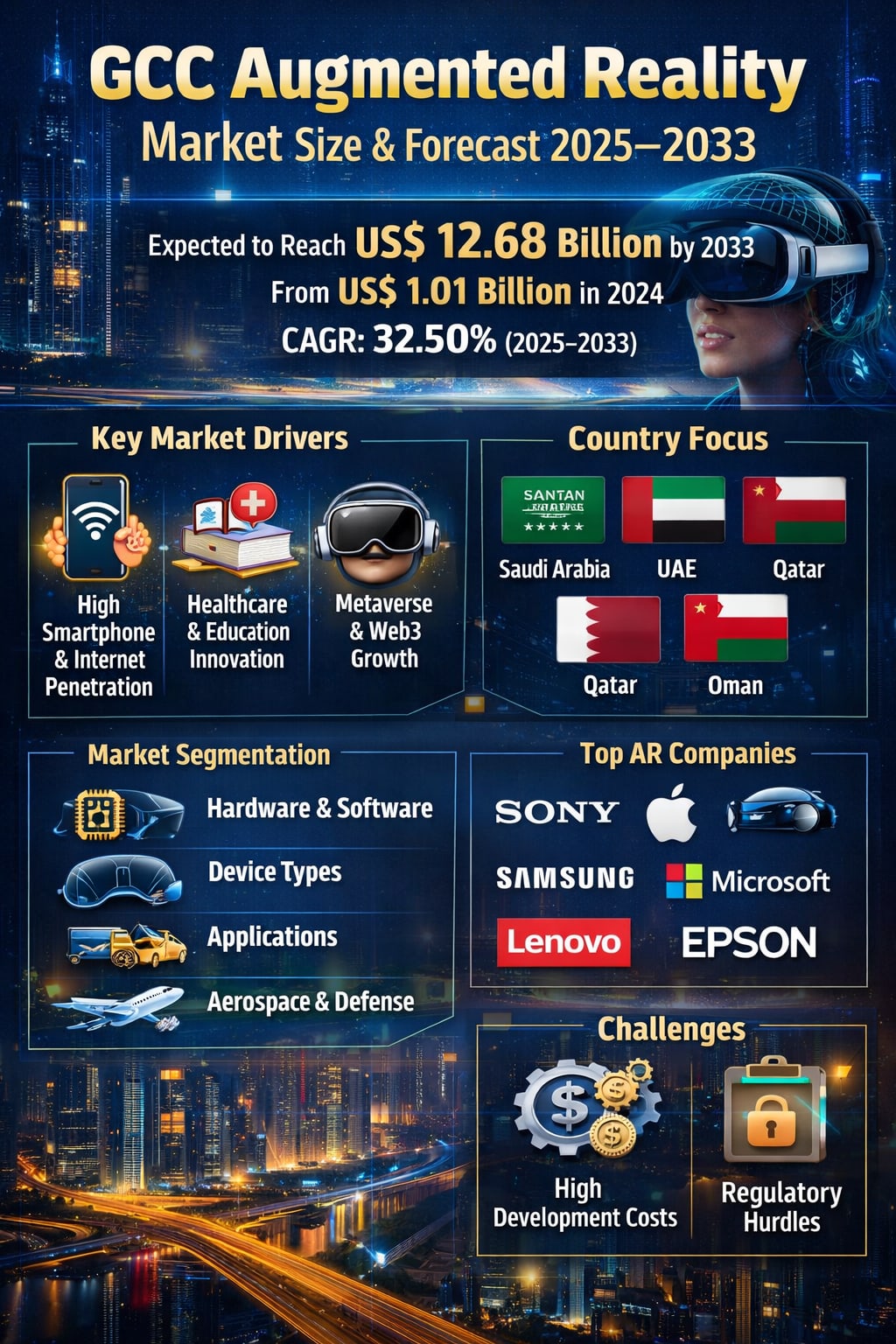
The GCC Augmented Reality Market is entering a high-growth phase, driven by rapid digital transformation, rising smartphone adoption, strong government backing for smart technologies, and increasing demand for immersive digital experiences across industries. According to Renub Research, the GCC Augmented Reality Market is expected to reach US$ 12.68 billion by 2033, up from US$ 1.01 billion in 2024, growing at an impressive CAGR of 32.50% from 2025 to 2033.
This extraordinary growth reflects how augmented reality (AR) is shifting from being a niche innovation to a core digital tool for businesses, governments, and consumers across the Gulf Cooperation Council (GCC) region, including Saudi Arabia, the UAE, Qatar, Kuwait, Oman, and Bahrain.
Augmented reality overlays digital content—such as images, data, or sounds—onto the real world in real time through smartphones, tablets, smart glasses, or headsets. Unlike virtual reality (VR), which creates a fully simulated environment, AR enhances the physical world, allowing users to interact with both digital and real elements simultaneously. This blended experience is proving valuable in sectors ranging from manufacturing and healthcare to education, retail, gaming, and real estate.
Across the GCC, AR adoption is being fueled by high internet penetration, young tech-savvy populations, ambitious national digital strategies, and heavy investments in smart infrastructure. Governments and enterprises alike are embracing immersive technologies to improve efficiency, customer engagement, training quality, and service delivery.
Key Growth Drivers of the GCC Augmented Reality Market
High Smartphone and Internet Penetration
One of the strongest pillars supporting AR growth in the GCC is the region’s exceptionally high smartphone usage and internet connectivity. Countries such as Saudi Arabia and the UAE consistently rank among the world’s leaders in mobile penetration and digital adoption.
The rollout of 5G networks is further accelerating this trend. Faster speeds, lower latency, and higher data capacity make it possible to deliver real-time, high-quality AR experiences without lag—something that was difficult with earlier network technologies. As 5G coverage expands across the region, AR applications in gaming, retail, navigation, education, and industrial operations are becoming smoother, more reliable, and more appealing to both consumers and enterprises.
For businesses, this means AR can now be deployed at scale—whether for virtual product try-ons, remote maintenance support, interactive marketing campaigns, or immersive training programs.
Healthcare and Education Innovation
Healthcare and education are emerging as two of the most promising application areas for AR in the GCC.
In healthcare, AR is transforming:
Medical training, through 3D anatomical visualizations and simulation-based learning
Surgical procedures, by providing real-time guidance and overlays
Patient education, by helping patients better understand diagnoses and treatments
Hospitals and medical institutions in Saudi Arabia and the UAE are increasingly exploring AR tools to improve precision, reduce errors, and enhance learning outcomes for medical professionals.
In education, AR is reshaping classrooms by turning static content into interactive, immersive learning experiences. Complex subjects such as science, engineering, and medicine become easier to understand when students can visualize concepts in 3D and interact with digital models in real time.
With GCC governments heavily investing in EdTech and digital healthcare transformation, AR is well-positioned to become a standard tool in both sectors over the coming decade.
Metaverse and Web3 Momentum
The GCC’s growing interest in the metaverse and Web3 technologies is another major catalyst for AR adoption. Initiatives such as Saudi Vision 2030 and the Dubai Metaverse Strategy highlight the region’s ambition to become a global hub for digital innovation and immersive technologies.
In the metaverse ecosystem, AR plays a critical role by:
Bridging the physical and digital worlds
Enabling context-aware digital overlays in real environments
Supporting immersive commerce, tourism, education, and social interaction
As governments and private investors pour resources into building virtual worlds, smart cities, and digital economies, AR is becoming a foundational technology that supports these experiences in everyday life—from shopping and entertainment to work and learning.
Challenges Facing the GCC AR Market
High Development Costs
Despite strong growth prospects, high development and implementation costs remain a key barrier. Building high-quality AR applications requires:
Advanced software tools
Skilled developers and designers
Sometimes specialized hardware such as AR headsets or smart glasses
For small and mid-sized businesses, these costs can be prohibitive. In addition, maintaining and updating AR content—especially 3D models and real-time features—adds ongoing expenses that may slow adoption in cost-sensitive sectors.
Regulatory and Compliance Uncertainty
Another challenge is the evolving regulatory environment. As AR technology advances rapidly, governments are still working to define rules around:
Data privacy
Digital content ownership
User safety and ethical use
Cross-border digital services
Inconsistent or unclear regulations across different GCC countries can create uncertainty for developers and investors, potentially delaying large-scale deployments and regional expansion strategies.
Country-Wise Market Outlook
Saudi Arabia Augmented Reality Market
Saudi Arabia is emerging as one of the largest and most dynamic AR markets in the GCC, supported by the ambitious digital transformation goals of Saudi Vision 2030. The government’s focus on smart cities, tourism development, healthcare modernization, and education reform is creating strong demand for immersive technologies.
AR is gaining traction in:
Healthcare, for medical training and surgical simulations
Education, through interactive and immersive learning tools
Retail, with virtual try-ons and enhanced product visualization
Tourism, via virtual tours of historical and cultural sites
With strong government backing and growing private-sector investment, Saudi Arabia is well on its way to becoming a regional leader in AR innovation and deployment.
UAE Augmented Reality Market
The UAE’s AR market is expanding rapidly, driven by smart city initiatives, digital government services, and technology-focused economic strategies. Dubai and Abu Dhabi, in particular, are positioning themselves as global centers for innovation, attracting startups and multinational tech firms alike.
AR adoption is increasing across:
Retail and e-commerce, for immersive shopping experiences
Tourism and hospitality, for interactive visitor engagement
Education and healthcare, for training and visualization
Infrastructure and urban planning, for design and simulation
While challenges remain in terms of infrastructure scaling and user adoption, the UAE’s proactive policy environment and investment climate make it one of the most promising AR markets in the region.
Oman Augmented Reality Market
Oman’s AR market is at an earlier stage but shows strong growth potential. The government’s push for digitalization and innovation is encouraging the adoption of AR across sectors such as:
Consumer applications
Healthcare
Manufacturing
Energy
Education
Gaming and entertainment
Key growth drivers include the increasing use of AR-enabled mobile applications, rising interest from enterprises, and supportive government policies. Although challenges such as development costs and hardware limitations exist, steady progress in digital infrastructure is expected to support long-term market expansion.
Market Segmentation: GCC Augmented Reality Market
By Component
Hardware
Software
By Device Type
Head-mounted Displays
Head-up Displays
Others
By Application
Automotive
Healthcare
Education
E-commerce & Retail
Entertainment & Gaming
Industrial & Manufacturing
Aerospace & Defense
Others
By Country
Saudi Arabia
UAE
Kuwait
Qatar
Oman
Bahrain
Competitive Landscape: Leading AR Companies in the GCC
The GCC augmented reality market features a mix of global technology giants and specialized solution providers. Key players include:
Seiko Epson Corporation
Sony Corporation
Lenovo Group Limited
Samsung Electronics Co.
Alphabet Inc.
Apple Inc.
Microsoft Corporation
Sysmex
These companies are competing across multiple fronts—hardware innovation, software platforms, enterprise solutions, and consumer applications. Their strategies typically focus on:
Expanding AR device portfolios
Enhancing software ecosystems
Forming partnerships with governments and enterprises
Investing in R&D for next-generation immersive technologies
All major companies are analyzed across four dimensions: Overview, Key Persons, Recent Developments, and Financial Insights, reflecting a mature and increasingly competitive market environment.
Future Outlook: AR as a Core Digital Infrastructure
Looking ahead, augmented reality is set to become a core pillar of the GCC’s digital economy. As smart cities expand, healthcare and education modernize, and retail and entertainment become more immersive, AR will shift from being a “nice-to-have” technology to a must-have digital capability.
The combination of:
Strong government support
Young, tech-savvy populations
Expanding 5G infrastructure
Rising enterprise digitalization
Growing interest in the metaverse and Web3
…creates a powerful growth engine for the GCC AR market over the next decade.
Final Thoughts
The GCC Augmented Reality Market is on a remarkable growth trajectory, projected to surge from US$ 1.01 billion in 2024 to US$ 12.68 billion by 2033, at a CAGR of 32.50%. This expansion reflects not only technological progress but also a broader regional transformation toward digital-first economies, smart cities, and immersive user experiences.
While challenges such as high development costs and regulatory uncertainties remain, the overall outlook is overwhelmingly positive. With strong backing from governments, increasing enterprise adoption, and rapid advances in connectivity and computing power, augmented reality is poised to become a mainstream technology across the GCC—reshaping how people learn, work, shop, heal, and interact with the world around them.
About the Creator
Australia Superannuation Market 2026: Set to Nearly Double to USD 150 Billion by 2033 on Strong Policy & Demographic Tailwinds
Australia Superannuation Market Overview The Australia superannuation market is on track for significant expansion as the nation’s retirement savings system continues to attract capital, adapt to demographic shifts, and benefit from supportive policy frameworks. According to IMARC Group, the market reached USD 80.0 billion in 2024 and is projected to grow to USD 150.0 billion by 2033, exhibiting a compound annual growth rate (CAGR) of 7.22 % between 2025 and 2033.
By Amyra Singh4 days ago in Trader
If You Write A Book, Don’t Tell Anyone
There are days when I’m grateful Amazon doesn’t tell me specifically who has bought my book and who hasn’t. If they did, I would be heartbroken when I read the list and noticed all the important names in my life were not on my list of customers.
By Ellen Frances6 days ago in Writers


Comments
There are no comments for this story
Be the first to respond and start the conversation.