
North America Digital Marketing Software Market Size and Forecast 2025–2033
From Data to Decisions: How AI, Automation, and E-Commerce Are Powering the Next Marketing Revolution

Introduction: Marketing Enters Its Most Data-Driven Era
The way businesses reach, engage, and convert customers has changed more in the past decade than in the previous fifty years combined. In North America, digital channels now dominate how brands communicate, sell, and build relationships. From social media campaigns and email automation to search marketing and AI-powered customer insights, digital marketing software has become the backbone of modern business strategy.
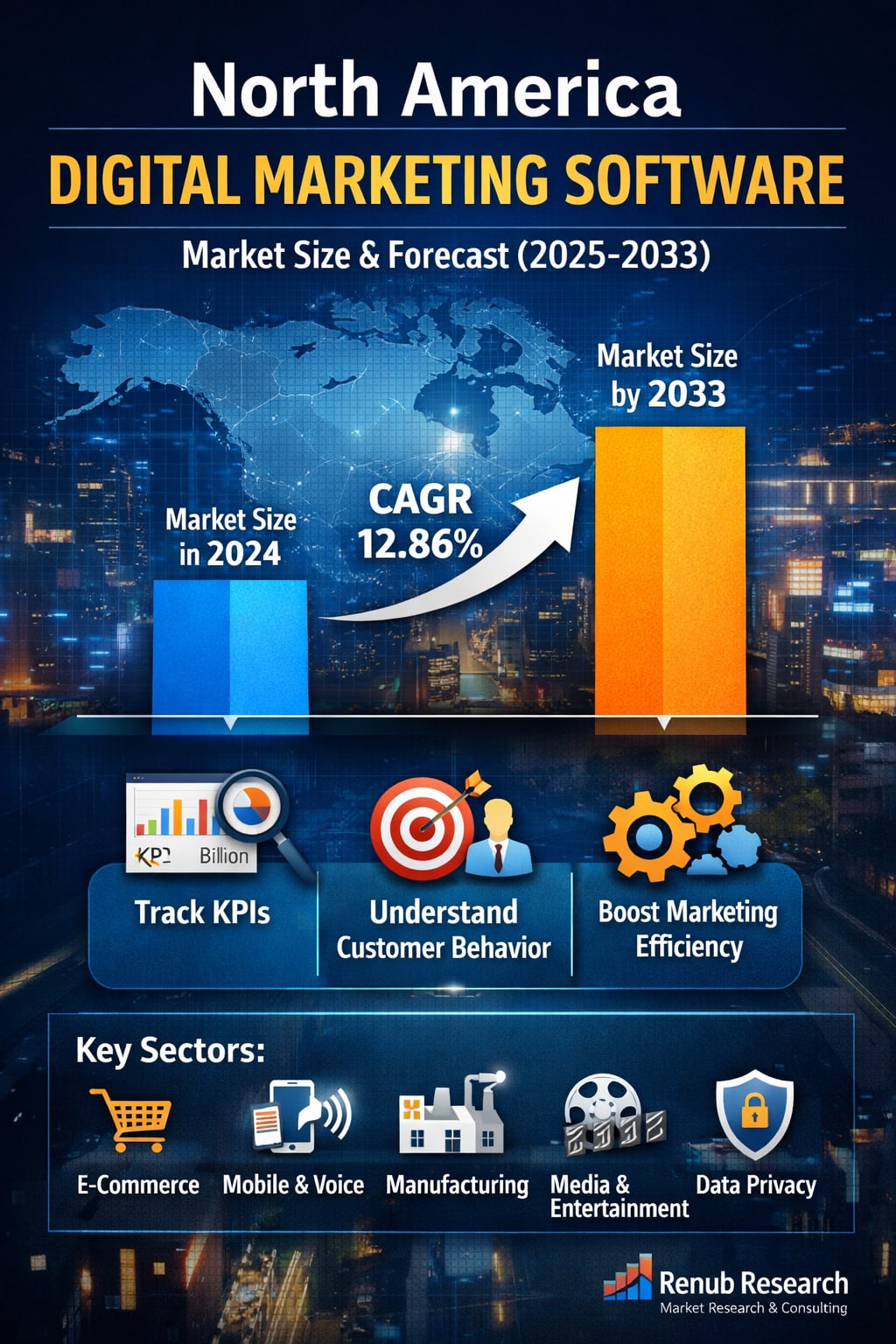
According to Renub Research, the North America Digital Marketing Software Market was valued at US$ 29.42 billion in 2024 and is projected to reach US$ 87.39 billion by 2033, growing at a CAGR of 12.86% from 2025 to 2033. This remarkable growth reflects a deeper shift: marketing is no longer driven by intuition alone—it is powered by data, automation, and intelligent platforms that help businesses understand customers in real time.
At the heart of this expansion is the rising need to track key performance indicators (KPIs), measure campaign effectiveness, and gain deeper insights into customer behavior. Companies across industries are realizing that without robust digital marketing software, staying competitive in a crowded, fast-moving digital economy is nearly impossible.
What Is Digital Marketing Software and Why It Matters
Digital marketing software refers to a wide range of tools designed to help organizations plan, execute, manage, analyze, and optimize their marketing activities across digital channels. These platforms cover everything from customer relationship management (CRM) and email marketing to social media management, search marketing, content management, marketing automation, and campaign analytics.
In North America’s highly competitive business environment, these tools are no longer optional. They allow companies to:
Centralize customer data and interactions
Personalize marketing messages at scale
Automate repetitive tasks and workflows
Measure ROI across multiple channels
Optimize campaigns in real time using data insights
As businesses increasingly compete for attention in digital spaces, the ability to deliver the right message to the right person at the right time has become a critical differentiator—and digital marketing software makes that possible.
A Market Fueled by Digital Transformation
The explosive growth of the North America digital marketing software market is closely tied to the region’s rapid digital transformation. Consumers are spending more time online than ever before, shifting away from traditional media toward digital platforms such as social media, search engines, e-commerce sites, and streaming services.
Globally, internet usage continues to rise at an impressive pace. In 2024, around 5.5 billion people were actively using the internet, representing approximately 68% of the world’s population. This massive digital audience has forced businesses to rethink how they communicate, advertise, and sell.
In North America, this shift is even more pronounced. Companies are investing heavily in software solutions that help them manage complex, multi-channel marketing strategies while keeping customer experience at the center. The focus on automation, data-driven decision-making, and personalization is accelerating adoption across enterprises of all sizes.
Country-Level Momentum: United States, Canada, and Mexico
United States: The Innovation Engine
The United States remains the largest and most dynamic market for digital marketing software in North America. Businesses across sectors—from retail and BFSI to healthcare and media—are increasingly relying on digital platforms to engage customers and drive growth.
The widespread adoption of cloud computing, e-commerce, and mobile technologies has made advanced marketing tools more accessible and scalable. U.S. companies are particularly focused on integrating analytics, automation, and AI into their marketing stacks to gain deeper insights into consumer behavior and improve campaign performance.
With intense competition in nearly every industry, organizations are using digital marketing software to sharpen targeting, improve personalization, and maximize return on investment—making the U.S. a key growth engine for the regional market.
Canada: A Growing Hub for Digital Media and Content
Canada’s digital marketing software market is expanding steadily, driven by the country’s strong media, entertainment, and content creation sectors. The demand for tools that manage campaigns, analyze performance, and personalize customer interactions is rising across industries.
Canada’s media industry, especially in online, television, and film production, plays a significant role in boosting demand for digital marketing platforms. Television productions alone accounted for 59.2% of the media industry’s US$ 11.3 billion in operational revenue in 2021, marking a 20.2% increase over the previous year. This growth highlights the increasing importance of digital channels for content distribution and audience engagement.
As more Canadian businesses adopt data-driven marketing strategies, the need for integrated solutions covering content management, social media analytics, email marketing, and CRM continues to grow.
Mexico: Digital Transformation Gains Speed
Mexico is emerging as a high-potential market for digital marketing software, supported by rising internet penetration, increased smartphone usage, and a strong push toward digital transformation across industries.
The country’s manufacturing sector—particularly in electronics and automotive—plays a major role in driving demand for advanced marketing solutions. In Q1 2024, manufacturing contributed MXN 6.26 trillion to the national GDP, underlining its economic significance. As manufacturers and other businesses seek to expand their digital presence and reach new customers, the adoption of marketing automation, analytics, and content platforms is accelerating.
E-commerce growth, social media adoption, and mobile-first consumers are further strengthening the case for digital marketing software in Mexico, making it an increasingly important contributor to regional market growth.
Key Growth Drivers Shaping the Market
1. Rapid Growth of E-Commerce
E-commerce has become one of the most powerful forces driving demand for digital marketing software in North America. As more consumers shop online, businesses face greater competition and higher expectations for personalized, seamless experiences.
Digital marketing software helps companies:
Segment customers more effectively
Deliver personalized product recommendations
Automate email and retargeting campaigns
Track customer journeys across multiple touchpoints
Optimize conversion rates using real-time data
Modern e-commerce platforms are also increasingly integrated with social media, search engines, and email marketing tools, creating a connected ecosystem where digital marketing software plays a central role in revenue generation and customer engagement.
2. Growing Adoption of Mobile and Voice Commerce
Mobile devices have become the primary gateway to the internet for millions of consumers. As mobile commerce (m-commerce) continues to grow, businesses are prioritizing mobile-optimized marketing strategies, including responsive websites, in-app marketing, and mobile-friendly advertising formats.
At the same time, voice-activated devices such as Amazon Alexa and Google Assistant are reshaping how consumers search for information and make purchasing decisions. This has created new opportunities—and challenges—for marketers, who now need to optimize content for voice search and conversational queries.
Digital marketing software that supports mobile-first and voice-enabled strategies is seeing increased demand, as companies look to stay visible and relevant across these emerging channels.
3. Advancements in AI and Automation Integration
Artificial intelligence (AI) and machine learning (ML) are transforming digital marketing from a reactive discipline into a predictive, highly personalized one. AI-powered tools can analyze massive volumes of data to uncover patterns, predict customer behavior, and recommend optimal actions in real time.
With AI and automation, marketers can:
Personalize content and offers at scale
Automate email campaigns, social media posting, and ad optimization
Improve customer service through chatbots and virtual assistants
Use predictive analytics to forecast trends and customer needs
These technologies not only improve efficiency but also free up human teams to focus on strategy, creativity, and long-term growth. As a result, AI-driven marketing platforms are becoming essential for companies that want to stay competitive in a data-driven economy.
Challenges Facing the Market
Data Privacy and Regulatory Compliance
Stricter data privacy regulations, including the California Consumer Privacy Act (CCPA) and the General Data Protection Regulation (GDPR), have created new challenges for digital marketers. These laws require greater transparency, stronger data protection measures, and explicit user consent for data collection and usage.
For businesses, this means:
Investing in secure data management systems
Ensuring compliance across all marketing platforms
Redesigning data collection and personalization strategies
Managing the risk of fines, penalties, and reputational damage
Digital marketing software providers must now embed robust privacy and compliance features into their platforms, making regulatory readiness a key differentiator in the market.
Fragmented Customer Data
Another major challenge is the fragmentation of customer data across multiple channels—websites, social media, mobile apps, email platforms, and offline touchpoints. When data is scattered across disconnected systems, it becomes difficult to build a unified view of the customer.
This fragmentation can lead to:
Inconsistent messaging
Poor personalization
Inaccurate performance measurement
Missed cross-selling and upselling opportunities
To overcome this, businesses are increasingly investing in integrated digital marketing platforms that unify data sources and provide a single, comprehensive view of customer interactions.
Market Segmentation Snapshot
By Solution:
CRM Software
Email Marketing
Social Media
Search Marketing
Content Management
Marketing Automation
Campaign Management
Others
By Service:
Professional Services
Managed Services
By Deployment Mode / Enterprise Size:
Cloud
On-Premise
Large Enterprises
Small & Medium-Sized Enterprises
By End Use:
Automotive
BFSI
Education
Government
Healthcare
Manufacturing
Media & Entertainment
Others
By Country:
United States
Canada
Mexico
Rest of North America
Competitive Landscape: Innovation at the Core
The North America digital marketing software market is highly competitive and innovation-driven. Leading players are continuously enhancing their platforms with AI, automation, analytics, and cloud-based capabilities to meet evolving customer needs.
Key companies covered in the market include:
Adobe, Inc.
Teradata Corp
Hewlett Packard Enterprise Company
Microsoft Corporation
HubSpot, Inc.
Oracle Corporation
Salesforce, Inc.
IBM Corporation
These companies compete on product depth, integration capabilities, scalability, ease of use, and advanced analytics, while also expanding their ecosystems through partnerships and acquisitions.
Final Thoughts: A Market Built for the Digital-First Future
The North America Digital Marketing Software Market is entering a powerful growth phase, driven by the unstoppable rise of e-commerce, mobile and voice commerce, and AI-powered marketing strategies. With the market expected to grow from US$ 29.42 billion in 2024 to US$ 87.39 billion by 2033, the role of digital marketing software in shaping business success will only become more critical.
In a world where customers expect personalized, seamless, and meaningful interactions, companies that invest in the right marketing technologies will be best positioned to win loyalty, drive growth, and stay ahead of the competition. The future of marketing in North America is digital, data-driven, and deeply intelligent—and the software powering it is set to become one of the most important pillars of modern business strategy.
About the Creator
Legrand SA: Global Electrical Solutions and Investment Insights
Legrand SA is a leading global provider of electrical and digital building infrastructure solutions. Headquartered in France, the company has established itself as a prominent player in the electrical industry, offering a wide range of products including switches, sockets, cable management systems, lighting solutions, and smart building technologies. With operations in over 90 countries, Legrand SA combines innovation, quality, and sustainability to meet the evolving needs of residential, commercial, and industrial clients worldwide.
By Hammad Nawaz4 days ago in Trader
Idea Share Price: Trends, Market Drivers, and Investment Outlook
The Indian stock market continues to attract investor attention with opportunities in both traditional and digital assets. One stock in focus is Idea Cellular, a prominent player in India’s telecom sector. Recent trends in Idea share price indicate active market interest, driven by the company’s operational performance, strategic initiatives, and sector dynamics.
By Hammad Nawaz5 days ago in Trader
If You Write A Book, Don’t Tell Anyone
There are days when I’m grateful Amazon doesn’t tell me specifically who has bought my book and who hasn’t. If they did, I would be heartbroken when I read the list and noticed all the important names in my life were not on my list of customers.
By Ellen Frances7 days ago in Writers




Comments
There are no comments for this story
Be the first to respond and start the conversation.