
Asia Halal Food Market Size & Forecast 2025–2033: A Trillion-Dollar Opportunity Shaped by Faith, Trust, and Global Trade
Asia’s halal food industry is entering a golden decade, driven by a rising Muslim population, expanding e-commerce, and growing trust in halal-certified quality across both Muslim and non-Muslim consumers.

Asia Halal Food Market at a Glance
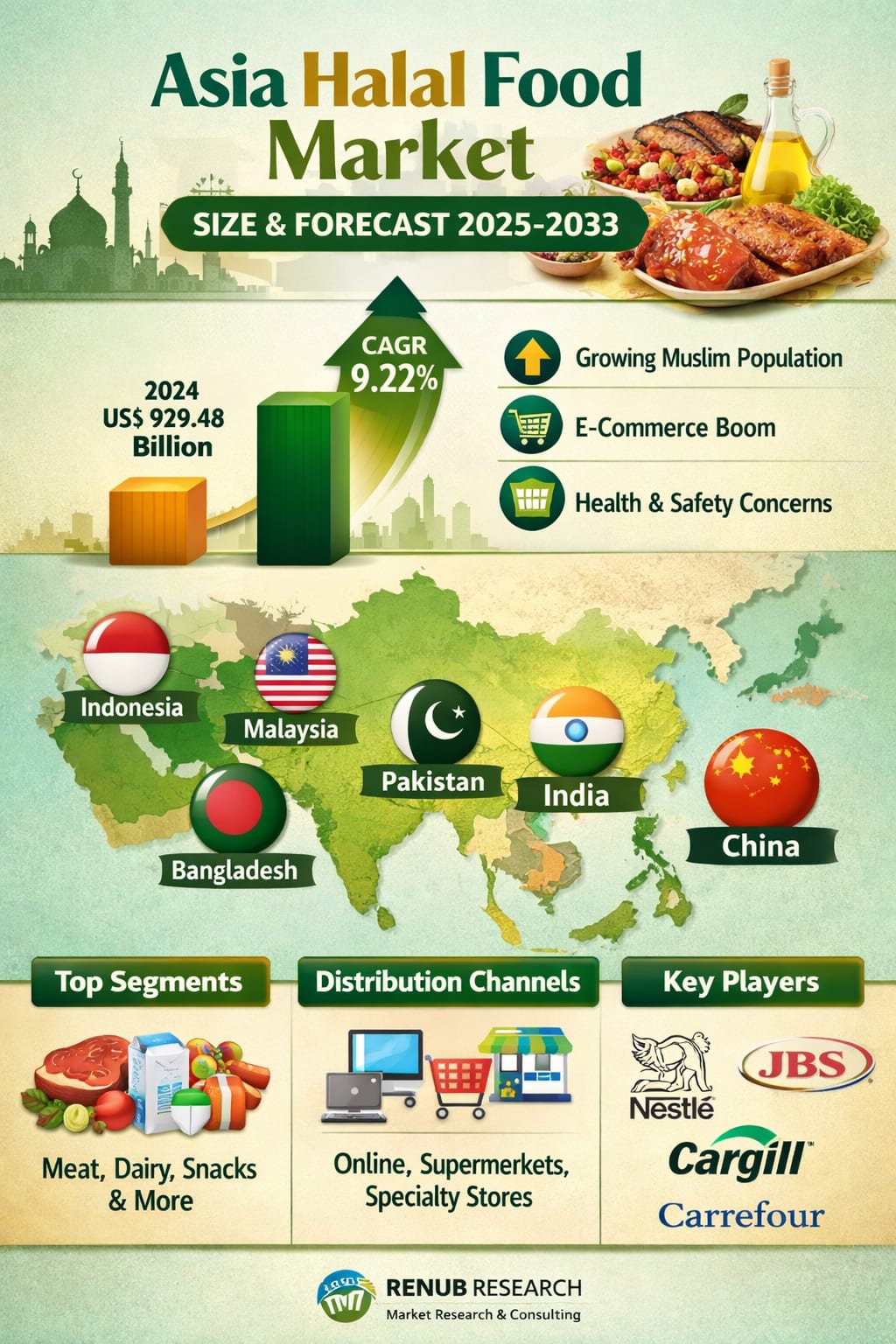
The Asia Halal Food Market is on a powerful growth trajectory, reflecting not only demographic strength but also deep changes in consumer behavior, retail formats, and global food supply chains. According to Renub Research, the Asia Halal Food Market is expected to reach US$ 2,056.06 billion by 2033, rising from US$ 929.48 billion in 2024, at a robust CAGR of 9.22% from 2025 to 2033.
This remarkable expansion is being fueled by a combination of factors: rising public awareness, rapid globalization, stricter food standards, the growth of e-commerce platforms, and increasing concerns around health, safety, and food authenticity. What was once a niche religious requirement has now become a mainstream marker of quality, hygiene, and ethical production across large parts of Asia.
The report Asia Halal Food Market & Forecast covers the market by Product (Meat, Poultry & Seafood; Fruits & Vegetables; Dairy Products; Cereals & Grains; Oil, Fats & Waxes; Confectionery; Others), Distribution Channel (Hypermarkets & Supermarkets, Online Stores, Convenience Stores, Specialty Stores, Others), and Countries (Pakistan, Indonesia, India, Bangladesh, China, Malaysia, Kazakhstan), along with detailed company analysis from 2025 to 2033.
Asia Halal Food Industry Overview
Asia’s halal food market is one of the largest and most dynamic in the world, supported by the region’s massive Muslim population and strong cultural ties to halal dietary practices. Countries such as Indonesia, Pakistan, Bangladesh, India, and Malaysia are not only major consumers but also important producers in the global halal ecosystem.
Demand spans across meat, poultry, snacks, beverages, dairy, and processed foods that carry halal certification. While religious obligation remains the core driver among Muslim consumers, a growing number of non-Muslim customers are also choosing halal products because they associate them with cleanliness, safety, quality control, and ethical sourcing.
Governments across Asia have played a key role in supporting this industry. Many countries have established national halal standards and certification bodies to build consumer trust and to position themselves as credible players in international halal trade. Malaysia and Indonesia, in particular, have emerged as global halal hubs by investing in certification infrastructure, modern processing facilities, and halal-compliant logistics networks.
Another major shift is the rapid expansion of digital retail and e-commerce platforms, which has made halal products more accessible, especially to urban and younger consumers. Online grocery platforms, quick-commerce apps, and direct-to-consumer brands are widening the reach of halal food beyond traditional specialty stores. At the same time, innovation in product categories—such as ready-to-eat meals, functional foods, and even halal-certified nutraceuticals—is helping the market diversify and mature.
Despite this strong momentum, the industry still faces challenges. Differences in certification standards across countries can complicate cross-border trade and confuse consumers. Concerns about supply chain transparency and the authenticity of halal claims also persist, particularly in less regulated or informal markets. Addressing these issues through harmonized standards, better traceability technologies, and stronger consumer education will be crucial for sustaining long-term growth.
A Demographic Engine: The Growing Muslim Population
One of the most powerful forces behind the expansion of the halal food market in Asia is simple and undeniable: demographics. Asia is home to the world’s largest Muslim population, and this population continues to grow steadily.
Indonesia alone has around 231 million Muslims, accounting for roughly 86.7% of its population and more than 13% of all Muslims globally, according to World Population Review 2024. Large Muslim communities in Pakistan, Bangladesh, India, and Malaysia further strengthen the region’s position as the global center of halal food consumption.
This demographic reality is reshaping retail shelves. Mainstream supermarkets are increasingly dedicating entire sections to halal-certified products, ranging from fresh meat and poultry to frozen meals, snacks, and packaged foods. Quick-service restaurants and fast-casual dining chains are also adding halal-certified options to attract a broader customer base.
What’s important is that this demand is not just growing in size—it is also becoming more sophisticated. Urban consumers, in particular, are looking for variety, convenience, and branded halal products that match global food trends while still meeting religious requirements.
Key Growth Drivers of the Asia Halal Food Market
1. Large and Expanding Muslim Consumer Base
The foundation of the halal food market in Asia is its massive Muslim population. For millions of consumers, halal is not a lifestyle choice but a religious obligation. This ensures stable, long-term demand for halal-certified food across fresh, processed, and packaged categories.
As populations grow and urbanize, the demand is shifting from traditional wet markets to modern retail formats, including supermarkets and online platforms. This transition is creating new opportunities for branded and value-added halal food products, encouraging both local and international companies to invest more heavily in this segment.
2. Regional and Global Trade Initiatives
Trade agreements and regional cooperation frameworks are playing a significant role in expanding the halal food industry. Organizations like ASEAN and various free trade agreements are helping reduce trade barriers and simplify cross-border movement of halal-certified goods.
Countries such as Malaysia and Indonesia are actively positioning themselves as global halal hubs, promoting mutual recognition of halal standards and supporting exporters with certification and logistics infrastructure. These efforts reduce duplication, improve supply chain efficiency, and build trust among trading partners.
As a result, manufacturers are more willing to scale up production and explore new export markets, strengthening Asia’s role in the global halal food supply chain.
3. Rising Interest Among Non-Muslim Consumers
One of the most interesting trends in the Asian halal food market is its growing appeal among non-Muslim consumers. Halal certification is increasingly associated with strict hygiene standards, careful ingredient sourcing, and ethical treatment of animals.
For health-conscious and ethically minded consumers, halal has become a quality signal, not just a religious label. This is especially visible in urban centers, where shoppers pay closer attention to food labels and certifications.
This broader acceptance is pushing halal products into mainstream retail and hospitality channels, expanding the market far beyond its traditional base and encouraging innovation across product categories.
Challenges Facing the Asia Halal Food Market
1. High Certification and Compliance Costs
For small and medium-sized enterprises (SMEs), the cost of obtaining and maintaining halal certification can be a significant barrier. The process often involves detailed documentation, facility upgrades, staff training, and regular audits—all of which require time and money.
These costs discourage many smaller producers from entering the formal halal market, even if their products already comply with halal principles in practice. As a result, large corporations tend to dominate the certified halal space, while smaller players remain underrepresented.
Reducing these barriers through simplified processes, subsidies, or technical support could help broaden participation and increase product diversity in the market.
2. Supply Chain Transparency Issues
As supply chains become more complex and international, ensuring halal compliance at every stage—from raw material sourcing to processing, packaging, and distribution—becomes more challenging.
The risk of cross-contamination or the use of uncertified ingredients can undermine consumer trust and damage brand reputations. In many parts of Asia, robust digital traceability systems are still lacking.
Investing in blockchain, digital tracking, and better audit systems could significantly improve transparency and help maintain confidence in halal-certified products across borders.
Country-Level Market Insights
India Halal Food Market
India’s halal food market is growing steadily, supported by its large Muslim population and rising awareness of halal-certified products. While religious observance remains a key driver, there is also increasing interest from health-conscious and ethically minded consumers.
Halal products in India range from meat and snacks to processed foods and even personal care items. Availability is improving in urban retail stores and online platforms. However, challenges remain, including the lack of a centralized certification system, limited awareness in rural areas, and occasional political sensitivities around halal standards.
Despite these hurdles, the long-term potential is strong, especially with better standardization, improved supply chains, and broader consumer education.
China Halal Food Market
China’s halal food industry is expanding due to domestic demand and growing export opportunities to Muslim-majority countries. Production is concentrated in regions such as Ningxia, Xinjiang, and Gansu, supported by local certification systems and government initiatives.
The Belt and Road Initiative has further boosted trade links with Muslim countries, opening new markets for Chinese halal products. However, the industry still faces challenges, including fragmented certification standards and lingering concerns over food safety.
With continued investment and improved regulatory alignment, China has the potential to become a more significant player in the global halal food market.
Pakistan Halal Food Market
Pakistan has immense potential in the halal food sector, given its large Muslim population and strong agricultural base. The country is a major producer of halal meat and dairy but still accounts for a relatively small share of global halal trade.
The establishment of the Pakistan Halal Authority (PHA) in 2016 was a step toward standardizing certification and promoting exports. However, operational challenges, limited processing infrastructure, and weak export channels have slowed progress.
With the right investments in modern facilities, certification systems, and trade partnerships, Pakistan could emerge as a major global halal food supplier, particularly to the Middle East and Central Asia.
Market Segmentation Snapshot
By Product:
Meat, Poultry & Seafood
Fruits & Vegetables
Dairy Products
Cereals & Grains
Oil, Fats & Waxes
Confectionery
Others
By Distribution Channel:
Hypermarkets & Supermarkets
Online Stores
Convenience Stores
Specialty Stores
Others
By Country:
Pakistan
Indonesia
India
Bangladesh
China
Malaysia
Kazakhstan
Competitive Landscape: Key Companies
The Asia halal food market features a mix of global giants and specialized halal-focused companies. Key players covered in the analysis include:
Nestlé SA
JBS SA
BRF SA
Kawan Food Berhad
Cargill Inc.
Carrefour SA
Crescent Foods Inc.
VegaVites
American Halal Company Inc.
American Foods Group LLC
Al Islami Foods
These companies are competing through product innovation, geographic expansion, stronger certification credentials, and partnerships with regional distributors and retailers.
Final Thoughts
The Asia Halal Food Market is no longer just a religious niche—it is a multi-trillion-dollar economic force in the making. With the market projected to grow from US$ 929.48 billion in 2024 to US$ 2,056.06 billion by 2033, the scale of opportunity is impossible to ignore.
Driven by demographics, rising quality consciousness, digital retail expansion, and stronger regional trade ties, halal food is becoming a central pillar of Asia’s food industry. At the same time, challenges around certification costs and supply chain transparency highlight the need for smarter regulation, better technology, and more inclusive industry practices.
For businesses, investors, and policymakers, the message is clear: the future of food in Asia will be shaped not only by taste and price, but also by trust, standards, and values—and halal food sits right at the center of that transformation.
About the Creator
Tech Stocks Slide as Microsoft, Meta Drop Over 2%; Nvidia Extends Losses
Technology stocks came under renewed selling pressure as major Wall Street giants including Microsoft and Meta Platforms declined more than 2%, while Nvidia extended its recent losses. The pullback weighed heavily on broader market sentiment, highlighting growing investor caution around high valuations, AI-driven optimism, and near-term earnings sustainability.
By Hammad Nawaz7 days ago in Trader
United States Luxury Handbag Market Size and Forecast 2025
United States Luxury Handbag Market Overview The United States luxury handbag market stood at US$ 10.77 billion in 2024 and is anticipated to grow to US$ 16.94 billion by 2033, expanding at a compound annual growth rate (CAGR) of 5.17% from 2025 to 2033. This steady rise reflects more than just a love for fashion—it highlights a deeper shift in how American consumers perceive luxury accessories: not only as style statements, but also as lifestyle markers and, in many cases, long-term investments.
By shibansh kumar7 days ago in Trader



Comments
There are no comments for this story
Be the first to respond and start the conversation.