
Europe Home Appliance Market Trends & Summary (2025–2033)
How Smart Tech, Sustainability, and Changing Lifestyles Are Reshaping Europe’s Home Appliance Industry

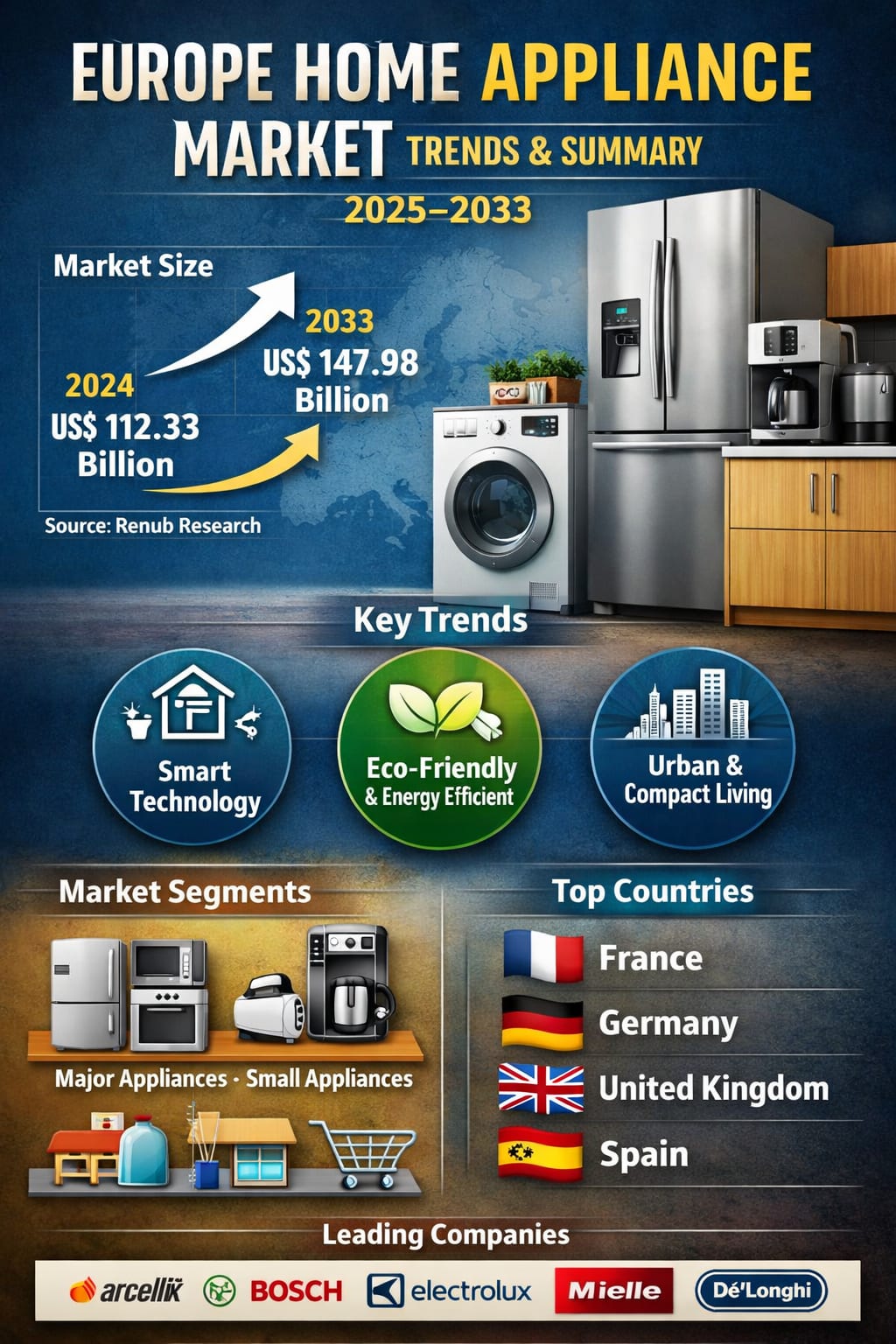
Europe Home Appliance Market: A Decade of Smart, Sustainable Growth
The Europe Home Appliance Market is entering a decisive decade of transformation, shaped by rapid technological innovation, evolving consumer lifestyles, and a strong regional push toward sustainability. According to Renub Research, the market is expected to grow from US$ 112.33 billion in 2024 to US$ 147.98 billion by 2033, registering a compound annual growth rate (CAGR) of 3.11% from 2025 to 2033.
While this growth rate may appear moderate compared to some fast-moving tech sectors, it reflects the maturity, resilience, and steady evolution of the European home appliance industry. Home appliances are no longer just functional tools—they are becoming smarter, more energy-efficient, more connected, and more aligned with modern lifestyles that prioritize convenience, design, and environmental responsibility.
Across Western Europe, in particular, consumers are increasingly gravitating toward premium and feature-rich appliances. This shift is driven by higher disposable incomes in certain regions, greater awareness of energy efficiency, and the growing appeal of smart home ecosystems. At the same time, Eastern and Southern European markets continue to offer growth opportunities through urbanization, housing development, and rising middle-class consumption.
Industry Overview: Where Technology Meets Everyday Living
The European home appliance industry is being reshaped by three powerful forces: sustainability, digitalization, and changing living patterns. Consumers today expect more than just durability and performance. They want appliances that reduce energy and water consumption, integrate seamlessly with smart home systems, and fit into smaller, more design-conscious living spaces.
Energy efficiency has become a central purchasing criterion. Stricter European Union regulations on energy labeling and environmental impact have accelerated innovation across both major and small appliances. Washing machines, dishwashers, refrigerators, and ovens are now designed not only to perform better but also to consume fewer resources over their lifetime.
At the same time, smart home technology is moving from a niche feature to a mainstream expectation. Wi-Fi-enabled washing machines, app-controlled refrigerators, and AI-powered vacuum cleaners are increasingly common in European households. These connected devices offer benefits such as remote monitoring, predictive maintenance, and personalized usage settings, making daily life more convenient and efficient.
Urbanization is also influencing product design. As more Europeans live in apartments and smaller homes, demand is rising for compact, multifunctional, and space-saving appliances. Manufacturers are responding with slimline dishwashers, combination washer-dryers, modular kitchen appliances, and multi-purpose small appliances that maximize utility without taking up extra space.
The growth of e-commerce has further transformed how consumers discover and purchase appliances. Online platforms now play a critical role in product comparison, reviews, and price transparency, while manufacturers increasingly invest in digital channels to reach wider audiences and offer more personalized shopping experiences.
Product Innovation and Design: Competing Beyond Price
For manufacturers operating in the European market, product innovation and portfolio expansion have become strategic priorities. Competition is intense, not only among established European brands but also from global players and low-cost imports. To stand out, companies are focusing on:
Smart features such as AI-driven programs, remote diagnostics, and app-based controls
Sustainable design using recyclable materials and energy-saving technologies
Aesthetics and customization, especially in premium kitchen and built-in appliances
Integration with home automation systems for a more connected living experience
Design is no longer an afterthought. Appliances are increasingly viewed as part of home décor, especially in open-plan kitchens and modern apartments. This has led to a rise in minimalist designs, customizable finishes, and appliances that blend seamlessly with contemporary interiors.
Distribution Landscape: The Rise of Omnichannel Retail
The way Europeans buy home appliances is changing rapidly. While traditional brick-and-mortar stores remain important—especially for high-value purchases—the market is clearly shifting toward omnichannel retail strategies.
Online channels are gaining share due to convenience, wider product selection, and competitive pricing.
Multi-brand stores continue to play a key role in offering comparison and hands-on experience.
Exclusive brand stores and showrooms are being used, particularly by premium brands, to create immersive product experiences.
Hybrid models now dominate, allowing customers to research online, compare in-store, and purchase through the channel that suits them best.
This seamless shopping journey is becoming a key differentiator, with both manufacturers and retailers investing heavily in digital tools, virtual showrooms, and enhanced customer service.
Key Growth Drivers in the Europe Home Appliance Market
1. Rising Demand for Smart and Eco-Friendly Appliances
European consumers are increasingly tech-savvy and environmentally conscious. This combination is driving strong demand for smart, energy-efficient, and connected appliances. Manufacturers are responding by integrating advanced technologies that optimize performance while reducing environmental impact.
A good example of this innovation-driven approach is Samsung’s launch of the Bespoke Infinite Line refrigerator in January 2023, offering customizable options for wine storage, freezing, and refrigeration. Such products reflect a broader trend toward personalization, premiumization, and smart functionality.
In addition, stricter hygiene standards in households, hotels, and restaurants are boosting demand for advanced dishwashers, washing machines, and cleaning appliances. The convenience of online shopping is further accelerating adoption, as consumers can easily compare features, prices, and energy ratings before making a purchase.
2. Lifestyle Changes and Urbanization
Europe’s steady urbanization is reshaping how people live—and how they use appliances. Smaller living spaces and busier lifestyles are increasing demand for compact, efficient, and multifunctional appliances. Consumers are looking for products that save time, reduce effort, and adapt to flexible schedules.
Features such as quick wash cycles, delayed start options, and customizable programs are no longer premium extras; they are becoming standard expectations. In response, manufacturers are designing appliances that align with modern routines, offering greater convenience without compromising performance.
3. Sustainability and Energy Efficiency at the Core
Sustainability is no longer just a marketing message in Europe—it is a regulatory and consumer-driven necessity. Strict EU rules on energy and water efficiency have transformed product development, particularly for major appliances like washing machines, dishwashers, and refrigerators.
Countries such as Germany, Italy, and Poland are at the forefront of innovation in sustainable appliance technology, supported by significant investments in research and development. The integration of smart energy management systems now allows consumers to monitor and optimize usage, reinforcing the appeal of appliances that combine environmental responsibility with long-term cost savings.
Challenges Facing the Europe Home Appliance Market
Competition from Low-Cost Imports
One of the biggest challenges for European manufacturers is the growing presence of low-cost imports. These products, often produced in regions with lower labor and production costs, attract price-sensitive consumers and put pressure on established brands.
While European brands are known for quality, durability, and energy efficiency, competing purely on price is difficult. As a result, many companies are focusing on premium positioning, innovation, and sustainability to differentiate themselves—strategies that may not appeal to every consumer segment but are essential for long-term brand value.
Rising Raw Material and Energy Costs
The industry is also under pressure from increasing costs of raw materials and energy. Metals, plastics, and electricity are critical inputs in appliance manufacturing, and price volatility directly affects profit margins.
Higher production costs often lead to higher retail prices, which can dampen demand in a price-sensitive market. At the same time, supply chain uncertainty makes planning and budgeting more complex, forcing manufacturers to balance affordability with profitability in an increasingly competitive environment.
Country-Level Market Insights
France
France’s home appliance market is driven by strong interest in sustainability, energy efficiency, and smart technology. Consumers favor compact, multifunctional appliances suited to urban living, with growing emphasis on durability, recyclability, and repairability. While economic factors such as inflation can influence purchasing decisions, companies are responding by enhancing product value through better design, technology integration, and digital retail strategies.
United Kingdom
The UK market is evolving around smart, connected, and eco-friendly appliances. AI and IoT integration are becoming more common, enabling automation and remote control features. Demand for small, multifunctional appliances is rising due to urban living trends, while government policies supporting energy efficiency continue to shape both supply and demand.
Germany
Germany remains one of Europe’s most important markets, driven by a strong focus on engineering quality, energy efficiency, and sustainability. Consumers show high interest in smart appliances that offer convenience and lower environmental impact. The adoption of AI and IoT is steadily improving user experience and reinforcing Germany’s reputation as a leader in premium and technologically advanced home appliances.
Spain
Spain’s market is undergoing a notable transition, with growing demand for smart and energy-efficient appliances. Urbanization and home modernization are increasing interest in compact, multifunctional products. Government initiatives promoting sustainability further support this trend, although economic pressures and regulatory requirements continue to shape market dynamics.
Recent Industry Developments
May 26, 2024: Haier, a global leader in home appliances, partnered with the Roland-Garros tennis tournament as an official partner, reinforcing its brand visibility among more than one billion tennis fans worldwide and highlighting its focus on premium experiences and innovation.
April 25, 2024: Electrolux Group announced that President & CEO Jonas Samuelson will step down on January 1, 2025, after more than eight years in the role, prompting the Board to begin the search for a successor—an important leadership transition for one of Europe’s key appliance players.
Market Segmentation Snapshot
By Product:
Major Appliances: Refrigerators, Freezers, Dishwashing Machines, Washing Machines, Cookers and Ovens, Other Major Appliances
Small Appliances: Vacuum Cleaners, Food Processors, Coffee Machines, Irons, Toasters, Grills and Roasters, Other Small Appliances
By Distribution Channel:
Exclusive Stores
Multi-brand Stores
Online
Other Distribution Channels
By Country:
France, Germany, Italy, Spain, United Kingdom, Belgium, Netherlands, Russia, Poland, Greece, Norway, Romania, Portugal, Rest of Europe
Key Companies Analyzed:
Arcelik AS, Robert Bosch GmbH, Electrolux AB, De’Longhi S.p.A, Liebherr Group, Miele, Koninklijke Philips, Gorenje Group
Final Thoughts: A Market Built for the Long Term
The Europe Home Appliance Market is not about explosive growth—it is about steady, sustainable, and innovation-driven expansion. With the market projected to rise from US$ 112.33 billion in 2024 to US$ 147.98 billion by 2033, the industry’s future will be shaped by smart technology, environmental responsibility, and evolving consumer lifestyles.
Manufacturers that successfully combine energy efficiency, digital connectivity, thoughtful design, and omnichannel retail strategies will be best positioned to win in this competitive landscape. For European consumers, this means a future filled with appliances that are not only more efficient and sustainable—but also smarter, more convenient, and better suited to modern living.
About the Creator
infosys share price today: should investors buy or wait?
The infosys share price is grabbing attention today. After recent ups and downs, investors are asking whether it is the right time to buy or hold. Understanding the reasons behind its movement is key for making informed decisions. This article examines the current infosys share price trend, expert opinions, key factors influencing the stock, and strategies for investors. By reading this, you can get a clear view of the market situation.
By John.doe798about 9 hours ago in Trader
Mexico Digital Twin Market Size, Opportunities & Investment Trends 2026–2034 | IMARC Analysis
Mexico Digital Twin Market Growth, Trends, Forecast, Key Players, and Opportunities Mexico Digital Twin Market Overview The Mexico Digital Twin Market is witnessing strong expansion as organizations across industries accelerate digital transformation initiatives. Digital twin technology, which enables the creation of virtual replicas of physical assets, systems, and processes, is increasingly being adopted to improve operational efficiency, predictive maintenance, and real-time decision-making.
By Kim Soo hyun4 days ago in Trader


Comments
There are no comments for this story
Be the first to respond and start the conversation.