
YouTube fumbles political influence, election coverage
Why YouTube might not want to remove a video they agree undermines election confidence despite their acknowledgement of the responsibility to take action.
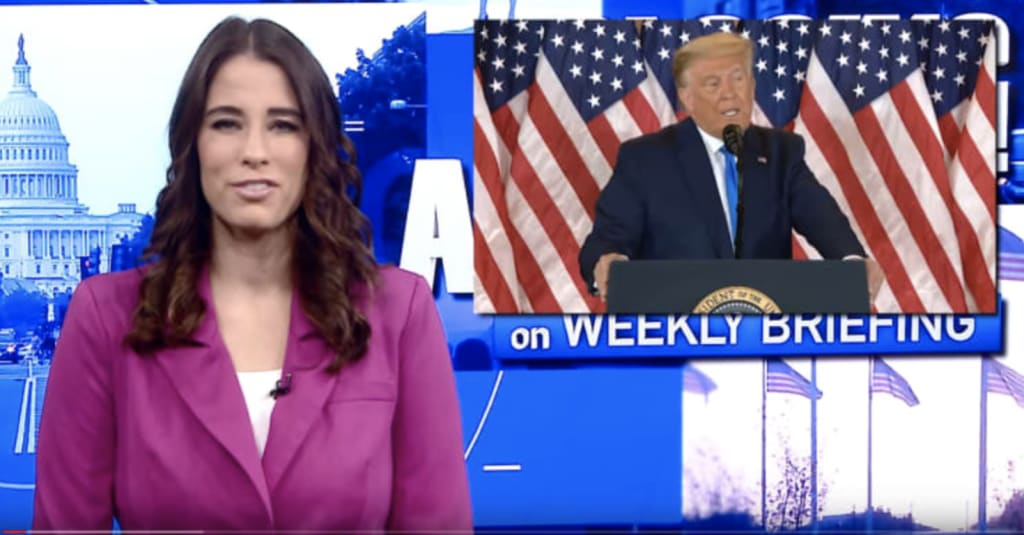
YouTube has declined to remove a video that it admits impinges on confidence in election results with its unsubstantiated assertion that Trump has won and that Democrats are committing voter fraud against Republican ballots.
One American News Network (OAN), a conservative media organization, posted a video Wednesday morning in which anchor Christina Bobb announces, “President Trump won four more years in the office last night.”
This was followed by claims of “rampant voter fraud” from the left without providing any evidence. It racked up over 348,000 views in its first 13 hours online. YouTube’s policies commit to removing any content that is fairly construed as “encouraging others to interfere with democratic processes, such as obstructing or interrupting voting procedures.”
YouTube demonetized and branded the video with a warning label: “We do not allow ads to run on content that undermines confidence in elections with demonstrably false information.”
On Thursday, YouTube spokeswoman Ivy Choi also issued a statement to Business Insider clarifying, “Our Community Guidelines prohibit content misleading viewers about voting, for example content aiming to mislead voters about the time, place, means or eligibility requirements for voting, or false claims that could materially discourage voting. The content of this video doesn’t rise to that level.”
Choi’s statement is consistent with the language already present in the guidelines, which “prohibit content misleading viewers about voting.” The controversy is over whether or not YouTube should be expected to act more harshly.
YouTube went out of its way to make a point in October that it would now crackdown on conspiracy theory videos that could reasonably incite violence. The Google subsidiary added new features specifically for election day that went as far as to effect suggested autofills for user search queries related to election results.
Since the election began, YouTube has made sure that, when users search for anything related to election results, the page that loads is corniced with an election results panel meant to keep score, so to speak, but in turn confirm that votes are still being counted as users watch these videos.
YouTube’s official statement as of Oct. 27, 2020 on the election results panel: “This information panel will note that election results may not be final and link to Google’s election results feature, which will enable you to track election results in real time. As in previous years and for this year’s primaries, Google will be working with The Associated Press to provide authoritative election results.”
Social media platforms have been a focal point of defense against the potential for misinformation and the proliferation thereof in light of the 2016 election being ostensibly impacted by biased content micro-targeting 87 million American Facebook users via Cambridge Analytica—content generated or recirculated by any of thousands of fake, American social media accounts created from a troll farm called the Internet Research Agency in Saint Petersburg, Russia.
Historian and authoritarianism expert Timothy Snyder voiced a popular concern when he described the general election this year as “an election surrounded by the authoritarian language of a coup d’etat,” alluding to Trump’s public equivocation on whether or not he would peacefully relinquish power if he lost the election.
Trump has also called mail-in ballots a form of voter fraud and urged supporters to “go into the polls and watch very carefully.” He also claimed that the only way he could lose was if the election were rigged. These and many other behaviors on the president’s part led many to worry that Trump might claim victory early, which could deal irreparable damage to the electorate’s faith in its process if he were to then lose the election because it would be ideal fodder for conspiracy videos.
YouTube had to take this possibility seriously, but removing the “Trump Won” video may not necessarily be a superior response to the reaction YouTube has already taken. Removing the video could arguably buttress conspiracy theories all the more if it is perceived as censorship of truth.
Nevertheless, CNBC and others characterize the response by saying “YouTube refuses to remove [the] video,” tacitly assuming removal is inherently the right thing to do.
The delicacy of a nation’s political discourse is to social media as truth and reconciliation are to the slaver-colonizer; it’s a necessary burden fraught with catch-22s in ubiquity.
YouTube committed in its aforementioned announcement about policy shifts intended to combat misinformation to “continue to elevate authoritative sources, including news publishers like CNN and Fox News, for election-related news and information queries in search results and ‘watch next’ panels.”
Vice columnist, David Gilbert, criticized this because of Fox’s history of spreading disinformation, particularly regarding mail-in ballots and voter fraud, citing a Media Matters for America survey that found Fox News to be the greatest purveyor of videos about mail-in ballots from March to August.
While Fox has, indeed, disseminated disinformation that undermined confidence in the democratic process, it’s debatable whether or not that confidence would be better served by YouTube removing Fox from its roster of easily accessible, authoritative sources. To conservatives, it could seem so unfair as to elicit cries after the election for a special counsel-led investigation into Google’s interference in the 2020 election if Biden won for example.
One video from Fox features host Tucker Carlson asserting that democrats are attempting to use voter fraud to abscond with the presidency, along with detailed, unsubstantiated claims of democrats practicing what he calls ballot harvesting. The video has broken the 1 million-view milestone on YouTube, yet YouTube hasn’t added a warning label thus far.
Confidence in the electoral process in modern, American politics may be best measured by the breadth of the challenge for either side to trust YouTube or Google regardless of the outcome.
About the Creator
Cedric Dent Jr.
Cedric Dent, Jr. is an investigative journalist with an English B.A. and extensive experience in editorial writing for, among others, the Nashville Post, USA Herald, NPR’s Curious Nashville podcast, and the Lebanon Democrat (TN).
Keep reading
More stories from Cedric Dent Jr. and writers in The Swamp and other communities.
Waitress ‘Who Accidentally Started Swiss Bar Fire’ Was Killed in the Blaze
A Night That Ended in Catastrophe The devastating fire that tore through a popular bar in the Swiss resort town of Crans-Montana, killing dozens of people, has taken on a tragic new dimension. Authorities have confirmed that the waitress believed to have accidentally started the fire was herself among those who died in the blaze. The revelation has shocked the local community and reshaped public understanding of one of Switzerland’s deadliest fires in recent years. What was initially seen as a case of negligence has now become a story of shared human tragedy, loss, and unanswered questions. What Happened Inside the Bar The fire broke out late in the evening at a crowded bar that was popular with both locals and tourists. According to preliminary findings by investigators, the blaze may have started accidentally during routine operations behind the bar. Officials say the waitress, a young woman employed at the venue, was handling flammable materials near a heat source when the fire ignited. Within minutes, flames and thick smoke spread rapidly through the building, trapping patrons and staff inside. Emergency services arrived quickly, but the intensity of the fire and the speed at which it spread left little time for escape. The Waitress Among the Victims In a heartbreaking twist, authorities have now confirmed that the waitress linked to the accidental ignition did not survive. Her body was identified among the victims recovered from the scene. Investigators emphasized that there is no indication of criminal intent. “This was a tragic accident,” a spokesperson for local prosecutors said. “The individual involved was also a victim.” Friends and colleagues described the waitress as hardworking and kind, noting that she had been trying to do her job on an exceptionally busy night. A Locked Exit Raises Alarms As investigations continue, attention has also turned to serious safety failures at the venue. Survivors and officials report that a service door was locked from the inside, preventing escape and contributing to the high death toll. Fire safety experts say blocked or locked exits are often the deadliest factor in mass-casualty fires. “In emergencies like this, seconds matter,” said one Swiss fire safety specialist. “If exits are inaccessible, survival chances drop dramatically.” Authorities are examining whether the bar complied with fire regulations, including occupancy limits, emergency exits, and staff training. Victims From Multiple Backgrounds The fire claimed the lives of men and women from different regions and backgrounds, including hospitality workers, local residents, and tourists. Many were young, and several families have lost more than one relative. Flags were lowered across the canton as Switzerland entered a period of mourning. Local churches and community centers have opened their doors to grieving families, while counseling services have been made available to survivors. “This town will never be the same,” said one resident. “Everyone knows someone who was inside that bar.” Community Reaction: From Anger to Grief Initial public anger, fueled by reports of negligence and safety violations, has softened following confirmation that the waitress died in the fire. Many residents now express sorrow rather than blame. “She should not be remembered as someone who caused this,” said a family friend. “She died trying to work and survive like everyone else.” Nevertheless, calls for accountability remain strong—directed not at individuals, but at systems that allowed unsafe conditions to persist. Legal and Regulatory Investigation Underway Swiss prosecutors have launched a full investigation into the bar’s ownership and management. Potential charges could include violations of fire safety laws, failure to maintain emergency exits, and negligence resulting in death. Authorities stress that the investigation will be thorough and impartial. “Our focus is to understand exactly how this happened and to ensure such a tragedy is never repeated,” officials said. Fire inspectors are also reviewing similar venues across the region, signaling possible nationwide safety checks. Lessons From a Preventable Disaster Fire safety experts argue that the tragedy highlights long-standing risks in nightlife venues, particularly overcrowding, inadequate exits, and poor staff training. “This fire was not inevitable,” said one safety consultant. “It was the result of small failures stacking up—flammable materials, locked doors, insufficient escape routes.” Advocates are now urging stricter enforcement of safety codes and harsher penalties for violations. Remembering the Victims As investigations continue, memorials have sprung up outside the burned-out bar. Flowers, candles, and handwritten notes line the street, many honoring not just the patrons but also the staff who died. Among them is a photo believed to show the waitress smiling behind the bar—now a symbol of how quickly ordinary life can turn into tragedy. “She went to work and never came home,” said a mourner. “That could have been any of us.” Conclusion: Tragedy Without Villains, Only Loss The confirmation that the waitress linked to the accidental fire died in the blaze adds a painful layer to an already devastating event. It shifts the narrative from blame toward a broader reckoning with safety, responsibility, and prevention. As Switzerland mourns, the focus now turns to learning from the disaster—honoring the victims not through anger alone, but through meaningful change that ensures such a tragedy never happens again.
By Aarif Lashari4 days ago in The Swamp


Comments
There are no comments for this story
Be the first to respond and start the conversation.