
Why US Not Shooting Down Chinese Spy Balloon?
Spy Balloon Spotted Over Billings
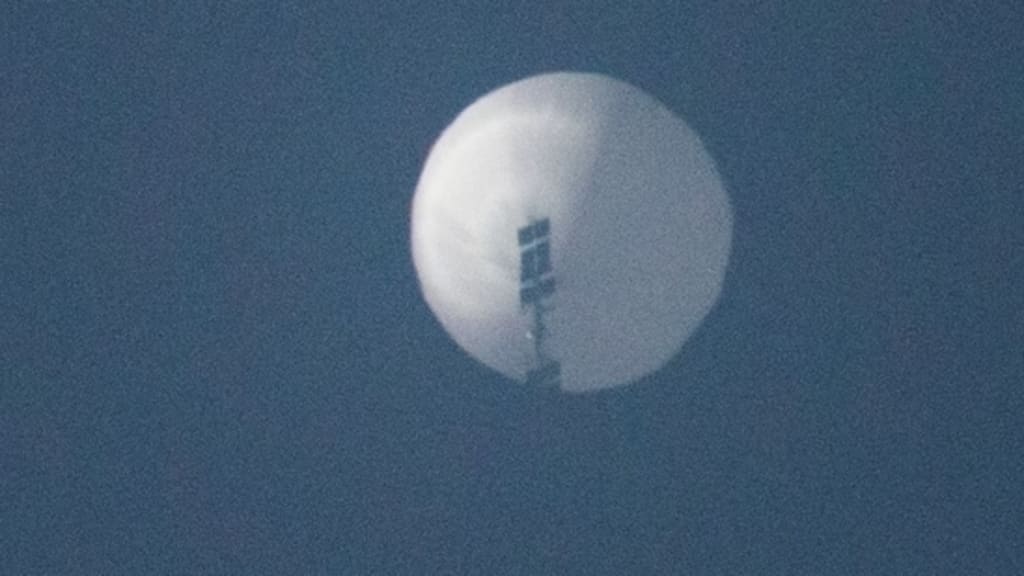
When it comes to shooting down a Chinese 'spy' balloon, a US expert says, 'It's not the Hindenburg.'
The Pentagon stated that the balloon over the United States is being used for surveillance, rejecting China's claim that the aircraft is a "civilian airship" that deviated from course for research.
While the US cited safety concerns as the reason for not shooting down the suspected Chinese surveillance balloon, a US expert said balloons are a valuable means of observation that are difficult to shoot down. William Kim, a surveillance balloon expert at the Marathon Initiative think tank in Washington, called it a "real possibility" that a Chinese balloon, as claimed by Beijing, was intended to collect data from outside US borders but malfunctioned.
what do we know so far?
A massive white orb the size of three buses is floating over the United States, causing a diplomatic storm. The balloon with visible "payload" and surveillance capabilities was discovered loitering over sensitive areas of Montana where nuclear warheads are siloed, according to the Pentagon.
Brig. Gen. Pat Ryder, Pentagon press secretary, told a media briefing that the US acted immediately to prevent the collection of sensitive information. Ryder also stated that the North American Aerospace Defense Command was still monitoring the balloon and that leaders were considering counter-measures.
Meanwhile, US State Secretary Antony Blinken has cancelled his trip to Beijing for next week.
‘Meteorological research’
China insisted that the balloon was simply an errant civilian airship, primarily used for meteorological research, that deviated from its course due to wind. According to the Chinese Foreign Ministry, Beijing "regrets the unintentional entry of the airship into US airspace."
Why isn't the US shooting down the balloon?
According to the Associated Press, US President Joe Biden initially wanted to shoot down the balloon, but top defense officials strongly advised him against it due to risks to the safety of people on the ground. According to the report, the balloon is large and high enough that any debris from a strike could stretch for miles, with no control over where it eventually lands.
Kim, on the other hand, emphasized the feasibility, or lack thereof, saying, "Helium is used in these balloons... It's not the Hindenburg; you can't just shoot it and then watch it burn "referring to the airship crash on May 6, 1937. The airship ran on hydrogen gas, which burned out in about 90 seconds."If you poke holes in it, it's just going to leak out very slowly."
According to AFP, Kim recalled the Canadian air force sending up F-18 fighter jets in 1998 to try to shoot down a rogue weather balloon.
"A thousand 20-millimeter cannon rounds were fired into it. Even so, it took six days for it to be removed. When you shoot at these things, they do not explode or pop."
According to AFP, he said it was unclear whether using surface-to-air missiles would work because their guidance systems are designed to hit fast-moving missiles and aircraft.
What Chinese 'spy' balloons are capable of that satellites are not. Experts have revealed
The discovery of the Chinese spy balloon heightened diplomatic tensions, prompting US Secretary of State Antony Blinken to cancel a rare planned trip to Beijing.
The detection of Chinese spy balloons over US skies has heightened diplomatic tensions between Washington and Beijing. The spy balloon was first spotted earlier this week hovering over Montana, which is home to sensitive airbases and strategic missiles, and another was spotted on Friday over Latin America. According to the Pentagon, the balloons were not shot down for safety reasons.
According to William Kim, a surveillance balloon expert at the Marathon Initiative think tank in Washington, the spy balloons are an important means of observation and traction that are difficult to shoot down. Kim told AFP that the spy balloon resembled a regular weather balloon but had distinct features and characteristics.
Benefits of balloons over satellites:
According to AFP, Kim stated that balloons are difficult to detect on radars because they are made of materials that do not reflect.
"So, even though these balloons can expand to quite large sizes, detecting... the balloon itself will be a problem," he explained.
According to the surveillance balloon expert, these balloons typically operate at altitudes of 65,000-100,000 feet and can maintain a stationary position over a surveillance target as opposed to satellites, which constantly rotate within their orbit. He also mentioned that the balloons can stay over a location for months at a time.
Furthermore, balloon payloads are lighter, smaller, cheaper, and easier to launch than satellites. Small spy balloons can also avoid radar detection, according to Peter Layton, a former Royal Australian Air Force officer.
According to Blake Herzinger, an expert in Indo-Pacific defense policy at the American Enterprise Institute, the spy balloon can also be monitored via onboard computers to take advantage of winds.
About the Creator
Happy Place
As an experienced writer on the law of attraction, I bring a unique perspective to this powerful principle
Keep reading
More stories from Happy Place and writers in The Swamp and other communities.
Daniel Ives: Trump’s Electricity Policy Could Be a ‘Bottleneck’ for Data Centers
If you’ve been following the AI boom lately, you know that it’s not just about clever algorithms or smart apps—it’s also about massive amounts of electricity. And according to Wall Street analyst Daniel Ives, the electricity policies being pushed by the Trump administration could become a serious bottleneck for U.S. data centers, the massive facilities that power everything from cloud storage to AI models like ChatGPT. Ives warns that while the administration wants to protect consumers from higher electricity bills—which is understandable—the way these policies are being implemented may slow down the very infrastructure needed for America to stay competitive in AI and tech innovation. Data Centers: More Than Just Big Computers Think of a data center as a giant brain for the internet. These facilities run thousands of servers 24/7, processing the data behind social media, streaming video, cloud apps, and artificial intelligence. Unlike your laptop or phone, data centers never power down, which means they use an incredible amount of electricity. In 2023, U.S. data centers used about 4.4% of all electricity in the country—roughly the same as major cities like New York or Chicago. And with AI becoming a bigger part of business and daily life, demand for power is expected to double or triple by 2030. So when policies affect electricity pricing or availability, it hits data centers directly—and fast. Trump’s Electricity Policy Explained President Trump’s administration has been clear: Americans shouldn’t pay higher utility bills because of data centers. The plan encourages Big Tech to cover their own energy costs instead of relying on electricity rates that might indirectly affect households and small businesses. In response, companies like Microsoft have pledged to pay more for electricity and make their operations more efficient. While this helps protect consumers, Daniel Ives says it could also slow down the growth of new data centers if companies decide the costs are too high or too uncertain. Why Daniel Ives Calls It a Bottleneck Ives calls this situation a “bottleneck” for several reasons: Rising Costs for Tech Firms: If companies have to pay more for electricity, building new data centers becomes more expensive. That can slow expansion. Infrastructure Limits: Many regions of the U.S. grid weren’t designed for the current surge in AI-powered data centers. Limited power availability can delay or block projects. Global Competition: Ives warns that if U.S. policies make data center growth harder, other countries—like China—might pull ahead in AI infrastructure. In short, protecting consumers is important, but it needs to be balanced with ensuring America can scale its AI and cloud capabilities quickly. The Reality of Power Demands This isn’t just about politics—it’s about practical energy challenges. The U.S. grid is already under pressure from data centers, electric vehicles, and growing industrial demand. In some hotspots, developers wait years just to get a power hookup. Without careful planning, the electricity needed for AI innovation could hit a hard limit, delaying projects or pushing companies to relocate where energy is cheaper or more abundant. Balancing Innovation and Consumer Protection The Trump administration’s approach tries to strike a balance: protect household electricity bills while allowing tech growth. But Daniel Ives argues that if the balance isn’t right, it could unintentionally discourage investment and slow AI infrastructure development. Companies are trying to adapt. Microsoft, for instance, has promised to cover energy costs and invest in efficiency. Utilities and lawmakers are also revisiting subsidies and incentives for energy-intensive projects, trying to find a way that keeps everyone happy. Why This Matters for AI The bottleneck isn’t just about data centers or corporate profits—it’s about the speed of AI development in the U.S. AI doesn’t just need processing power; it needs continuous, reliable electricity. If supply is limited or policies make energy too expensive, AI projects could slow down, affecting everything from business innovation to national competitiveness. Ives’ warning is clear: electricity policy isn’t a small detail. It’s a strategic factor that could shape the future of AI in America. Conclusion: Watching the Power Flow Daniel Ives’ perspective highlights a key lesson: tech innovation depends on energy policy just as much as it does on talent or investment. The U.S. needs policies that protect consumers but also allow data centers—and the AI revolution—to grow. Otherwise, we could see delays in AI infrastructure just as the world is racing to adopt new technologies. For policymakers, companies, and consumers, the takeaway is clear: energy policy isn’t just about rates; it’s about the future of American technology. The next few years will show whether Washington can balance consumer protection with the energy needs of AI—or if Daniel Ives’ bottleneck warning becomes reality.
By Muhammad Hassan6 days ago in The Swamp




Comments
There are no comments for this story
Be the first to respond and start the conversation.