
Why Russia’s attacks on Ukraine’s energy grid aren’t ‘revenge’ for Kyiv’s deep strike campaign
How Moscow’s infrastructure strikes reflect long-term strategy, not retaliation, and why the distinction matters for understanding the war.

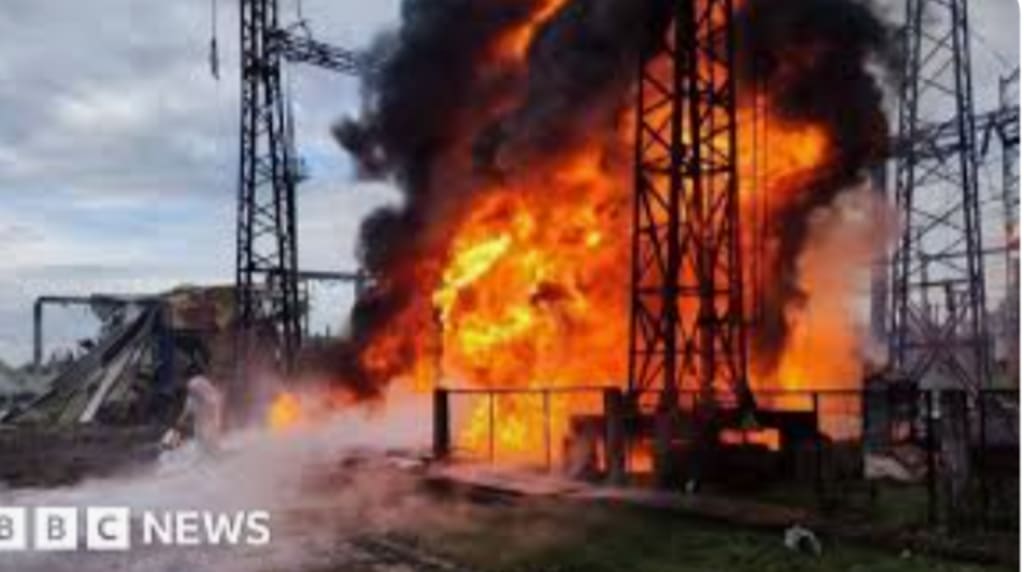
When Russian missiles slam into Ukrainian power stations and substations, the Kremlin often claims these attacks are acts of “revenge” for Ukraine’s long-range drone strikes inside Russia. This narrative has been repeated after almost every major wave of bombardment on Ukraine’s energy infrastructure.
But calling these strikes retaliation oversimplifies — and distorts — what is really happening. Russia’s campaign against Ukraine’s energy grid is not a spontaneous emotional response to Ukrainian actions. It is a calculated, long-term military strategy designed to pressure civilians, destabilize society, and weaken Ukraine’s ability to function as a modern state.
Understanding this distinction is crucial, because it reveals how differently each side is fighting this war.
A familiar justification from Moscow
The Kremlin has used the language of “retribution” since the early stages of the war. After Ukraine struck the Kerch Bridge connecting Russia to Crimea in 2022, Russian President Vladimir Putin publicly framed attacks on Ukrainian infrastructure as punishment.
That framing has returned whenever Ukraine hits Russian oil refineries or military-related facilities. State media presents missile barrages on Ukrainian cities as necessary responses to Ukrainian “terrorism.”
This messaging serves two purposes:
It portrays Russia as reacting defensively rather than acting aggressively.
It attempts to create moral equivalence between Ukraine’s strikes and Russia’s bombardment of civilian infrastructure.
Yet the targets and intentions behind these operations tell a very different story.
Russia’s strategy: pressure through civilian suffering
Russia’s attacks on Ukraine’s energy grid focus on power plants, heating stations, substations, and transmission networks. These strikes intensify during winter, when Ukrainians rely most on electricity and heating to survive.
The result is predictable:
Rolling blackouts
Disrupted water supplies
Hospitals running on generators
Families forced to live without heat in freezing temperatures
This is not incidental damage. It is part of what many analysts describe as a strategy of “weaponizing winter.”
By targeting systems that keep civilian life functioning, Russia seeks to exhaust the population psychologically and physically. The hope appears to be that prolonged hardship will weaken Ukrainian morale and pressure the government into concessions.
This approach is not new. Russia has used similar tactics in conflicts in Syria and Chechnya, where infrastructure strikes were intended to break resistance by making daily life unbearable.
Calling this “revenge” suggests an emotional response. In reality, it reflects a consistent doctrine: using civilian suffering as leverage.
Ukraine’s deep strikes: targeting the war machine
Ukraine’s long-range drone and missile strikes inside Russia have focused largely on oil refineries, fuel depots, and industrial facilities that support Moscow’s war effort.
These targets matter for three main reasons:
They fuel the military.
Oil and refined fuel power tanks, aircraft, and logistics networks.
They fund the war.
Energy exports remain a major source of revenue for Russia’s economy.
They are usually far from population centers.
These facilities are typically located in industrial zones, reducing civilian casualties.
Ukraine’s stated goal is not revenge but degradation of Russia’s capacity to continue fighting. In a war where Ukraine lacks Russia’s numerical advantage in missiles and aircraft, deep strikes are one of the few ways Kyiv can project force beyond the front lines.
This creates a stark asymmetry:
Russia hits civilian life-support systems.
Ukraine hits economic and military infrastructure tied to the invasion.
The myth of moral symmetry
Labeling Russia’s grid attacks as retaliation creates the illusion of balance — as if both sides are simply trading blows of equal nature. This framing ignores a key reality: Russia initiated the full-scale invasion, and Ukraine’s long-range operations are defensive measures aimed at weakening an occupying force.
The “revenge” narrative also helps Russian domestic audiences accept attacks on civilian infrastructure. By presenting them as justified responses, the Kremlin avoids addressing the humanitarian consequences of its strategy.
International law draws a distinction between military objectives and civilian infrastructure essential for survival. Power plants and heating systems that serve entire cities fall into a protected category when their destruction causes disproportionate harm to civilians.
That legal and moral gap is what Russian propaganda tries to blur.
Life under the grid attacks
For Ukrainians, the debate over revenge versus strategy is abstract compared to the lived experience of darkness and cold.
Blackouts disrupt:
medical treatments
transportation
education
food supply chains
communications
Parents worry about heating their homes. Doctors worry about electricity for life-support machines. Businesses shut down. Daily life becomes survival mode.
These consequences reinforce the view that the energy campaign is meant to break resilience, not respond tactically to battlefield events.
Information warfare matters too
Beyond physical damage, the “revenge” narrative plays a role in information warfare. It reframes Russia as reacting to provocation rather than prosecuting a deliberate campaign against infrastructure.
This messaging also seeks to weaken international support for Ukraine by portraying the conflict as mutually escalatory rather than fundamentally asymmetrical.
If everything is seen as retaliation, then responsibility becomes blurred.
Conclusion: strategy, not spite
Russia’s attacks on Ukraine’s energy grid are not emotional outbursts in response to Ukrainian deep strikes. They are part of a broader strategy aimed at civilian endurance, economic pressure, and psychological fatigue.
Ukraine’s strikes inside Russia focus on facilities that enable Moscow’s war effort. Russia’s strikes inside Ukraine focus on systems that keep civilians warm, safe, and functioning.
Calling this “revenge” disguises the real nature of the campaign. It is not about payback. It is about leverage.
Understanding that difference matters — because it reveals that this war is not simply a cycle of retaliation, but a conflict in which one side targets the foundations of civilian life while the other seeks to limit the aggressor’s ability to keep fighting.
And that distinction may ultimately shape how history judges both strategies.
About the Creator
Sajida Sikandar
Hi, I’m Sajida Sikandar, a passionate blogger with 3 years of experience in crafting engaging and insightful content. Join me as I share my thoughts, stories, and ideas on a variety of topics that matter to you.
Keep reading
More stories from Sajida Sikandar and writers in The Swamp and other communities.
The Stock Market Is Expected to Move Big on Friday’s CPI
Wall Street is bracing for a pivotal moment. Friday’s release of the Consumer Price Index (CPI) could set the tone for markets in the weeks ahead, with investors preparing for sharp swings in stocks, bonds, and currencies. Inflation data has become one of the most powerful market-moving forces in recent years, and this report is no exception.
By Sajida Sikandar2 days ago in The Swamp
Why Black History Matters in America?
The United States of America is celebrating their 250th anniversary in 2026. I'm proud to be an American and as someone who was born here, I wouldn't imagine myself living anywhere else. This is a country where opportunities are possible. Where anyone can be successful in anything they desire to do. Equality, community, and togetherness are the backbones of what America is and should be about. However, we have an administration who wants to erase and disregard those who have made positive, meaningful impacts in our country, specifically Black figures, such as Martin Luther King, Jr., Rosa Parks, and Maya Angelou. President Trump and his administration have been constantly complaining and fighting against what they call the "Woke agenda". They use this excuse as a distraction from other issues they refuse to address, such as the high cost of living, climate change, and inflation. That equality is dividing America, when in reality, it's bringing us together. Being woke is not tied to a specific political party. No matter where you stand on the political spectrum, you can still care about other people and their plights. Compassion and empathy for others isn't tied to a political party, either. We were taught as children to treat others the way we want to be treated and not judge others because they're different from us. Caring about others isn't a personal attack on your beliefs. It doesn't make you any less of a person. People who are easily offended over African American figures, past or present, or anything related to it, are grasping at straws. Current and future generations need to know who people like Harriet Tubman and Shirley Chisholm were, especially in the classroom. Black History is part of American History. It should be recognized, not hidden or forgotten. Besides, you can't shield children from everything, just because your feelings are easily hurt.
By Mark Wesley Pritchard 13 days ago in The Swamp
Japan Seizes Chinese Fishing Boat and Arrests Skipper Amid Rising East China Sea Tensions
In a dramatic escalation of long-standing maritime tensions, Japan has seized a Chinese fishing boat and arrested its skipper in disputed waters of the East China Sea. The incident, which unfolded near the contested Senkaku Islands, has reignited diplomatic friction between Tokyo and Beijing and drawn international attention to one of Asia’s most sensitive geopolitical flashpoints.
By Aqib Hussain2 days ago in The Swamp




Comments
There are no comments for this story
Be the first to respond and start the conversation.