
Why Being in the Middle Is WRONG
Why people are saying you should choose between right and wrong when it comes to Nazis.
Picture this. You’re on the playground, and there’s a smaller kid from your class trying to play on the swings. He was always timid, shy, and just wanted to keep to himself. Well, you’re next to him on the swing set, but you’re much bigger. The kids in class would never do anything to bully you. They come over and they push the kid next to you off his swing, and start calling him names like weakling and scrawny and these kids really start laying into him.
You’re busy though. I mean, you have your own life to worry about, right? You don’t have the time to get up and easily knock those kids off the poor victim who is now bleeding into the sand. You know it’s wrong, but hey, you also know that this kid provoked them too by taking the swing set they claimed as theirs. You absolve yourself by saying that this kid knew those big kids always came out to play on that swing set, and you weren’t the one who started punching him violently in the head.
This kid ends up hospitalized from the beating he took on the playground. He has severe brain trauma and is now in a coma, because the only person who did stand up was another kid who knew he wouldn't have enough muscle to stand up to the big bullies.
So, that kid went and grabbed a teachers attention, but by the time the teacher got to the situation, the small child was already severely hurt requiring medical assistance. If you'd just stood up and even said something to the bullies, that kids life wouldn't be in danger right now.
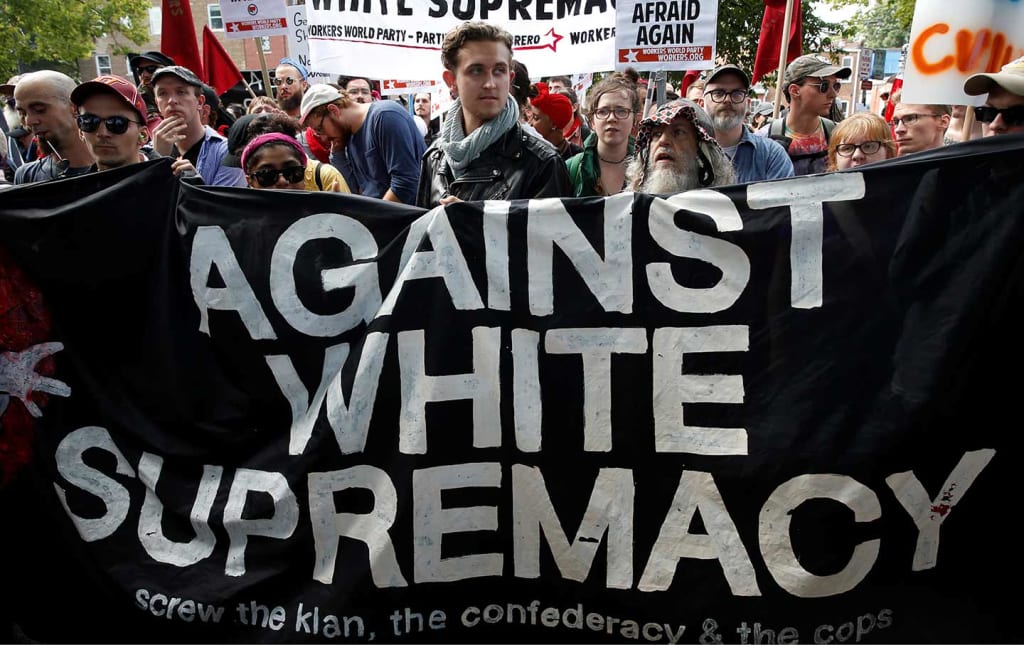
I hate to break it to you centrists, but you’re doing this right now. This kid up there is you. Bouncing blame back and forth like there is no such thing as right and wrong. I understand that there are a lot of places where compromise is needed, but being a racist isn’t one of them. We tried that before, remember? World War II was a disaster that was left to fester until it almost consumed the entire world. People fought against this, literally our entire country on a huge war!
Now, our own country is being divided on right and wrong again, but there’s still people in the middle talking about how the Nazis have free speech. Sure. They have free speech, and I’m not going to argue against that.
I will, however, argue that they get to deal with the consequences for hate speech. I will, however, argue that when the things they say affect how other people’s lives turn out, how other people are treated, entire races of people, that society shouldn’t just sit back and say, “Well, I see your point. You have a point. Good on you!”
Fuck NO!
They get to deal with what you have to say after that. They get to deal with discriminatory laws that have been put in place to protect everyone. They get to be socially ostracized. And yes, they get to lose their jobs, because what if this was your hiring manager and they thought those terrible things about people who were different from them? What if you got fired for what race or religion you were? Wouldn’t be too happy then, would you?
I've watched people in workplaces being discriminated against, and I've been the voice for people too afraid to stand up for themselves, fearing retaliation. I've had to stand up for myself against wrong doing and judgments for disabilities.
A lot of people have and refuse to acknowledge that it happened to them too. I'll never stop fighting for justice, and I'm trying to tell you right now to start fighting too. Please. Be on the right side of history with us.
About the Creator
Keep reading
More stories from Nicole King and writers in The Swamp and other communities.
Convulsive Seizures and Mental Health in the Workplace
Convulsive Seizures and Mental Health in the Workplace and School This is for all those people out there who really want to work, but are too sick. When you have a disability, it becomes all too depressing when you ultimately either lose your job or have to quit. Even when you just hated the job you had to quit, there’s a certain somber feeling on it, because you didn’t really choose that path, you had to. You start losing opportunities other people have that they don’t want, even complain about, like driving and working, and sometimes, just admit it, you hate them for it. This is my story.
By Nicole King9 years ago in Psyche
Why Black History Matters in America?
The United States of America is celebrating their 250th anniversary in 2026. I'm proud to be an American and as someone who was born here, I wouldn't imagine myself living anywhere else. This is a country where opportunities are possible. Where anyone can be successful in anything they desire to do. Equality, community, and togetherness are the backbones of what America is and should be about. However, we have an administration who wants to erase and disregard those who have made positive, meaningful impacts in our country, specifically Black figures, such as Martin Luther King, Jr., Rosa Parks, and Maya Angelou. President Trump and his administration have been constantly complaining and fighting against what they call the "Woke agenda". They use this excuse as a distraction from other issues they refuse to address, such as the high cost of living, climate change, and inflation. That equality is dividing America, when in reality, it's bringing us together. Being woke is not tied to a specific political party. No matter where you stand on the political spectrum, you can still care about other people and their plights. Compassion and empathy for others isn't tied to a political party, either. We were taught as children to treat others the way we want to be treated and not judge others because they're different from us. Caring about others isn't a personal attack on your beliefs. It doesn't make you any less of a person. People who are easily offended over African American figures, past or present, or anything related to it, are grasping at straws. Current and future generations need to know who people like Harriet Tubman and Shirley Chisholm were, especially in the classroom. Black History is part of American History. It should be recognized, not hidden or forgotten. Besides, you can't shield children from everything, just because your feelings are easily hurt.
By Mark Wesley Pritchard 27 days ago in The Swamp




Comments
There are no comments for this story
Be the first to respond and start the conversation.