
When Trump Met Putin in Alaska: Power, Peace, and Political Theater
Two leaders, two agendas, one handshake under Arctic skies—what really happened behind closed doors?


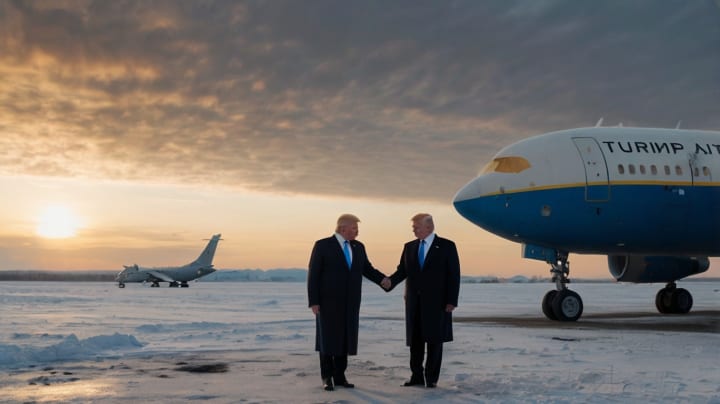
The icy landscapes of Alaska witnessed a rare spectacle this week—Donald Trump and Vladimir Putin meeting face-to-face once again. Arriving separately on their own aircrafts, both leaders walked down the red carpet and shook hands in front of cameras flashing from every angle. Symbolically, the choice of Alaska carried weight: a territory that historically linked Russia and America, now serving as a backdrop for renewed dialogue.
For Moscow, the message was clear—Russia is not an isolated state. By engaging in direct talks with a former U.S. president and potentially future leader, Putin signaled that his country maintains historic ties with Washington, despite strained relations in recent years. For Trump, the meeting carried two distinct objectives. First, to project himself as a peacemaker, someone who deserves recognition on the global stage, even the coveted Nobel Peace Prize. Second, to revive one of his key electoral promises: the claim that he could end the Russia-Ukraine war with his unique negotiation skills.
The Symbolism of the Stage
The optics of the event were carefully choreographed. Trump, noticeably taller, looked dominant in the frame, while Putin, seven years younger, appeared more energetic. Both men carry the weight of age, but their contrasting presence told a subtle story: Trump projecting statesmanlike grandeur, Putin radiating stamina. While media outlets often emphasize body language, the substance of this meeting went far beyond gestures.
Originally planned as a two-round engagement, the first lasting two hours and the second six, the dialogue stretched to three hours in its opening round. Surprisingly, both leaders agreed that no further talks were necessary. Instead, they faced reporters in what was more of a briefing than a full press conference.
Trump’s “Landscape” Formula
Trump repeatedly emphasized that he had a “formula of landscape” to resolve the Russia-Ukraine conflict. Drawing a parallel with the 1965 ceasefire between India and Pakistan, he hinted at a territorial compromise: Crimea and Donbas to remain under Russian control, while the rest of the occupied areas would be returned to Ukraine.
But the reality on the ground is far more complicated. Russia currently occupies nearly 19 percent of Ukraine’s territory and shows no sign of retreating. Ukraine, on the other hand, has reclaimed little and continues to expend enormous military and economic resources in contested zones. Some analysts argue that Moscow intentionally allowed Ukraine to bleed resources in these battles, only to shift focus elsewhere.
Trump’s proposed landscape deal—partitioning land as if it were negotiable—was quickly dismissed in practice. Neither Russia nor Ukraine supports such an arrangement. For Kyiv, it would mean legitimizing occupation. For Moscow, it would fall short of Putin’s stated ambitions, which extend toward the Dnipro region and beyond. Not surprisingly, the subject faded from the official narrative of the talks, despite Trump’s insistence that he holds a solution in hand.
Putin’s Strategic Message
Putin, by contrast, came prepared. Opening the dialogue, he spoke for eight minutes from written notes. While he briefly mentioned Ukraine, most of his remarks centered on U.S.-Russia relations. His tone was deliberate: Russia and America, he said, are not distant rivals but near neighbors—separated by only four kilometers across the Bering Strait. Europe, he argued, is geographically and strategically farther away.
The Russian leader stressed that if Washington and Moscow worked together, there would be no limits to what they could achieve—particularly in energy, security, and global trade. He reminded listeners of the joint victory of World War II, a historical bond that he suggested could serve as a foundation for the future. Addressing an audience that included American businessmen, he highlighted the vast trade potential between the two nations.
Perhaps most strikingly, Putin extended an invitation to Trump to visit Moscow. This, he said, could deepen U.S.-Russia ties while signaling a pivot away from Europe, which Moscow increasingly views as an adversarial bloc rather than a partner.
A Meeting That Raised More Questions Than Answers
While the Alaska encounter ended without a concrete agreement, it revealed much about the political theater both men are engaged in. For Trump, the narrative was about demonstrating leadership and positioning himself as the only figure capable of negotiating peace. For Putin, the goal was to project legitimacy, underline Russia’s enduring global role, and hint at a vision of a U.S.-Russia partnership independent of European influence.
Yet beneath the symbolism and rhetoric, the core issues remain unresolved. Ukraine’s sovereignty, Russia’s territorial ambitions, and Europe’s opposition to any Trump-Putin formula ensure that the war will not be easily “terminated” by diplomacy alone.
Still, the image of Trump and Putin standing together in Alaska—a handshake framed against the snow—will circulate widely. For both leaders, it was less about resolving the war than about reshaping perceptions: Trump as peacemaker, Putin as statesman. Whether history views it as a turning point or merely another performance on the global stage remains to be seen.
About the Creator
Leah Brooke
Just a curious storyteller with a love for humor, emotion, and the everyday chaos of life. Writing one awkward moment at a time
Keep reading
More stories from Leah Brooke and writers in The Swamp and other communities.
Games of Tariffs & Power: Why Is Trump Hitting India Hard and Praising Pakistan?
Tariffs are never just about economics — they’re about leverage, influence, and sometimes, pure political theatre. Under Donald Trump, America’s trade policy became a chessboard where South Asia was a critical square. While India faces a crushing 50% tariff on key exports, Pakistan enjoys a much friendlier 19% rate — a move that has sparked debate from Washington to Islamabad. But is this short-term favor a blessing or a trap? In this article, we break down why Trump’s White House hit India hard, praised Pakistan, and what this means for the region’s future in an interconnected global economy. The Tariff Landscape: Numbers That Speak
By Leah Brooke7 months ago in The Swamp
A Gathering of Evil Bosses
“I’m the queen of chin jutting while I smooth my hair, attacking, insulting, and deflecting to protect my appointer.” “Oh, please, Blondi, my hair is curled, highlighted, and longer than yours. I feature television commercials telling immigrants that we will give them a free plane ride home, and if they voluntarily turn themselves in, they will be allowed to legally apply for re-entry. It runs everywhere, and I look good in it! You can’t compete because of your blond hair. Mine is nicer, and my lips are prettier than yours.”
By Andrea Corwin 10 days ago in The Swamp


Comments
There are no comments for this story
Be the first to respond and start the conversation.