
When some Arabs support the invasion of Ukraine
This happened in the summer of 1990. Iraqi forces invaded Kuwait at the dawn of August 2, and President Saddam Hussein made a series of statements stressing the centrality of the Palestinian cause, in a strong criticism of the world's handling of it other than what it does with its invasion of its southern neighbor.
This happened in the summer of 1990. Iraqi forces invaded Kuwait at the dawn of August 2, and President Saddam Hussein made a series of statements stressing the centrality of the Palestinian cause, in a strong criticism of the world's handling of it other than what it does with its invasion of its southern neighbor.
A speech that caught the eye of many for exposing the double standards of international politics, especially the American one, but they forgot that in the folds of this proposition was neglect of the tragedy of an entire people and a country whose sovereignty was violated and even denied its entire existence.
The Tunisians were at the time among those who were enthusiastic about this proposition, but they were not the only ones, which the Kuwaitis did not understand or forgive, so what is the meaning of them paying, in particular, a heavy price for other Arabs to deduce such duality, even though it was necessarily known from international politics.
The Tunisians engaged in boundless enthusiasm to support what Iraq had done, especially with the situation turbulent with an unprecedented US and international military mobilization to liberate Kuwait, and it was not easy for anyone to declare the opposite position. The editor-in-chief of the famous daily newspaper, Al-Sabah, Abdellatif Al-Furati was almost the only one who dared express in an editorial immediately after the invasion a clear and principled opposition to the occupation of a country and its removal from the map with such ease, while the rest of the media facilitated blowing their illusions.
It was also interesting to monitor the positions of many Arab leaders who preferred, for their own considerations, to identify with such popular positions in their countries, whether out of conviction or to avoid collision with a crowd angry at the unjust policies of the great powers. Those Arab countries that adopted such a position were called “countries of the opposite,” although in fairness none of their leaders publicly supported the occupation of Kuwait, but their various positions opposed to the military option and to seek the help of foreign military forces to expel the Iraqis from Kuwait, and the absence of strictness in condemning this occupation, were understood as Well, no matter how accurate.
The Tunisians were impressed by the position of their president Zine El Abidine Ben Ali, who boycotted the Arab summit in Cairo, which secured the cover for the recruitment of foreign forces. The Palestinians were also impressed by the position of Yasser Arafat, the Jordanians by the position of King Hussein, the Yemenis by the position of Ali Abdullah Saleh, and so on. Later, they paid a heavy price for their stances, and it took years to overcome the remnants of a stage that Iraq and the Arabs are still paying the bill for to this day.
These leaders did not think that the real challenge before them was to confront their people with the true principled position of rejecting the invasion and occupation of a country, regardless of the pretexts. It is true that this would undoubtedly have cost them a severe collision with a general mood sympathetic to Iraq, but that is the fate of the great leaders who do not go along with the moods of their people, but rather create them.
History is replete with such examples. For example, until we stay in Tunisia, the position of the leader, Habib Bourguiba during the Second World War. Tunisians tended to support Germany in defiance of the occupied France, but Bourguiba pushed strongly in the direction of publicly standing with the allies, considering Germany's support The Nazis are a losing bet, and they have to be on the right side of history, as they say. It was not easy to push the people mobilizing against France to do this, but in the end, his argument was that he was keen to tell the Western camp that he shared with them the values of freedom and the right to self-defense, and he rejected the logic of arrogance and resort to force, so that he would argue with them all later, in contrast to what the situation would be if he aligned with Hitler.
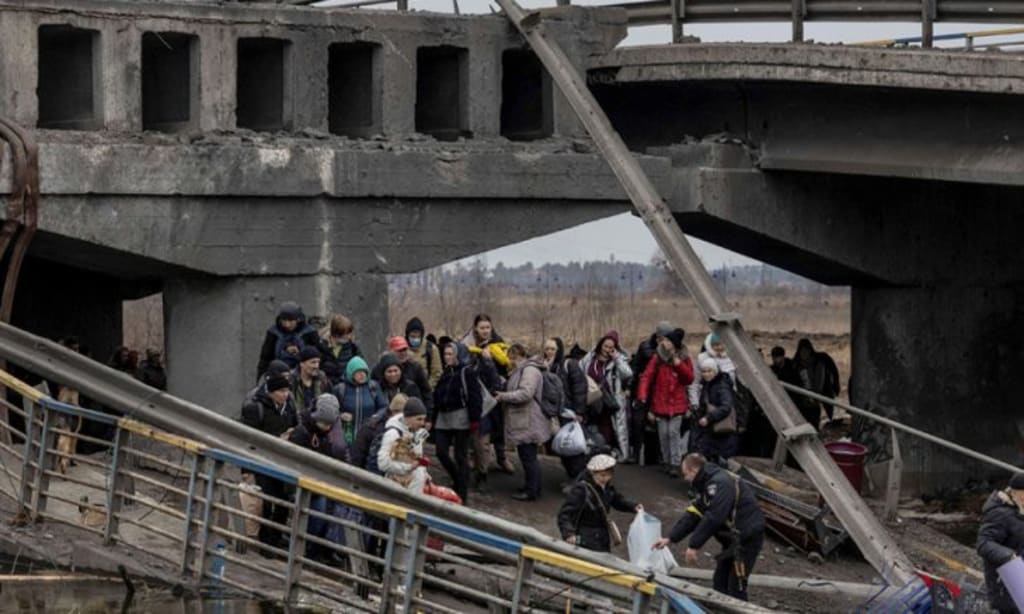
Just causes are never served by offending others, nor by ignoring the suffering of an entire people just because of animosity in this country or this policy. Rather, they are served by faith in the values of freedom, justice and respect for international law, especially the refusal to resort to force and the right of peoples to resist it and freely decide their own destiny. That America and Europe be selective, opportunistic and even unjust in their dealings with our Arab issues, especially the Palestinian issue, does not make the invasion of another country, which this time happened to be Ukraine, destroying its infrastructure and pushing its women, children and elderly to flee a matter that can be accepted, let alone justified.
What moral downfall is there today among us who supports Moscow in its aggression?! Although he himself is the one who stands denouncing the world that is failing the Palestinians in front of the Israeli war machine. This is only described as hypocrisy, and its owner is the last person who has the right to criticize the hypocrisy of the West.
Principles are indivisible, and you cannot wave them screaming indignantly only when they are in your favour, and then trample them if they go against your whim. The world unquestionably has its many moral problems in dealing with our issues, but we also have our most difficult problems, such as some of us supporting Russia in its current war on Ukraine, while others' fascination with a president like Putin is another calamity that goes on to explain.
About the Creator
Keep reading
More stories from Zernouh abderrahman and writers in The Swamp and other communities.
The Palestinian Prisoner on International Women's Day
Yesterday, humanity celebrated International Women’s Day, which falls on the eighth of March, and the United Nations chose to hold this year’s celebrations under the slogan “Gender Equality for a Sustainable Tomorrow.” It is clear that this choice emphasizes a first aspect related to the consolidation of women’s rights compared to men. And a second aspect stresses the social role of women in general and in sustainable development processes in particular.
By Zernouh abderrahman4 years ago in The Swamp
Two Wounded in a Shooting with US Federal Agents in Portland, Oregon
A tense encounter between U.S. federal agents and civilians in Portland, Oregon, has left two people wounded, once again placing the city at the center of a national conversation about immigration enforcement, law enforcement accountability, and community trust.
By Aqib Hussain5 days ago in The Swamp




Comments
There are no comments for this story
Be the first to respond and start the conversation.