
What is homelessness?
Why is there no clear guidance?


The cause and treatment of homelessness within the United Kingdom is often under debate. The definition and consequential categories are constructed around who is and is not included in the category and this is a cause of ongoing homeless problems.
With COVID-19 on the war path homeless people have made the news in waves due to the support offered by councils, hotels and the government. It has suddenly gone quiet again as well. There is the odd report showing that some councils are continuing to use their funding to support hotels keep those agreed as homeless in the area housed yet little is mentioned of the councils who have abandoned these people at their earliest opportunity.
Maybe the story was getting old, maybe the thought of people returning to the streets was too much to bare. Maybe the government are trying to keep our attention on something else. Maybe it is because no-one actually knows who is and who is not homeless as the definition changes depending on who is discussing it. For example, are people who sleep on their friends settee homeless? What if it is for one night? What if it is for six weeks because they have nowhere else to go? Who decides whether they are tenants or homeless sofa surfers?
A report by Peace (2015) shows that measures which should count and decrease homeless figures are lacking within the UK and it is therefore difficult to gain a full understanding of the situation. I would say almost impossible!
Consequential categories are the expectations, features and characteristics of belonging to a category whether you chose it or not. Regardless of the stereotypes being implied, a study should define categories so that the research is focused and relevant. If there is no consensus then the variable being studied is open to interpretation, manipulation and confusion. Without an agreed definition, the homeless have no hope of being understood.
Figures are important in the United Kingdom, there is a statistic for everything. Policies, procedures and guidance are based on these statistics, so why is there is no generic definition of what counts as homeless? What statistics are actually being measured and acted upon?
There are some researchers who evade categorisations, instead defining what a home is rather than who a homeless person is. For example, Homeless Link (2014) has sidestepped defining homelessness and based their classifications on what they identify as a home. In this scenario; affordable accommodation, with support networks and an adequate income to maintain it. Others avoid any attempt at categorising vagrancy and assume that the readers already know what it means.
Do not get me wrong, there have been attempts to create one common definition through a European Typology which focuses on physical, social and legal domains, however not all countries adopted this due to individual political, ethical and moral viewpoints. Is the globalisation of a definition too much to handle? Surely we could at least get to national though?
These differing interpretations make correlations difficult and therefore the cause of homelessness is hard to pinpoint. Without a cause is it impossible to change?

Pleace (2015) suggests that homeless people have a myriad of issues, which can include domestic violence and learning difficulties making it difficult to locate an independent factor which could end homelessness. Pleace also illustrates that the longer people are homeless, the more issues they develop. Does it really matter how they became homeless? Is it not possible to work on where they are now and what support they require to be where they want to be? Be in the moment with them, instead of analysing their past?
Has it also been considered that not all homeless people want to live in a standard home, with a standard life? Some wish to be homeless as it is more comfortable for them. Should we force them to live somewhere they do not want to? Would it be appropriate for you to be hounded despite your wishes? Whose idea is it that everyone must have home anyway? Current cultures and trends within the UK.
In a video showcasing several homeless people who have struggled to maintain accommodation, Les tells us that he cannot cope with the rules in hostels and Tam says that the accommodations are isolating so they both chose to live on the streets instead of accepting accommodation for many years (McCulloch, 2017).
For those that do chose to accept support, each issue must fit into categories to get adequate support. Those who do not fit all characteristics can be overlooked, adding to the spiral which leads to being or remaining homeless. For example, benefit sanctions for those with undiagnosed health conditions can lead to an inability to pay rent, thus being found not intentionally homeless (Pleace, 2015).
As categories, values and expectations differ by place, they also differ by time and context. Categories are constructions and fluid according to interactions, debates and norms. This can have consequences for those at risk of homelessness (McCulloch, 2017). For example, when the government capped housing benefit amounts in 2015 some tenants were evicted because landlords no longer wanted tenants who relied on benefits (Financial Times, 2018). There has been a recent case that has determined this to be discrimination but how fast this is acted upon and enforced is a tale to be told. The Government has also extended the ban on evicting renters by a further for weeks. No long term goal has yet been established however.
There are some stereotypes that have been maintained in peoples thoughts about definitions, the negative ones. As always, negative things stick better than positive.
For example, the viewpoints when fundraising for homeless charities is static. Thames Reach have a campaign which encourages donations to be given to charities rather than directly to homeless people. They use a startling caption to grab attention: ‘Your kindness could kill’. Although dramatic, this encourages the public to engage with the posters but portrays homeless people as a category which cannot be trusted. Are all homeless people dishonest?
This choice of advertising is found due to the struggle between fundraising targets and the public's existing stereotypes. Breeze and Dean (2012) quote a young man who felt that people disassociate from stereotypes because they do not fit them and cannot imagine being homeless. They asked participants how they feel about this and the homeless participants felt it important that the public start to engage with the story of how they have become homeless rather than iconic images. Speaking up in this way is allowing the individuals in destitution to engage with the way they are portrayed and initiating a new concept to be developed. A lack of understanding about the stories of homeless people adds to homelessness still being an issue within the UK. It is a shame that the only way someone can be accepted as a kind person is to reveal their own story to everyone. Should people not see kindness before judgement?
It is very clear that dominant definitions of destitution are taking a top down approach when a bottom up one would be more appropriate. This can begin by engaging with complaint and appeal procedures so that it is possible to change policy. There are other ways that the homeless can change or embrace the categories placed upon them. Feedback provided by workers and individuals can and must change the policies, categories and requirements.

One way is for the homeless to accept the category that they are in and build homeless camps. Through engagement with the category it continues to be dominant. As they have been erected in areas of the UK which is an attempt from homeless people to build their own communities (The Financial Times, 2018). This article talks about the sharing of social norms such as sharing food, space and chores. This
To explore why homelessness is still an issue in the United Kingdom, new research is needed which considers the active definitions, the engaged public's and policy makers. This makes it is possible to get a comparative result from all councils with limited room for interpretation. A case study, which actively engages the subjects through collaborative research has been shown to inspire understanding and conversations about issues (Breeze and Dean, 2012). This will allow collaborative definitions, with generic guidelines for all participants, easing the transparency of data and allowing accurate representation of the severity, causes and successful outcomes thus far. Using surveys in a variety of audio, written and video formats for participants is useful to gain the implicit feelings of the participants. This means the true feelings, rather than the explicit ones which the participants feel are acceptable answers.
There is hope that one day this group of citizens can be understood, worked with and supported. My fingers are crossed that this day will come soon.
About the Creator
Janine S White
Janine thrives on bringing into awareness the inequalities and misconceptions of society. Janine hopes of a more tolerant and understanding future for the world. Giving a voice to those less privileged, ignored and forgotten about.
Keep reading
More stories from Janine S White and writers in The Swamp and other communities.
The prison service and the social harm perspective continued...
In the first part of this article previously published, I explained the beginning of the prison service and the intentions of its use. I also raised the social harm perspective as an alternative to the retribution currently in use.
By Janine S White6 years ago in Criminal
A Gathering of Evil Bosses
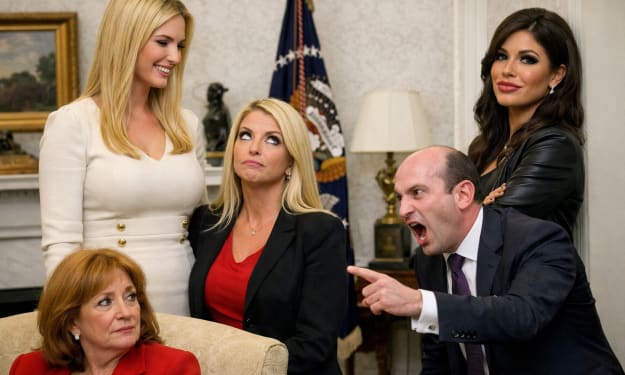
“I’m the queen of chin jutting while I smooth my hair, attacking, insulting, and deflecting to protect my appointer.” “Oh, please, Blondi, my hair is curled, highlighted, and longer than yours. I feature television commercials telling immigrants that we will give them a free plane ride home, and if they voluntarily turn themselves in, they will be allowed to legally apply for re-entry. It runs everywhere, and I look good in it! You can’t compete because of your blond hair. Mine is nicer, and my lips are prettier than yours.”
By Andrea Corwin 10 days ago in The Swamp
Researchers Praise ‘Stunning’ Results of New Prostate Cancer Treatment
In a development that researchers are calling “stunning,” a new prostate cancer treatment has delivered results that could significantly reshape how one of the most common cancers in men is treated. Early data from clinical trials indicate substantial improvements in survival rates and disease progression, prompting cautious optimism across the oncology community.
By Aarif Lashari26 minutes ago in The Swamp
No Word Comes Near Enough
The English language has its limits. I learned this when I became a student of the Bible and looked up the Greek and Hebrew definitions behind the Scriptures I loved. Some languages have so much more depth and power than the one I use to convey my thoughts. But, even so, I don't think any word could ever come close to describing this void and pain I am journeying through. I don't know how to swim through its murky waters.
By Shirley Belk4 days ago in Poets



Comments
There are no comments for this story
Be the first to respond and start the conversation.