
Verified Video Shows Collision Between US Navy Ships in Caribbean Sea
The footage has prompted a Navy investigation into navigation procedures and crew coordination during routine operations.

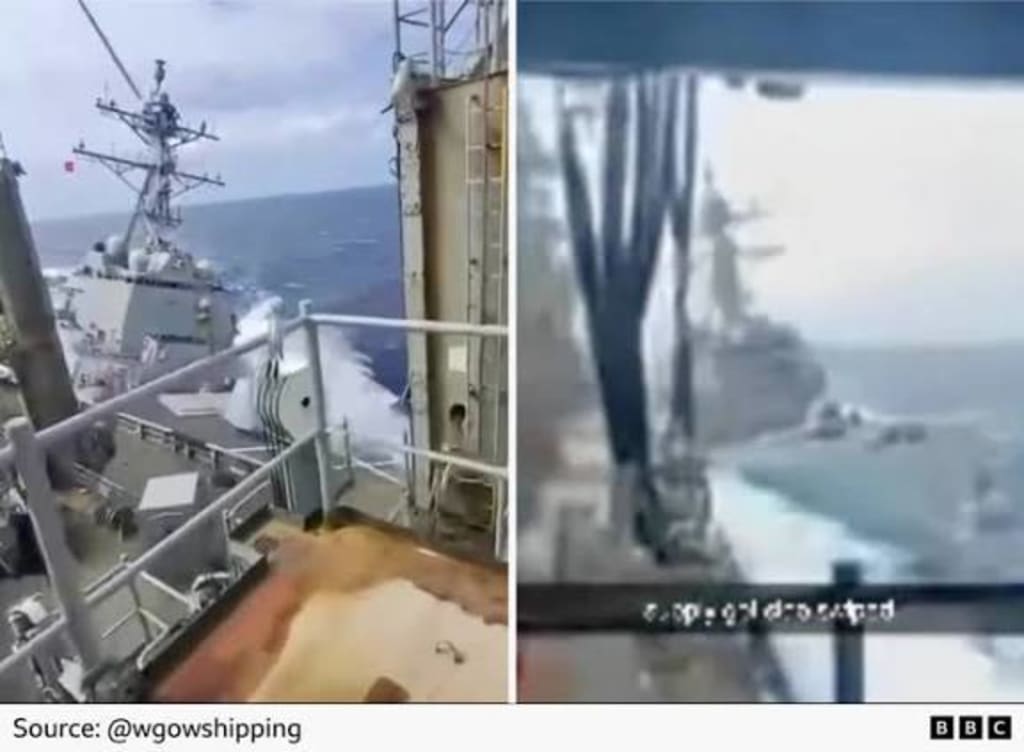
A verified video circulating online has captured a dramatic collision between two vessels belonging to the United States Navy in the Caribbean Sea, raising fresh concerns about maritime safety and operational coordination in busy international waters.
The footage, first shared by a civilian ship crew and later confirmed by naval officials as authentic, shows one warship maneuvering at moderate speed before striking the side of another vessel operating nearby. The impact appears sudden but not catastrophic, with visible damage to the hull of at least one ship and crew members rushing to respond in the immediate aftermath.
According to preliminary statements from Navy officials, the collision occurred during routine operations. Both vessels were reportedly conducting training and patrol activities when the incident took place. No fatalities were reported, though several sailors sustained minor injuries and were treated aboard ship. The ships were able to remain afloat and move under their own power after the collision.
The Navy has launched a formal investigation to determine the precise cause of the accident. Early indications suggest a possible breakdown in communication or misjudgment in navigation, but officials stressed that conclusions would not be drawn until all evidence is reviewed, including radar data, bridge logs, and crew testimony.
Maritime experts say that while collisions involving military vessels are rare, they are not unprecedented. The Caribbean Sea is a heavily trafficked region, hosting commercial shipping routes, fishing vessels, and military patrols from multiple nations. Even with advanced navigation systems and trained crews, the risk of accidents increases in congested or complex operational environments.
The release of video footage has intensified public scrutiny. In the clip, alarms can be heard sounding shortly before the collision, and sailors appear to react quickly to secure equipment and assess damage. Analysts note that the footage provides valuable insight into the seconds leading up to the impact and will likely play a central role in the investigation.
A Navy spokesperson said the service is committed to transparency and safety. “We are reviewing all available information to understand what happened and how similar incidents can be prevented in the future,” the statement read. The spokesperson added that both ships have since returned to port for inspection and repairs.
The incident has prompted questions about training standards and operational tempo. In recent years, the Navy has faced challenges related to crew fatigue and increased deployment demands. Defense observers argue that sustained high activity levels can strain personnel and heighten the likelihood of human error, even among experienced crews.
This collision also comes amid broader discussions about maritime readiness and modernization. As the Navy upgrades its fleet with more advanced sensors and automated systems, critics emphasize that technology alone cannot replace sound judgment and disciplined command procedures. Safe navigation, they argue, still depends heavily on human decision-making.
From a strategic perspective, the Caribbean Sea remains an important region for U.S. naval operations, including counter-narcotics missions, disaster response, and regional security cooperation. Any disruption to fleet readiness, even from non-combat incidents, can affect broader mission objectives.
International reaction has been muted, but regional maritime authorities have requested information to ensure that commercial shipping lanes were not affected. So far, no environmental damage has been reported, and there were no signs of fuel leakage or hazardous material release into the sea.
The verified nature of the video has also reignited debate about operational security in the digital age. With smartphones and onboard cameras now common, incidents that once might have remained internal quickly become public. Some defense officials worry that such footage, while valuable for accountability, could expose vulnerabilities or be misinterpreted without full context.
Legal and procedural reviews are expected to follow the Navy’s internal investigation. Depending on the findings, disciplinary action or changes in navigation protocols could be recommended. Historically, similar incidents have led to revised training programs and stricter enforcement of maritime rules of the road.
For sailors involved, the priority remains recovery and readiness. Both crews have reportedly resumed limited duties while repairs are underway. Counseling and medical evaluations have also been offered, recognizing the psychological impact of sudden accidents at sea.
As the investigation continues, the collision serves as a reminder of the inherent risks of naval operations, even in peacetime conditions. The oceans may appear vast, but the margins for error can be narrow when large, heavily armed vessels operate in close proximity.
The Navy has pledged to release further details once the inquiry is complete. Until then, the verified video stands as a stark visual record of how quickly routine maneuvers can turn into serious incidents—and how crucial vigilance remains in safeguarding lives and ships on the open sea.
About the Creator
Fiaz Ahmed
I am Fiaz Ahmed. I am a passionate writer. I love covering trending topics and breaking news. With a sharp eye for what’s happening around the world, and crafts timely and engaging stories that keep readers informed and updated.
Keep reading
More stories from Fiaz Ahmed and writers in The Swamp and other communities.
Don Lemon Pleads Not Guilty to Civil Rights Charges After Minnesota Anti-ICE Protest
Former CNN anchor and independent journalist Don Lemon appeared in federal court in St. Paul, Minnesota on February 13, 2026, where he formally pleaded not guilty to a set of federal civil rights charges connected to his presence at a protest that disrupted a church service earlier this year. The case has sparked intense debate over press freedom, religious rights, and the limits of protest activity under U.S. law. The Guardian Lemon, now an independent broadcaster, was among nine people charged in connection with a protest at Cities Church in St. Paul on January 18. The protest targeted Immigration and Customs Enforcement (ICE) policies after the fatal shooting of Renee Good by an ICE agent. Lemon has consistently maintained that he was present in a journalistic capacity, livestreaming and documenting the event for his show, and not participating in the protest itself. At the arraignment, Lemon stood beside veteran attorneys and entered his plea without incident. “I will not be silenced,” he told reporters afterward, invoking the First Amendment and the importance of a free press in holding powerful institutions accountable. The Charges The federal government has charged Lemon under several statutes, including: Conspiracy to deprive civil rights — alleging coordinated efforts to intimidate or interfere with the religious freedom of worshippers. Violation of the Freedom of Access to Clinic Entrances (FACE) Act — traditionally used to prohibit obstruction or harassment at reproductive health facilities or houses of worship. Prosecutors contend that the church service was disrupted by demonstrators chanting “ICE out” and other slogans, and that Lemon’s presence with protesters contributed to an environment that obstructed worshippers’ rights. Supporters of the charges say the group’s actions went beyond peaceful coverage and entered into interference with others’religious activities. If convicted, Lemon and others could face penalties including fines and potential prison time, though legal experts say the government has yet to specify exact sentencing ranges tied to these counts. Lemon’s Defense: Press Freedom and Journalism Lemon’s defense team has centered its argument on the First Amendment, asserting that Lemon was performing core journalistic functions — interviewing participants, documenting events, and providing independent coverage of a protest that touched on matters of public concern. Attorney Abbe David Lowell, representing Lemon, asked the court to return Lemon’s confiscated phone, arguing it contains crucial journalistic work product that was seized without proper cause. Legal filings also suggest his lawyers may seek access to grand jury transcripts to scrutinize the basis for the indictment. In public statements, Lemon has highlighted his three-decade career covering major national stories and emphasized that nothing about the Minnesota protest alters the legal protections afforded to reporters. “The First Amendment of the Constitution protects that work for me and for countless other journalists,” Lemon said outside the courthouse. Inquirer.com Other Defendants and Broader Context Civil rights attorney Nekima Levy Armstrong and other activists also entered not-guilty pleas alongside Lemon. Several persons charged include activists and another independent journalist, Georgia Fort, who is scheduled to appear in court soon. The Guardian +1 The protest itself was part of a broader wave of demonstrations in Minnesota and across the United States following the deaths of Renee Good and Alex Pretti in separate encounters with federal immigration enforcement agents. These incidents have fueled heated national debates over immigration policy, law enforcement tactics, and civil liberties. Public Reaction and Legal Debate Reactions to the charges have been sharply divided. Press freedom organizations, including the National Association of Black Journalists, have condemned the federal action as an attempt to intimidate reporters and repress dissent — particularly in an era of heightened political polarization. The Guardian Dozens of Lemon supporters gathered outside the courthouse during the arraignment, chanting slogans like “Protect the Press,” underscoring public concern that the case could create a chilling effect on journalists covering contentious events. Conversely, conservative political figures and some religious leaders have argued that the protest crossed a line by disrupting a worship service. They claim the charges are appropriate under existing laws that protect the rights of those engaging in religious practice. Legal Complexity and What’s Next Legal experts note that the case raises novel questions about the application of civil rights statutes in protest contexts — particularly when journalists are present. Whether Lemon’s actions constitute protected press activity or unlawful interference will likely hinge on how the defense frames his role and how prosecutors interpret the contours of the FACE Act and civil rights laws. � AP News As the legal process unfolds, Lemon’s plea ensures that the fight over these charges will move forward in court. For Lemon and his supporters, the case has become emblematic of broader concerns over press freedom and government power. For prosecutors and critics of the protest, it represents a test of legal boundaries in highly charged political demonstrations. The next significant court date for Lemon and co-defendants is expected in the coming weeks, as both sides prepare more detailed arguments and motions ahead of pretrial proceedings. The Guardian
By Fiaz Ahmed a day ago in The Swamp
Why Black History Matters in America?
The United States of America is celebrating their 250th anniversary in 2026. I'm proud to be an American and as someone who was born here, I wouldn't imagine myself living anywhere else. This is a country where opportunities are possible. Where anyone can be successful in anything they desire to do. Equality, community, and togetherness are the backbones of what America is and should be about. However, we have an administration who wants to erase and disregard those who have made positive, meaningful impacts in our country, specifically Black figures, such as Martin Luther King, Jr., Rosa Parks, and Maya Angelou. President Trump and his administration have been constantly complaining and fighting against what they call the "Woke agenda". They use this excuse as a distraction from other issues they refuse to address, such as the high cost of living, climate change, and inflation. That equality is dividing America, when in reality, it's bringing us together. Being woke is not tied to a specific political party. No matter where you stand on the political spectrum, you can still care about other people and their plights. Compassion and empathy for others isn't tied to a political party, either. We were taught as children to treat others the way we want to be treated and not judge others because they're different from us. Caring about others isn't a personal attack on your beliefs. It doesn't make you any less of a person. People who are easily offended over African American figures, past or present, or anything related to it, are grasping at straws. Current and future generations need to know who people like Harriet Tubman and Shirley Chisholm were, especially in the classroom. Black History is part of American History. It should be recognized, not hidden or forgotten. Besides, you can't shield children from everything, just because your feelings are easily hurt.
By Mark Wesley Pritchard 13 days ago in The Swamp
Telegram Is Reportedly Being Slowed and Restricted in Russia
In recent days, Telegram — one of the world’s most widely used messaging platforms — has reportedly been slowed and restricted in Russia, prompting concern among millions of users. The Russian communications regulator, Roskomnadzor, has been throttling Telegram’s network traffic, affecting media uploads, downloads, and the smooth operation of voice and video messages. While text messaging continues to work, the degraded performance has left many users frustrated. This is part of a broader effort by Russian authorities to tighten control over foreign technology platforms and push citizens toward government-backed alternatives. For Telegram users in Russia, this has significant implications for daily communication, business operations, and access to news. What Exactly Is Happening? Reports indicate that Telegram’s functionality has slowed significantly across Russia. Media-heavy features such as voice messages, videos, and large file transfers are experiencing delays, while connections often drop intermittently. Users have noted that group chats and channels that rely on fast updates have become less reliable. The slowdown appears to be a deliberate measure by Roskomnadzor, citing Telegram’s alleged non-compliance with Russian laws, including content regulation and data localization requirements. However, no official security threat has been publicly disclosed. This partial throttling means that Telegram is still accessible but its performance is noticeably hindered. Why Russia Is Targeting Telegram Russia’s authorities claim that Telegram has failed to comply with multiple legal requirements: Removing content flagged by authorities Hosting user data on Russian servers Preventing misuse of the platform for criminal or extremist activity The Kremlin has also been promoting “digital sovereignty,” encouraging the use of state-backed messaging platforms. Telegram’s refusal to fully comply with local laws makes it a prime target for regulation, as the government seeks greater control over online communication. Telegram’s founder, Pavel Durov, has criticized these measures, arguing that they violate privacy and freedom of expression while attempting to force users into government-supervised alternatives. Historical Context: Telegram and Russia Telegram has faced Russian restrictions before. In 2018, the platform was temporarily banned for failing to provide encryption keys to authorities, only for the ban to be lifted later due to widespread public disruption. In 2025, Russia also imposed partial restrictions on voice and video messaging. These recurring measures highlight a broader pattern: Russian regulators increasingly control foreign platforms through fines, throttling, or outright bans, often citing security, compliance, or national legislation. Telegram’s current slowdown is the latest example in a decade-long tension between the platform and Russian authorities. Impact on Users The restrictions have multiple consequences for Russian Telegram users: 1. Disrupted Communication Slower media uploads and downloads affect how users share photos, videos, and voice messages. Large group chats and public channels face delays, reducing their reliability for real-time communication. 2. Reduced Access to Information Telegram channels are widely used as news sources. Throttling media-rich content hampers the app’s role as a source of updates and public information, particularly in regions with restricted press freedom. 3. Adoption of VPNs Many users are turning to VPNs or proxy services to bypass the throttling, illustrating both the demand for unrestricted access and the limitations of government-imposed restrictions. 4. Shift Toward State-Backed Apps Russia is encouraging the adoption of its government-backed messaging platform, Max, raising concerns over privacy, surveillance, and state control. International Reactions Human rights organizations, including Amnesty International, have criticized the throttling as a restriction on freedom of expression. Limiting Telegram’s performance undermines digital rights and the ability of citizens to communicate privately and securely. Globally, the situation in Russia raises questions about the future of encrypted messaging and the balance between government oversight and personal privacy. Telegram’s challenges could set a precedent affecting other countries’ regulatory approaches to tech platforms. What Comes Next for Telegram? Telegram continues to function in Russia, but the future remains uncertain. Possible scenarios include: Further throttling or partial blocking of the platform New fines or legal actions against the company Full bans if compliance is not achieved Increased use of VPNs by users to bypass restrictions The platform’s commitment to privacy and free communication will continue to be tested as Russian authorities tighten regulatory controls. Users, both inside and outside Russia, will likely monitor the situation closely to see how it evolves. Conclusion Russia’s throttling of Telegram highlights a growing global tension between government control and digital freedom. While users in Russia still have access to the platform, its performance degradation affects daily communication, business activities, and access to news. For the international community, the Telegram situation serves as a reminder of the challenges facing encrypted communication in countries with strict online regulations. It also underscores the ongoing struggle between user privacy, freedom of expression, and government oversight in the digital age. As Telegram navigates these challenges, the resilience of both the platform and its users will be critical. For now, Russian users are adapting with workarounds, while the world watches closely to see if more severe restrictions are coming next.
By Ayesha Lashari4 days ago in The Swamp



Comments
There are no comments for this story
Be the first to respond and start the conversation.