
US Unveils Plans for ‘New Gaza’ With Skyscrapers: What It Means and Why It Matters
Washington’s ambitious vision for a rebuilt Gaza promises modern infrastructure and economic revival, but faces major political, humanitarian, and security challenges.

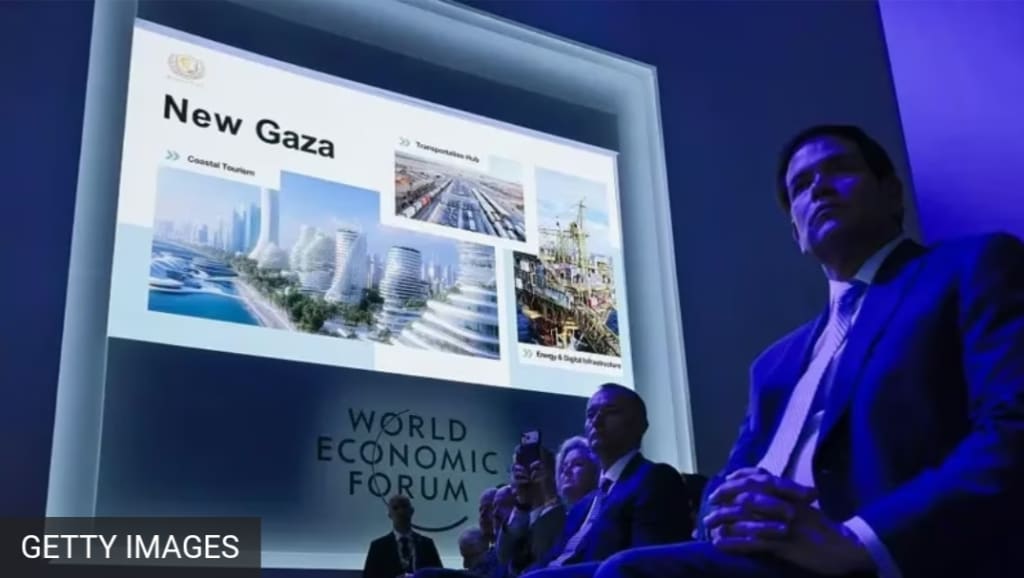
The United States has reportedly unveiled conceptual plans for a so-called “New Gaza,” a vision that imagines the war-scarred Palestinian enclave rebuilt as a modern urban center featuring skyscrapers, advanced infrastructure, and economic hubs. While details remain limited and the proposal is still at a preliminary stage, the idea has already sparked intense debate across diplomatic, humanitarian, and regional circles. Supporters see it as a bold reconstruction roadmap, while critics warn that development plans cannot be separated from political realities on the ground.
The Vision Behind “New Gaza”
According to officials familiar with the discussions, the “New Gaza” concept centers on large-scale post-conflict reconstruction. The proposal envisions transforming Gaza from a densely populated strip with fragile infrastructure into a modern coastal city, complete with high-rise residential towers, business districts, renewable energy facilities, and upgraded transport networks.
Skyscrapers have become the most striking symbol of the plan. Proponents argue that vertical development would help address Gaza’s chronic land scarcity while accommodating a growing population. Beyond housing, these towers are said to include offices, hospitals, hotels, and educational institutions, aiming to create a self-sustaining urban ecosystem rather than isolated reconstruction projects.
Economic Ambitions and Investment Strategy
A major pillar of the “New Gaza” proposal is economic revival. US officials have emphasized that physical reconstruction alone is insufficient without long-term economic opportunity. The plan reportedly includes special economic zones, technology parks, and port upgrades designed to integrate Gaza into regional and global trade networks.
International investment would be key. The US is expected to encourage participation from Gulf states, European partners, and international financial institutions. By attracting private capital alongside public aid, planners hope to reduce Gaza’s long-standing dependence on humanitarian assistance and shift toward job creation, entrepreneurship, and exports.
Infrastructure, Sustainability, and Daily Life
Infrastructure modernization is another core element. The plan highlights reliable electricity generation, potentially through solar and other renewable sources, to address Gaza’s persistent power shortages. Desalination plants and modern water networks are also part of the vision, targeting one of the enclave’s most urgent humanitarian challenges: access to clean water.
Urban planners involved in similar post-conflict projects stress that sustainability is central to the idea of “New Gaza.” Green building standards, public transportation corridors, and climate-resilient coastal defenses are reportedly under discussion. If implemented effectively, these measures could significantly improve daily life for Gaza’s residents, who have endured years of deteriorating services.
Political and Security Realities
Despite its ambitious scope, the proposal faces major political obstacles. Gaza’s future governance remains deeply contested, and any reconstruction effort would depend on durable security arrangements and political agreements. Critics argue that unveiling grand development plans without resolving questions of sovereignty, movement restrictions, and control risks turning “New Gaza” into a symbolic gesture rather than a practical solution.
Palestinian voices have also raised concerns about inclusion. Many argue that Gaza’s residents must play a central role in shaping any reconstruction plan, rather than having visions imposed from abroad. Without local ownership and political legitimacy, even the most well-funded projects could struggle to gain traction.
Regional and International Reactions
Reactions across the Middle East and beyond have been mixed. Some regional actors cautiously welcome the focus on reconstruction, seeing economic stability as a pathway to reducing conflict. Others remain skeptical, viewing the proposal as premature or disconnected from broader peace efforts.
Humanitarian organizations have also weighed in, emphasizing that immediate needs—such as shelter, healthcare, and food security—cannot be overshadowed by long-term urban visions. They stress that reconstruction must proceed alongside emergency relief and respect international humanitarian principles.
Lessons From Other Post-Conflict Rebuilds
The idea of rebuilding war-torn regions into modern cities is not new. From Beirut to Sarajevo, post-conflict reconstruction has shown that physical renewal can help heal societies, but only when paired with political reconciliation and inclusive governance. Analysts note that Gaza’s unique constraints—blockades, repeated conflicts, and limited mobility—make its case especially complex.
Skyscrapers and modern skylines can symbolize hope and progress, but they can also become hollow symbols if underlying social and political issues remain unresolved. This tension lies at the heart of the debate over “New Gaza.”
What Comes Next?
For now, the US “New Gaza” plan remains a conceptual framework rather than a finalized policy. Its future will depend on diplomatic developments, regional cooperation, and, most importantly, the voices and needs of Gaza’s people. Whether it evolves into a genuine reconstruction roadmap or fades amid political disagreements will be a key question in the months ahead.
What is clear is that the proposal has reignited global attention on Gaza’s long-term future. Beyond headlines about skyscrapers and modern cities, the real challenge lies in translating vision into reality—one that delivers dignity, opportunity, and stability to a population that has endured far too much uncertainty.Start writing...
About the Creator
Keep reading
More stories from Salaar Jamali and writers in The Swamp and other communities.
What the TikTok Deal Means for the App’s Future in the US
After years of political, legal, and diplomatic drama, TikTok has finally secured its future in the United States through a landmark deal that transforms its U.S. presence and resolves long-standing concerns from lawmakers, regulators, and national security officials. The agreement, officially finalized in January 2026, creates a new corporate structure that allows TikTok to continue operating legally and widely among its roughly 200 million U.S. users — while imposing new layers of data security and government oversight.
By Salaar Jamalia day ago in The Swamp
The Things That Almost Got Said
There are moments in life when words rise to the surface of our lips, press against our teeth, and then retreat back into silence. These are the things that almost got said — the confessions, apologies, truths, and goodbyes that never quite found their voice. They linger in our minds long after the moment has passed, replayed again and again, heavier each time.
By Aarif Lashari4 days ago in The Swamp
US, Ukraine and Russia Delegations Head to Abu Dhabi for First Trilateral Talks
In a move that could shape the trajectory of the ongoing conflict in Eastern Europe, delegations from the United States, Ukraine, and Russia are set to meet in Abu Dhabi for their first trilateral discussions. The historic talks, scheduled to take place at the UAE capital, aim to open channels for dialogue after months of heightened tensions and military escalation.
By Aarif Lasharia day ago in The Swamp


Comments
There are no comments for this story
Be the first to respond and start the conversation.