
US Power Couple Under Spotlight: How USAID and DHS Leaders Shaped Immigration and Online Control
"The Hidden Hand: USAID, DHS, and Their Surprising Connection to Indian Politics"
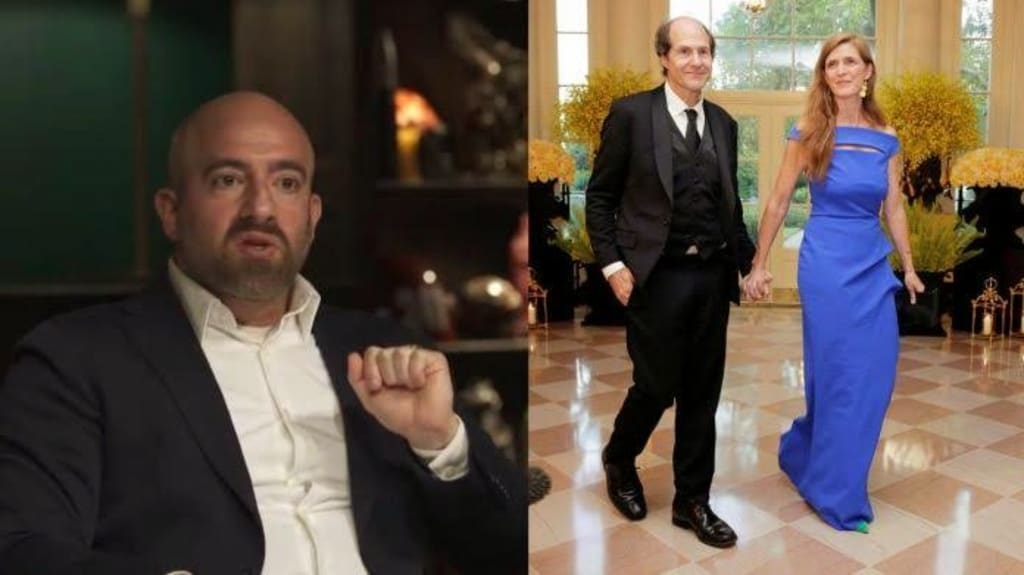
11A shocking revelation by former US diplomat Mike Benz has brought attention to how a powerful married couple might have worked together to change immigration rules and control online discussions. Let's break down this interesting story that also has surprising connections to Indian politics.
The Power Couple and Their Roles
At the center of this story are Samantha Power, who led USAID (United States Agency for International Development), and her husband Cass Robert Sunstein, who worked at the Department of Homeland Security (DHS). According to Benz, they worked together in an interesting way: Power handled the money side at USAID, spending billions to help illegal immigrants reach the US, while Sunstein worked at DHS creating policies that made it easier for these immigrants to enter and stay.
As Benz explained on the Shawn Ryan Show, it was like a tag-team effort. Power provided the funding to help people get to the US borders, and Sunstein made sure the borders stayed open with policies that prevented strict enforcement. This coordinated approach between the two agencies raised serious questions about the deliberate nature of US immigration policy changes.
Controlling Online Discussions
But there's more to this story. Sunstein wasn't just focused on immigration. He wrote an important paper called 'Conspiracy Theories' that suggested something quite concerning: the US government should get involved in online discussions to control certain ideas they didn't like.
Why did he want this? Benz explains that Sunstein worried about people sharing alternative views online, especially about things like the 9/11 attacks or US military actions in places like Afghanistan and Iraq. He thought these online discussions could make it harder for the US to work with other countries or carry out military operations.
According to Benz, Sunstein's paper specifically called for the government to "infiltrate" online spaces and influence the thinking of alternative movements. The goal was to either stop these movements entirely or change how their leaders thought about issues. This was particularly focused on preventing the spread of ideas that might make people question their governments, not just in the US but also in countries like France, Germany, and the UK.
The India Connection
This story gets even more interesting when we look at how it connects to Indian politics. There were questions raised when Congress leader Rahul Gandhi visited Uzbekistan in 2023 at the same time as Samantha Power was there. Some people wondered if this was more than just a coincidence, especially given USAID's history of involvement in international affairs.
The connection goes deeper through Sam Pitroda, who leads the Indian Overseas Congress. Pitroda started an organization called the Global Knowledge Initiative (GKI) that got money from USAID and other US organizations. This raised eyebrows because Pitroda is close to the Gandhi family and helps arrange Rahul Gandhi's international trips.
A Look at Sam Pitroda
Pitroda's story is fascinating. He used to be an American citizen but gave it up when Indira Gandhi asked him to. He later became an advisor to former Indian Prime Minister Manmohan Singh. In 2009, while advising Singh, he started GKI with two other people - Nina V. Fedoroff and Sara Farley - who had strong connections to the US government and big foundations like the Rockefeller Foundation.
Why This Matters
This story shows how government agencies and powerful individuals can work together in ways that affect both immigration policies and how information spreads online. It also raises questions about international connections and influence in different countries' politics.
The revelations by Mike Benz paint a picture of coordinated efforts to change both physical borders and the borders of online discussion. While some might see these actions as necessary for government operations, others might worry about the impact on freedom of movement and freedom of speech.
As this story continues to unfold, it reminds us how important it is to pay attention to the connections between different government agencies and international relationships, especially when they might affect multiple countries' political systems. The interconnected nature of these revelations suggests a complex web of influence that extends far beyond simple policy decisions into the realm of international relations and information control.
About the Creator
Gaza Technocratic Panel Meets for First Time, as Officials Fear It’s Hobbled from Get-Go
After months of war, uncertainty, and diplomatic maneuvering, a newly formed Gaza technocratic panel has officially met for the first time. On paper, this moment signals progress — a step toward stabilizing a territory devastated by conflict and humanitarian collapse. In reality, however, many officials and observers are already questioning whether this panel is doomed to struggle from the very beginning.
By Aqib Hussain3 days ago in The Swamp



Comments (1)
Hello, just wanna let you know that if we use AI, then we have to choose the AI-Generated tag before publishing 😊