
US Launches Strikes Against Islamic State in Nigeria: A New Chapter in Counterterrorism Engagement
Airstrikes in Sokoto Signal Washington’s Renewed Focus on Counterterrorism in West Africa

On December 25, 2025, the United States military carried out a series of precision strikes targeting Islamic State militants in northwest Nigeria, marking one of the most significant direct U.S. military actions in West Africa in years. Announced publicly by President Donald Trump on his social media platform, the operation underscores deepening U.S. involvement in Africa’s complex security landscape and highlights the ongoing global effort to counter extremist violence.
The Strategic Strikes in Sokoto State
The airstrikes were conducted in Sokoto State, a region of northwest Nigeria where militant activity linked to the Islamic State and affiliated groups has increased. According to the U.S. Africa Command (AFRICOM), the strikes were carried out in coordination with Nigerian authorities and resulted in the deaths of “multiple ISIS terrorists.”
President Trump described the operation as “powerful and deadly,” emphasizing that the U.S. military had struck militants who he said were “targeting and viciously killing, primarily, innocent Christians.” He characterized the militants with stark language, calling them “ISIS terrorist scum” and warning that the U.S. would not allow “radical Islamic terrorism to prosper.”
U.S.–Nigeria Security Cooperation
The December strikes were not a unilateral U.S. action but occurred within the framework of ongoing security cooperation between the United States and Nigeria. Nigerian government officials confirmed that the military action was consistent with structured collaboration, involving intelligence sharing and strategic coordination to enhance counterterrorism efforts.
In recent months, Nigeria has faced criticism from U.S. officials over its handling of violent extremist activity. Earlier in 2025, the U.S. designated Nigeria a “country of particular concern” under the International Religious Freedom Act, a status that allows the U.S. to impose sanctions in response to serious violations of religious freedom. Additionally, the U.S. announced visa restrictions for Nigerians involved in mass violence tied to extremist groups.
Why Now? The Context of Rising Violence
Nigeria has long grappled with multifaceted insecurity. The northeastern part of the country has been a battleground for years, primarily due to the insurgency of Boko Haram and its splinter faction, the Islamic State West Africa Province (ISWAP). More recently, lesser-known groups such as Lakurwa have emerged in the northwest, carrying out attacks on civilian communities and security forces alike.
Conflict in Nigeria is not limited to religious violence. Long-standing tensions between various ethnic and social groups, clashes over land use and resources, and communal rivalries have compounded the security crisis. These conditions have allowed extremist groups to gain footholds in remote regions.
While President Trump framed the strikes in the context of protecting Christian communities, Nigerian leaders and many analysts argue that extremist violence affects all citizens—Christians and Muslims alike. Nigeria is a highly diverse country with a near-even religious split: approximately 45 percent Christian and 53 percent Muslim. Violence in the country has historically been rooted in broader political, economic, and social issues, not solely religious persecution.
Domestic and International Reactions
The strikes have drawn attention both at home and abroad. Supporters of the operation praise the U.S. for taking decisive action against groups that threaten civilians and regional stability. For many observers, the strikes represent an important commitment to fighting terrorism beyond traditional theaters of conflict.
However, critics argue that military action alone cannot resolve Nigeria’s underlying security problems. They point out that decades of insurgency show the limits of airstrikes without significant investment in governance, economic development, and local capacity building. Nigerian authorities have echoed this sentiment, emphasizing that security challenges require more than military interventions—they require strengthening institutions, community engagement, and sustainable development strategies.
Legal and Geopolitical Dimensions
International law generally requires that military strikes in another sovereign state either be conducted with that state’s consent or under a clear mandate, such as a United Nations Security Council resolution. According to official statements, the U.S. operation in Nigeria was carried out with Nigerian cooperation and consent, which helps legitimize the action on the international stage.
Geopolitically, the strikes signal a renewed U.S. focus on African security issues at a time when global priorities are increasingly complex. While the U.S. has scaled down some military footprints across Africa in recent years, the engagement in Nigeria illustrates that Washington remains willing to act when extremist threats escalate.
Looking Ahead: What Comes Next?
The strikes are likely to have both immediate and long-term implications. In the short term, they may degrade militant capabilities in targeted regions and disrupt planned attacks. But experts caution that such operations must be paired with broader strategies that address root causes of insurgency and instability.
In response to the strikes, Nigeria reiterated its commitment to security cooperation with international partners, signaling willingness for further joint efforts. The U.S. also hinted that additional action could follow if militant violence persists.
For the people of Nigeria, especially those living in conflict-affected areas, the hope is that external assistance will translate into tangible improvements in safety and stability. For U.S. policymakers, the challenge will be balancing military action with diplomatic engagement and development partnerships that contribute to long-term peace.
---
If you’d like, I can also provide headlines, SEO titles, or social media summaries for this article. Just let me know!
About the Creator
Keep reading
More stories from Salaar Jamali and writers in The Swamp and other communities.
U.S. Strikes ISIS in Nigeria After Trump Warnings on Christian Killings
Introduction: In a dramatic escalation of U.S. military operations against ISIS, a targeted strike on the terrorist group’s cells in Nigeria was carried out recently, drawing attention to the growing security crisis in the region. The strike, which followed sharp warnings from former U.S. President Donald Trump about the targeting of Christian communities in the area, has sparked debate about the U.S.'s role in Africa and the global fight against terrorism. This article explores the context surrounding the U.S. military action, the situation facing Christians in Nigeria, and the broader geopolitical implications of the strike.
By Salaar Jamali24 days ago in The Swamp
Global Wind Power Market Size & Forecast 2025–2033: Clean Energy Momentum Reshapes the Global Power Landscape
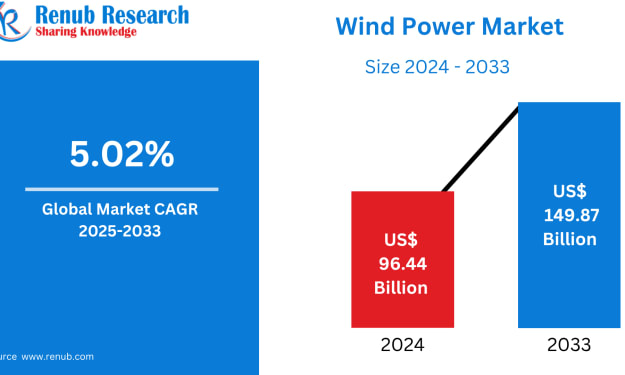
Global Wind Power Market Outlook The global energy landscape is undergoing a historic transformation as nations move away from fossil fuels and embrace renewable sources of electricity. At the center of this transition stands wind power—one of the fastest-growing and most scalable clean energy technologies worldwide. According to Renub Research, the Global Wind Power Market is expected to grow from US$ 96.44 billion in 2024 to US$ 149.87 billion by 2033, expanding at a compound annual growth rate (CAGR) of 5.02% during 2025–2033.
By Aaina Oberoiabout 10 hours ago in The Swamp



Comments
There are no comments for this story
Be the first to respond and start the conversation.