
United States Sodium-ion Battery Market Size & Forecast 2025–2033
Why Sodium-ion Batteries Are Emerging as America’s Next-Generation Energy Storage Alternative

Introduction
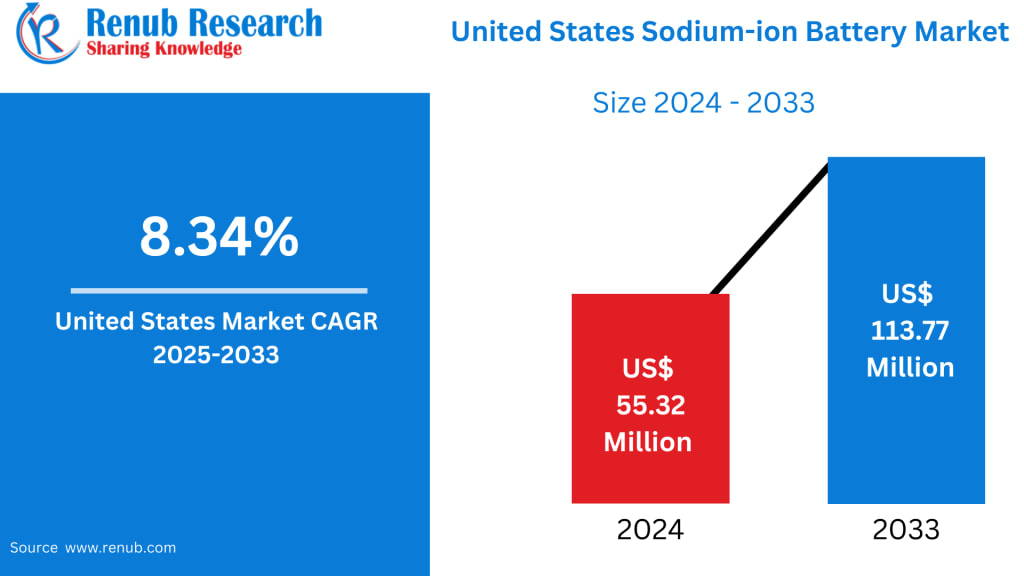
The United States sodium-ion battery market is entering a critical phase of development as the country accelerates its transition toward sustainable and domestically secure energy solutions. According to Renub Research estimates, the market is projected to grow from US$ 55.32 million in 2024 to US$ 113.77 million by 2033, registering a Compound Annual Growth Rate (CAGR) of 8.34% during 2025–2033.
This strong growth trajectory reflects increasing demand for cost-effective energy storage, rising renewable energy penetration, and mounting concerns around lithium supply chain risks. Sodium-ion batteries, once considered a niche or experimental technology, are now gaining traction as a practical alternative—particularly for grid-scale, industrial, and short-range mobility applications in the United States.
United States Sodium-ion Battery Market Outlook
A sodium-ion battery (NIB) is an electrochemical energy storage system that operates by moving sodium ions between the cathode and anode during charge and discharge cycles. Unlike lithium-ion batteries, which rely on relatively scarce and geopolitically sensitive raw materials, sodium-ion batteries use sodium—one of the most abundant elements on Earth.
This fundamental advantage positions sodium-ion technology as a more affordable, sustainable, and strategically secure option for the U.S. energy ecosystem. While sodium-ion batteries typically offer lower energy density than lithium-ion counterparts, they compensate through enhanced safety, longer cycle life in stationary applications, and superior performance across a wide temperature range.
In the United States, sodium-ion batteries are increasingly being evaluated for grid energy storage, renewable integration, backup power, and industrial energy management, with early-stage exploration in transportation and electric mobility.
Growth Drivers in the United States Sodium-ion Battery Market
Ample Raw Material Availability
One of the most powerful drivers fueling the adoption of sodium-ion batteries in the U.S. is the abundance of sodium as a raw material. Sodium can be sourced domestically through mineral deposits and seawater, eliminating heavy dependence on foreign imports.
In contrast, lithium supply chains remain vulnerable due to geographic concentration and mining constraints. As U.S. policymakers push for domestic energy independence and supply chain resilience, sodium-ion batteries offer a compelling strategic advantage. Their cost stability and scalability make them well-suited for large-scale deployment in national energy storage infrastructure.
In August 2024, a major milestone was announced when Natron Energy revealed plans to build the first large-scale sodium-ion battery manufacturing plant in the U.S., a US$ 1.4 billion facility in North Carolina with a planned annual output of 24 GWh—forty times larger than its existing Michigan facility.
Rising Demand for Grid-Scale Energy Storage
The rapid expansion of solar and wind power across the United States has intensified the need for reliable and cost-efficient energy storage solutions. Renewable energy sources are inherently intermittent, requiring storage systems capable of balancing supply and demand while ensuring grid stability.
Sodium-ion batteries are particularly well-suited for stationary storage due to their strong cycle life, low fire risk, and ability to operate in extreme temperatures. Compared to lithium-ion systems, sodium-ion batteries present a lower risk of thermal runaway, making them safer for deployment near residential and commercial zones.
In August 2025, Peak Energy announced the shipment of the largest sodium-ion phosphate pyrophosphate (NFPP) battery energy storage system in the world, marking the first grid-scale sodium-ion deployment in the U.S. The system entered pilot programs with nine utilities and independent power producers, reinforcing confidence in sodium-ion’s grid-level viability.
Sustainability and Recycling Advantages
Sustainability is becoming a defining criterion in U.S. energy policy and corporate procurement strategies. Sodium-ion batteries align strongly with environmental goals by eliminating the need for cobalt, nickel, and lithium—materials often associated with high environmental and ethical costs.
Sodium’s non-toxic nature and simpler chemistry enable more efficient recycling processes, supporting circular economy principles. As federal and state governments continue incentivizing low-carbon technologies, sodium-ion batteries are emerging as an environmentally responsible alternative across multiple sectors.
In July 2025, Inlyte Energy announced the installation of an advanced iron-sodium battery system at the Alliance Redwoods Conference Grounds in Sonoma County, California. Funded by a US$ 4.1 million U.S. Department of Energy grant, the project aims to enhance wildfire resilience and provide diesel-free backup power.
Challenges in the United States Sodium-ion Battery Market
Lower Energy Density Compared to Lithium-ion
Despite growing interest, sodium-ion batteries still face a fundamental technical challenge: lower energy density. This limitation restricts their applicability in long-range electric vehicles and compact consumer electronics, where size and weight are critical performance factors.
Although sodium-ion batteries perform well in stationary storage and short-range mobility, significant research and development investments are required to improve electrode materials and overall energy efficiency. Overcoming this hurdle remains essential for broader market penetration.
Limited Commercial Infrastructure and Ecosystem
The U.S. sodium-ion battery ecosystem is still in its early stages. Manufacturing capacity, supplier networks, and downstream integration remain limited compared to the well-established lithium-ion industry.
Most current sodium-ion deployments are pilot-scale or demonstration projects. Scaling production, reducing unit costs, and building OEM partnerships will require coordinated efforts between private companies, utilities, and government agencies.
Technology-Specific Market Segments
United States Sodium-Sulphur Battery Market
Sodium-sulphur (NaS) batteries have carved out a specialized role in long-duration energy storage. Their high operating temperatures enable strong energy density and extended cycle life, making them suitable for industrial and utility-scale applications.
While earlier safety concerns limited adoption, ongoing advancements in thermal management and system design are improving reliability. As grid resilience becomes a priority, NaS batteries are expected to see renewed interest in large-scale renewable integration projects.
United States Sodium-Air Battery Market
Sodium-air batteries remain largely in the research and pilot phase but offer extraordinary long-term potential. Their theoretical energy density rivals lithium-air systems, positioning them as a future breakthrough technology.
Challenges related to cycle stability, oxygen control, and efficiency persist. However, continued academic and startup-driven research in the United States keeps sodium-air batteries on the innovation roadmap.
Application-Based Market Analysis
Transportation Market
Sodium-ion batteries are emerging as a viable option for public transport fleets, delivery vehicles, buses, and two-wheelers. Their safety profile, affordability, and tolerance to temperature fluctuations make them ideal for urban mobility solutions.
While not yet suitable for long-range passenger EVs, sodium-ion batteries can accelerate electrification in cost-sensitive transport segments.
Automotive Market
In the automotive sector, sodium-ion batteries are being evaluated for entry-level and economy electric vehicles, where affordability and safety outweigh maximum driving range. This positioning supports broader EV adoption among price-conscious consumers.
Industrial Market
Industrial facilities, data centers, warehouses, and manufacturing plants require reliable and safe energy storage for backup power and load management. Sodium-ion batteries’ non-toxic nature and stable performance make them attractive alternatives to lithium-ion systems in industrial settings.
State-Level Market Insights
California
California leads sodium-ion adoption due to aggressive renewable energy targets and grid modernization initiatives. Sodium-ion batteries are being piloted for community storage, microgrids, and wildfire-resilient energy systems.
New York
New York’s focus on grid resilience and urban safety makes sodium-ion batteries appealing for dense population centers. Offshore wind expansion further increases demand for scalable energy storage.
Washington
Washington State’s clean energy leadership and strong research ecosystem support sodium-ion innovation, particularly for grid flexibility and renewable integration.
Market Segmentation Overview
By Type:
Sodium-Sulphur Battery
Sodium-Salt Battery
Sodium-Air Battery
By Application:
Stationary Energy Storage
Transportation
By End-User:
Consumer Electronics
Automotive
Industrial
Energy Storage
Others
By Top States:
California, Texas, New York, Florida, Illinois, Pennsylvania, Ohio, Georgia, New Jersey, Washington, North Carolina, Massachusetts, Virginia, Michigan, Maryland, Colorado, Tennessee, Indiana, Arizona, Minnesota, Wisconsin, Missouri, Connecticut, South Carolina, Oregon, Louisiana, Alabama, Kentucky, Rest of United States
Competitive Landscape
Key players operating in the U.S. sodium-ion battery ecosystem include:
Altris AB
Faradion Limited
AMTE Power plc
Natron Energy Inc.
Aquion Energy
NGK Insulators Ltd.
HiNa Battery Technology Co. Ltd.
Tiamat Energy
NEI Corporation
Each company has been analyzed across five viewpoints: overview, key personnel, recent developments, SWOT analysis, and revenue insights.
Final Thoughts
The United States sodium-ion battery market is transitioning from experimental promise to commercial reality. While lithium-ion technology continues to dominate high-energy applications, sodium-ion batteries are carving out a powerful niche in grid storage, industrial backup power, and affordable electric mobility.
With strong policy support, domestic manufacturing investments, and rising sustainability mandates, sodium-ion batteries are poised to play a vital role in America’s clean energy future. As technological improvements narrow performance gaps and infrastructure matures, sodium-ion batteries may soon become a cornerstone of the nation’s diversified energy storage portfolio.
About the Creator
jaiklin Fanandish
Jaiklin Fanandish, a passionate storyteller with 10 years of experience, crafts engaging narratives that blend creativity, emotion, and imagination to inspire and connect with readers worldwide.
Keep reading
More stories from jaiklin Fanandish and writers in The Swamp and other communities.
Global Cannabis Market Size & Forecast 2025–2033
The global cannabis market is undergoing one of the most dramatic transformations in modern consumer and healthcare history. Once viewed primarily through a legal and social stigma lens, cannabis is now evolving into a structured, regulated, and innovation-driven industry with applications spanning medicine, wellness, recreation, and even industrial manufacturing.
By jaiklin Fanandish12 days ago in The Swamp


Comments
There are no comments for this story
Be the first to respond and start the conversation.