
Global Cannabis Market Size & Forecast 2025–2033
From Stigma to Strategy: Cannabis Becomes a Global Growth Industry

The global cannabis market is undergoing one of the most dramatic transformations in modern consumer and healthcare history. Once viewed primarily through a legal and social stigma lens, cannabis is now evolving into a structured, regulated, and innovation-driven industry with applications spanning medicine, wellness, recreation, and even industrial manufacturing.
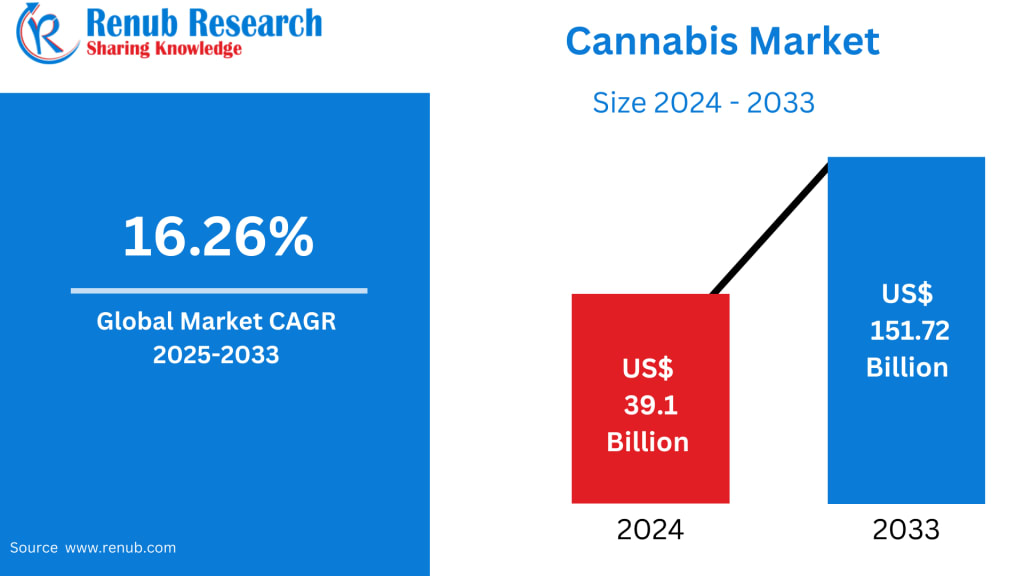
According to Renub Research, the Global Cannabis Market is anticipated to grow from US$ 39.1 Billion in 2024 to US$ 151.72 Billion by 2033, registering an impressive CAGR of 16.26% during 2025–2033. This rapid expansion is being fueled by rising legalization, increasing acceptance of medical cannabis, booming adult-use demand, and continuous product innovation across regions.
Global Cannabis Market Outlook
Cannabis, derived from the Cannabaceae family, has been used for centuries across cultures for medicinal, recreational, and industrial purposes. The plant contains more than 100 cannabinoids, with tetrahydrocannabinol (THC) and cannabidiol (CBD) being the most prominent.
THC is responsible for psychoactive effects such as relaxation and euphoria.
CBD is non-psychoactive and widely used for pain relief, anxiety reduction, inflammation control, and neurological conditions.
Beyond medicine and recreation, cannabis—especially hemp—is used in textiles, paper, biodegradable plastics, construction materials, and wellness supplements, making it a truly multi-industry commodity.
Renub Research Market Size & Forecast Snapshot
Market Size (2024): US$ 39.1 Billion
Forecast Value (2033): US$ 151.72 Billion
CAGR (2025–2033): 16.26%
This growth trajectory places cannabis among the fastest-growing regulated consumer and healthcare markets globally.
Key Growth Drivers in the Global Cannabis Market
1. Expanding Legalization Across Nations
Legal reform remains the single most powerful catalyst for cannabis market expansion. Countries such as Canada, Uruguay, and Germany have legalized cannabis for medical or recreational use, while others including Mexico and Thailand are progressively building regulatory frameworks.
In the United States, although cannabis remains federally illegal, over 20 states permit recreational use and nearly all allow medical cannabis. Legalization enhances accessibility, reduces stigma, boosts tax revenues, and encourages institutional investment.
Notably, in June 2025, Thailand introduced stricter rules requiring medical prescriptions, transitioning cannabis use toward regulated healthcare channels—demonstrating the industry’s shift from informal growth to structured governance.
2. Rising Demand for Medical Cannabis
Medical cannabis is increasingly accepted as a viable alternative to traditional pharmaceuticals, particularly for:
Chronic pain
Epilepsy
Multiple sclerosis
Cancer-related symptoms
Anxiety and sleep disorders
As opioid-related risks gain attention, cannabis-based therapies are being adopted as safer substitutes. Governments are approving cannabis-derived medicines, while clinical research continues to validate efficacy.
In May 2025, Curaleaf International expanded branded medical cannabis products in Australia, underlining the sector’s rapid internationalization and patient-centric focus.
3. Surging Recreational and Lifestyle Consumption
Recreational cannabis demand is rising rapidly, especially among Millennials and Gen Z, who view cannabis as a lifestyle and social product. Formats such as pre-rolls, edibles, infused beverages, and vape concentrates are redefining consumption patterns.
The legalization of recreational cannabis in new U.S. states, including Delaware in August 2025, continues to unlock new revenue pools. Premium branding, flavor innovation, and controlled dosing are pushing cannabis further into mainstream consumer culture.
Challenges Facing the Global Cannabis Industry
Regulatory Fragmentation
Despite progress, inconsistent regulations across countries—and within federal systems like the U.S.—create operational barriers. Banking restrictions, high taxation, and interstate trade limitations add compliance costs and discourage cross-border expansion.
The absence of harmonized international frameworks limits scalability and long-term planning for global operators.
Persistent Illicit Markets
Illegal cannabis markets continue to thrive in several regions due to lower prices and tax avoidance. These markets undercut legal operators and pose public health risks due to lack of quality control.
Combating illicit trade requires balanced taxation, strict enforcement, and differentiation through branded, lab-tested, and premium legal products.
Segment-Wise Market Analysis
Pre-Rolls Cannabis Market
Pre-rolls are among the fastest-growing product categories due to convenience and consistency. Infused pre-rolls with concentrates and terpene enhancements are gaining traction, particularly among social and occasional users.
North America and Europe dominate this segment, driven by recreational demand and brand-led innovation.
Edibles Cannabis Market
Edibles offer a smoke-free, discreet alternative, appealing to wellness-oriented and first-time users. Gummies, chocolates, baked goods, and beverages are gaining mainstream acceptance, supported by precise dosing and regulatory labeling standards.
North America leads adoption, while Europe is emerging as a strong secondary growth region.
Medical Cannabis Market
Medical cannabis remains the backbone of the global industry. Strong physician acceptance, expanding reimbursement programs, and pharmaceutical-grade distribution channels are driving sustained growth.
As aging populations and chronic disease prevalence rise, medical cannabis demand is expected to grow steadily across developed and emerging markets.
THC-Dominant Cannabis Market
THC-dominant products dominate recreational sales, especially in the U.S. and Canada. High-potency flowers, concentrates, vapes, and edibles are driving premiumization trends.
Despite stricter regulations in some regions, continued innovation in formats and branding ensures THC products remain key revenue drivers.
Minor Cannabinoids Market
Minor cannabinoids such as CBG, CBN, and THCV are emerging as high-potential niches. These compounds are linked to sleep aid, appetite regulation, and anti-inflammatory benefits.
As scientific research expands, minor cannabinoids are expected to unlock new wellness and therapeutic segments within the cannabis market.
Country-Level Market Insights
United States Cannabis Market
The U.S. is the world’s largest cannabis market, driven by widespread state-level legalization and strong consumer demand. Despite federal constraints, innovation, cultural acceptance, and investment momentum continue to propel double-digit growth.
Germany Cannabis Market
Germany leads Europe’s medical cannabis market and is transitioning toward partial adult-use legalization. Pharmacy-based distribution and pharmaceutical-grade standards position Germany as a regulatory and innovation hub for Europe.
India Cannabis Market
India’s cannabis market remains nascent due to strict laws, but growing interest in Ayurveda-based cannabis extracts, CBD wellness products, and industrial hemp signals long-term potential. Regulatory easing could unlock significant growth.
Saudi Arabia Cannabis Market
Saudi Arabia currently prohibits cannabis entirely. However, long-term wellness diversification under Vision 2030 may open discussions around hemp and CBD derivatives in the future, though legalization is not imminent.
Market Segmentation Overview
By Product Type
Flower
Pre-Rolls
Concentrates
Edibles
Beverages
Capsules/Soft-Gels
Topicals & Transdermals
Tinctures/Sublinguals
Other Product Types
By Application
Medical (Rx)
Adult-Use / Recreational
Wellness & Nutraceutical
By Compound Type
THC-Dominant
CBD-Dominant
Balanced THC : CBD
Minor Cannabinoids
Terpene / Flavonoid-rich Extracts
Key Players Analysis
Major companies shaping the competitive landscape include:
Canopy Growth Corporation
Tilray Brands, Inc.
Curaleaf
Aurora Cannabis Inc.
Jazz Pharmaceuticals plc
Green Thumb Industries
Trulieve
Cresco Labs
Organigram Global
TerrAscend
Each company has been evaluated across five viewpoints: Overview, Key People, Recent Developments, SWOT Analysis, and Revenue Performance.
Final Thoughts
The Global Cannabis Market is no longer a speculative industry—it is a structured, regulated, and innovation-led global growth engine. With Renub Research projecting a US$ 151.72 Billion valuation by 2033, cannabis is set to redefine healthcare, wellness, and consumer lifestyles worldwide.
While regulatory complexity and illicit competition remain challenges, continued legalization, medical validation, and product innovation will keep the industry on a high-growth trajectory. For investors, policymakers, and businesses alike, cannabis represents one of the most compelling long-term market opportunities of the decade.
About the Creator
jaiklin Fanandish
Jaiklin Fanandish, a passionate storyteller with 10 years of experience, crafts engaging narratives that blend creativity, emotion, and imagination to inspire and connect with readers worldwide.
Keep reading
More stories from jaiklin Fanandish and writers in The Swamp and other communities.
United Kingdom Defence Market Size & Forecast 2025–2033
United Kingdom Defence Market Outlook The United Kingdom Defence Market is poised for steady and strategic expansion over the coming decade. According to Renub Research, the market is expected to grow from US$ 50.23 billion in 2024 to US$ 72.05 billion by 2033, registering a CAGR of 4.09% during 2025–2033. This growth is underpinned by rising defence expenditure, accelerated modernization programs, rapid adoption of advanced technologies, and evolving global security challenges.
By jaiklin Fanandish13 days ago in The Swamp


Comments
There are no comments for this story
Be the first to respond and start the conversation.