
United States Household Appliances Market Size and Forecast 2025
Smart Living Drives the Next Wave of Growth Across American Homes


United States Household Appliances Market Overview
The United States Household Appliances Market is entering a robust growth phase, driven by technological innovation, evolving consumer lifestyles, and rising demand for energy-efficient and smart home solutions. According to Renub Research, the market is projected to grow from USD 97.8 billion in 2024 to USD 141.74 billion by 2033, expanding at a compound annual growth rate (CAGR) of 4.22% between 2025 and 2033.
Household appliances play an essential role in modern American life, enabling convenience, efficiency, and improved quality of living. From refrigerators and washing machines to air purifiers and smart coffee makers, these appliances support everyday activities such as cooking, cleaning, food preservation, personal care, and climate control. Over the years, appliances have evolved from basic mechanical tools into sophisticated, connected systems powered by artificial intelligence (AI), the Internet of Things (IoT), and automation.
In the United States, widespread urbanization, rising disposable incomes, and increasingly busy lifestyles have made household appliances indispensable. Consumers now expect appliances to deliver not just functionality but also energy efficiency, smart connectivity, sustainability, and sleek design. Major brands such as Samsung, LG, Whirlpool, GE Appliances, and Bosch are continuously innovating to meet these expectations, fueling strong market momentum.
Rising Demand for Energy-Efficient and Smart Appliances
One of the most significant drivers of growth in the U.S. household appliances market is the increasing demand for energy-efficient and smart appliances. Consumers are becoming more environmentally conscious and are actively seeking appliances that reduce electricity and water consumption while lowering long-term utility costs.
Smart appliances equipped with Wi-Fi connectivity, mobile app control, voice assistance, and AI-based automation are gaining strong traction. These products allow users to monitor performance remotely, optimize energy usage, and integrate appliances seamlessly with broader smart home ecosystems.
Manufacturers are responding aggressively to this shift. In February 2024, GE Appliances, a Haier subsidiary, launched its EcoBalance System, enabling consumers to optimize energy consumption by connecting appliances, air conditioners, water heaters, and smart lighting systems across multiple product lines. Such innovations are significantly strengthening consumer adoption and accelerating market growth.
Expansion of E-Commerce and Digital Retail Channels
The rapid expansion of e-commerce and online retail platforms has transformed how U.S. consumers purchase household appliances. Online channels offer competitive pricing, extensive product selections, customer reviews, financing options, and convenient home delivery, making them increasingly attractive.
Retail giants such as Amazon, Walmart, Best Buy, and Home Depot continue to invest heavily in their digital infrastructure, enhancing omnichannel experiences that seamlessly blend online browsing with in-store pickup and service support. In April 2024, Alibaba Group introduced a new 3D shopping application designed for the Vision Pro mixed-reality headset in the United States, signaling the future of immersive appliance shopping.
The ease of product comparison and access to promotional deals through digital platforms is significantly boosting appliance sales nationwide.
Urbanization and Changing Consumer Lifestyles
Urbanization remains a powerful structural driver for household appliance demand. Currently, 83% of the U.S. population lives in urban areas, a sharp rise from 64% in 1950. By 2050, urbanization is expected to reach 89%, intensifying demand for compact, multifunctional, and smart appliances suited for apartments and smaller homes.
Dual-income households and fast-paced lifestyles are increasing reliance on time-saving appliances such as dishwashers, washer-dryer combinations, robotic vacuum cleaners, and smart kitchen devices. At the same time, rising incomes are fueling demand for premium and luxury appliances that combine advanced functionality with aesthetic appeal.
Key Market Challenges
Supply Chain Disruptions and Rising Raw Material Costs
Despite strong growth prospects, the U.S. household appliances market faces challenges related to supply chain disruptions and volatile raw material prices. Global events, including geopolitical tensions and lingering effects of the COVID-19 pandemic, have impacted the availability of semiconductors, steel, plastics, and electronic components.
These disruptions have increased manufacturing costs and led to higher appliance prices, putting pressure on both manufacturers and consumers. To mitigate risks, companies are diversifying supply chains, increasing local sourcing, and investing in resilient production strategies.
Intense Competition and Price Sensitivity
The U.S. household appliances market is highly competitive, with established global players and emerging brands competing aggressively for market share. Consumers remain price-sensitive, often prioritizing affordability over premium features.
As a result, manufacturers must strike a careful balance between innovation, quality, and cost efficiency, while offering promotions, discounts, and flexible financing options to attract and retain customers.
Product Segment Insights
United States Household Dishwasher Market
The U.S. dishwasher market continues to grow as consumers prioritize convenience, hygiene, and water efficiency. Modern dishwashers feature quiet operation, smart connectivity, customizable wash cycles, and eco-friendly designs. Leading brands such as Bosch, Whirlpool, and KitchenAid dominate this segment with high-performance models tailored to busy households.
United States Household Refrigerator Market
Refrigerators remain a cornerstone of American homes. Demand is driven by advancements in smart refrigeration, energy efficiency, and enhanced storage solutions. French-door and side-by-side models are especially popular. Brands like Samsung, LG, and GE lead the market with Energy Star-certified models featuring touchscreens, temperature zoning, and smart home integration.
United States Household Washing Machine and Dryers Market
Rising urbanization and space constraints are boosting demand for high-efficiency washers, dryers, and washer-dryer combos. Consumers increasingly prefer appliances with app-based controls, water-saving technologies, and advanced drum systems. Whirlpool, Maytag, and Electrolux remain key players in this segment.
United States Household Coffee Makers Market
Coffee makers are a staple in U.S. households. Demand is strong for pod-based, espresso, programmable, and smart coffee machines that offer convenience and customization. Market leaders such as Keurig, Nespresso, and Breville continue to innovate with feature-rich designs tailored to evolving consumer preferences.
United States Household Toasters Market
The toaster market is expanding with growing interest in multifunctional and compact breakfast appliances. Smart toaster ovens with air-frying, baking, and digital control features are gaining popularity. Cuisinart, Breville, and Hamilton Beach are driving innovation in this segment.
United States Household Air Purifiers Market
Heightened awareness of indoor air quality has fueled strong growth in the air purifier segment. Consumers increasingly opt for models equipped with HEPA filters, activated carbon filters, UV technology, and real-time air quality monitoring. Leading brands include Dyson, Honeywell, and Blueair.
Distribution Channel Insights
Electronic Stores
Electronic retailers such as Best Buy, Lowe’s, and Home Depot remain key distribution channels. These stores offer hands-on product demonstrations, expert guidance, financing options, and reliable after-sales support, strengthening consumer confidence.
Hypermarkets and Supermarkets
Chains like Walmart, Target, and Costco play a vital role by offering competitive pricing, bundled deals, and one-stop shopping convenience. Their wide reach and affordability make them an essential channel for appliance sales.
Regional Market Insights
East United States
The Eastern U.S. leads in demand for smart, energy-efficient, and premium appliances, driven by high urban density and income levels in cities such as New York, Boston, and Washington, D.C.
West United States
The Western region, particularly California, is at the forefront of eco-friendly and smart appliance adoption. Strong environmental regulations and tech-savvy consumers drive demand for advanced, low-energy solutions.
Market Segmentation
By Appliances:
Major Appliances: Water Heaters, Dishwashers, Refrigerators, Cooktops & Ovens, Vacuum Cleaners, Washing Machines & Dryers, Air Conditioners
Small Appliances: Coffee Makers, Toasters, Blenders, Hair Dryers, Air Purifiers, Rice Cookers, Air Fryers, and more
By Distribution Channel:
Hypermarkets & Supermarkets, Electronic Stores, Exclusive Brand Outlets, Online, Others
By Region:
East, West, North, South
Key Players Profiled
Whirlpool Corporation
GE Appliances
Samsung Electronics Co., Ltd.
LG Electronics
Robert Bosch GmbH
Electrolux AB
Panasonic Corporation
Haier Group
Fisher & Paykel Appliances Holdings Ltd.
(All companies are analyzed across overviews, leadership, recent developments, and revenue performance.)
Final Thoughts
The United States Household Appliances Market is on a strong upward trajectory, supported by smart home adoption, sustainability initiatives, digital retail expansion, and evolving consumer lifestyles. With the market expected to reach USD 141.74 billion by 2033, manufacturers that focus on innovation, energy efficiency, and customer-centric design will be best positioned to thrive.
As American households increasingly embrace connected living and environmentally responsible choices, household appliances will remain at the center of modern, efficient, and comfortable homes.
About the Creator
Janine Root
Janine Root is a skilled content writer with a passion for creating engaging, informative, and SEO-optimized content. She excels in crafting compelling narratives that resonate with audiences and drive results.
Keep reading
More stories from Janine Root and writers in The Swamp and other communities.
United States Automotive Robotics Market Trends & Summary
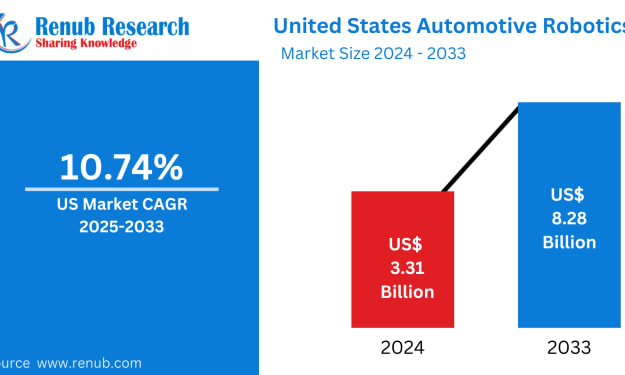
The United States automotive robotics industry is entering a transformative decade, rapidly evolving with advances in automation, AI, and smart manufacturing. According to Renub Research, the market is expected to grow from US$ 3.31 billion in 2024 to US$ 8.28 billion by 2033, recording a strong CAGR of 10.74% during 2025–2033. This expansion reflects mounting demand for precision-driven production, rising electric vehicle (EV) manufacturing, and the growing need for cost-efficient, high-speed automotive assembly processes.
By Janine Root about a month ago in The Swamp


Comments
There are no comments for this story
Be the first to respond and start the conversation.