
United States Automotive Robotics Market Trends & Summary
Automation, AI Integration, and EV Manufacturing Propel the Next Era of Robotics in U.S. Automotive Production

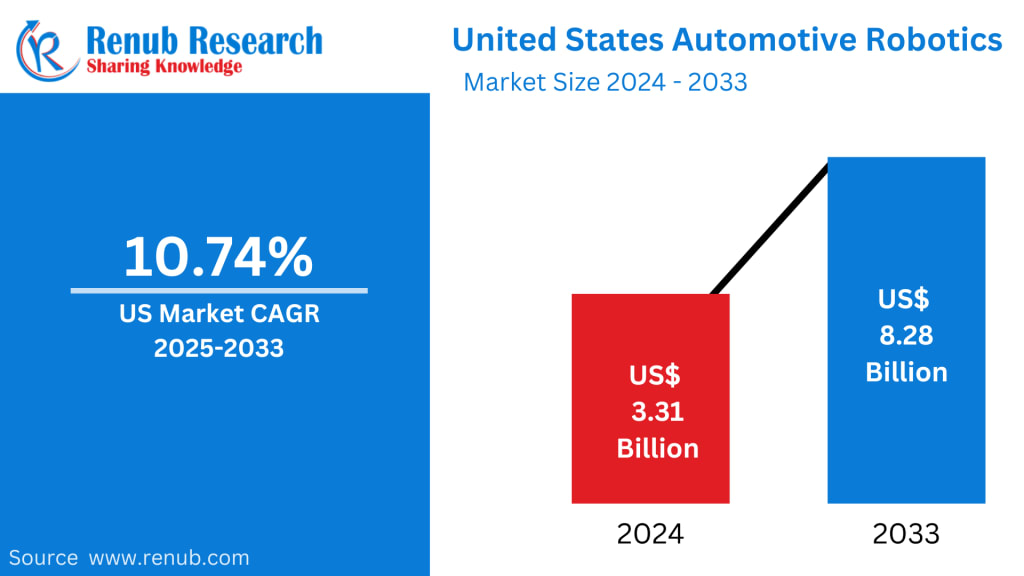
The United States automotive robotics industry is entering a transformative decade, rapidly evolving with advances in automation, AI, and smart manufacturing. According to Renub Research, the market is expected to grow from US$ 3.31 billion in 2024 to US$ 8.28 billion by 2033, recording a strong CAGR of 10.74% during 2025–2033. This expansion reflects mounting demand for precision-driven production, rising electric vehicle (EV) manufacturing, and the growing need for cost-efficient, high-speed automotive assembly processes.
From welding and painting to battery assembly and quality inspections, robotics are reshaping America’s automotive plants. As manufacturers embrace Industry 4.0 standards, automation is no longer a competitive advantage—it’s a necessity for survival in a global market defined by speed, efficiency, and innovation.
A New Outlook for the U.S. Automotive Robotics Market
Automotive robotics refers to the use of automated systems to perform essential functions in vehicle manufacturing, including welding, assembly, material handling, cutting, and inspection. These robots offer unmatched speed and precision, eliminating human error while enhancing worker safety by performing tasks considered hazardous, repetitive, or highly technical.
In the U.S., automotive giants and tier-1 suppliers rely on robots to strengthen productivity and maintain global competitiveness. The rise of electric and autonomous vehicles has intensified this trend. EV battery manufacturing, lightweight material handling, and high-precision wiring demand exceptional accuracy—making robotic automation indispensable. Meanwhile, collaborative robots (cobots) enable safe human–robot teamwork for flexible assembly lines.
Investments in Industry 4.0 are pushing automakers to incorporate AI-driven robotics, predictive maintenance tools, and real-time data analytics to optimize operations. The result is a U.S. automotive market increasingly defined by intelligent automation, offering cost savings, enhanced product quality, and faster manufacturing cycles.
Growth Drivers in the U.S. Automotive Robotics Market
1. Surging Automation Across Vehicle Production
The U.S. automotive industry is accelerating its adoption of automation to boost production efficiency, reduce labor-intensive processes, and improve product consistency. Automakers today rely on robots for:
Welding
Painting
Material handling
Assembly
Inspection and testing
With EV manufacturing on the rise, precision and speed matter more than ever. Robots ensure consistent quality, reduce waste, and maintain high throughput across production lines.
A notable example came in July 2024, when Massimo Group announced the installation of a new automated assembly robot line at its 376,000-square-foot factory in Garland, Texas, enhancing ATV and UTV vehicle production. This reflects a national trend toward automation to meet market demand while lowering long-term operational costs.
2. AI and Machine Learning Transforming Robotics
Artificial intelligence (AI) is revolutionizing automotive robotics across the United States. AI-powered robots bring advanced capabilities such as:
Predictive maintenance
Real-time data analysis
Automated fault detection
Adaptive decision-making
Enhanced machine vision
Machine vision systems, in particular, detect microscopic defects during assembly—ensuring high-quality automotive components.
A major milestone occurred in January 2025, when NVIDIA launched NVIDIA Cosmos™, a powerful platform equipped with generative world models and accelerated video processing pipelines. Designed to support autonomous vehicles and robotics, Cosmos marks a leap forward for physical AI systems that rely on simulated environments for training and testing.
3. Rising Production of Electric and Autonomous Vehicles
As the U.S. transitions toward EV and autonomous vehicle manufacturing, robotics are essential for meeting new production challenges. EVs require:
High-precision battery fabrication
Lightweight material handling
Complex wiring systems
Sensor and software integration
Robots perform these tasks faster and more accurately than human labor alone.
The autonomous vehicle sector is also expanding. In April 2024, Waymo began charging for robotaxi rides in Los Angeles, marking a new era for commercial self-driving operations. Such milestones push automakers to increase their robotics investments for efficient and scalable production lines capable of supporting EV and AV growth.
Market Challenges
While opportunities abound, the U.S. automotive robotics market faces notable hurdles.
1. High Upfront Investment and Maintenance Costs
Implementing robotics comes with a substantial price tag. Manufacturers must invest in:
Robotic arms
Sensors
Controllers
Software integration
Skilled personnel for operation & maintenance
Small and medium enterprises (SMEs) often struggle with these expenses, slowing broader market adoption. Although automation yields long-term cost savings, the heavy initial investment remains a significant barrier.
2. Workforce Displacement and the Skills Gap
The rise of robotics has heightened concerns about labor displacement. While robots reduce the need for manual labor, they also create demand for:
Programmers
Robotics engineers
Maintenance specialists
Data analysts
However, the U.S. faces a shortage of workers trained in advanced robotics technologies. Upskilling programs and workforce reskilling are essential to bridging this gap and ensuring smooth human–robot integration in automotive factories.
Market Analysis by Key Segments
Below is an overview of the major segments shaping the United States automotive robotics market.
United States Automotive Robotics Sensors Market
Sensors are central to robotic intelligence, enabling robots to:
Detect objects
Calculate distances
Capture real-time data
Perform precision tasks
Navigate safely
Demand is rising for advanced sensors such as:
LiDAR
Infrared sensors
Machine vision systems
These technologies elevate accuracy and enable smart automation within U.S. automotive plants.
United States Automotive Robotics Controller Market
Controllers act as the brain of robotic systems. They coordinate movement, manage workflows, and enable robots to learn from data. Automakers are increasingly adopting:
AI-enhanced controllers
Real-time decision systems
Predictive maintenance tools
As Industry 4.0 adoption accelerates, advanced controllers integrate more seamlessly with factory networks, sensors, and automated production lines.
United States Automotive Robotics Articulated Robot Market
Articulated robots dominate U.S. production lines thanks to their:
Flexibility
Multi-jointed structure
Ability to handle complex tasks
These robots excel at welding, assembly, and material handling, especially in tight spaces. Automakers favor articulated robots for their precision and scalability—qualities crucial for EV and lightweight vehicle manufacturing.
United States Automotive Robotics Cartesian Robot Market
Cartesian robots—also known as gantry robots—move along linear axes and provide superior:
Stability
Speed
Repeatability
They are widely used in:
Engine assembly
Packaging
Cutting and trimming tasks
High-precision component placement
Their ability to perform repetitive tasks with unmatched consistency makes them a vital asset in U.S. automotive factories.
United States Automotive Robotics Welding Market
Welding remains one of the most robotics-intensive applications in automotive manufacturing. Robotic welding systems deliver:
Uniform welds
Reduced defects
Faster cycle times
AI-assisted quality improvements
As EVs grow in popularity, lightweight frames require precise welding techniques—further boosting adoption of robotic welding systems.
United States Automotive Robotics Cutting Market
Robotic cutting systems are fundamental in producing:
Vehicle frames
Engine components
Plastic and composite parts
Laser cutting robots are particularly popular due to their ability to perform intricate cuts with unparalleled accuracy. Robotics ensure smoother production lines, higher levels of safety, and reduced waste, aligning with automakers' push for aerodynamic designs and lower vehicle weights.
Key Company Developments in the U.S. Automotive Robotics Market
Major companies continue to expand their robotics capabilities through investments, new product launches, and partnerships:
July 2024 – Rapyuta Robotics introduced its Rapyuta ASRS to the U.S., offering scalable, high-efficiency automated storage systems.
May 2024 – Comau showcased new AI-powered robotic automation systems at Automate, North America’s premier industrial automation event.
September 2024 – TOMA™ launched its advanced palletizing interface integrating industrial-grade robotics with usability-focused design.
February 2024 – OMRON Automation Americas unveiled the MD Series autonomous mobile robots (AMRs) to improve material transport efficiency.
July 2024 – FANUC America expanded its footprint with a new 650,000 sq. ft. facility in Michigan, doubling down on U.S. automation investment.
June 2024 – Rockwell Automation deepened its partnership with NVIDIA to develop smarter, safer industrial AI mobile robots.
United States Automotive Robotics Market Segmentation
Component
Sensors
Controller
End Effector
Robotic Arm
Drive
Others
Type
Articulated
Cartesian
SCARA
Cylindrical
Others
Application
Welding
Material Handling
Painting
Cutting
Others
Key Players Covered (5-Viewpoint Analysis: Overview, Key Persons, Revenue, Recent Developments)
ABB
FANUC Corporation
Yaskawa Electric Corporation
Omron Adept Robotics
Kawasaki Robotics
Harmonic Drive System
Nachi-Fujikoshi Corp.
KUKA Robotics
Final Thoughts
The United States automotive robotics market is moving rapidly toward a future defined by intelligent automation, electrification, and AI-powered manufacturing. With its projected rise to US$ 8.28 billion by 2033, the industry is set for substantial expansion. Robotics will continue to drive productivity, enhance workplace safety, and ensure precision in EV and autonomous vehicle manufacturing.
As automakers modernize their production ecosystems, the integration of robotics, AI, and Industry 4.0 frameworks will define the next phase of U.S. automotive competitiveness. Despite challenges such as high initial investment and workforce reskilling needs, the long-term gains in efficiency, sustainability, and innovation make robotics indispensable to the future of the automotive industry.
About the Creator
Janine Root
Janine Root is a skilled content writer with a passion for creating engaging, informative, and SEO-optimized content. She excels in crafting compelling narratives that resonate with audiences and drive results.
Keep reading
More stories from Janine Root and writers in The Swamp and other communities.
Global Smart Parking Market Trends & Summary
The global smart parking market is experiencing one of the most rapid technological transformations within the urban mobility ecosystem. According to Renub Research, the market is projected to reach USD 8.57 billion in 2024 and expand at an impressive 22.14% CAGR between 2025 and 2033, ultimately achieving a valuation of USD 51.82 billion by 2033. This remarkable growth is fueled by the widespread adoption of IoT, data analytics, and digital mobility platforms—technologies that are revolutionizing the way cities and commercial hubs manage parking demand, traffic flow, and sustainability goals.
By Janine Root about a month ago in The Swamp
E.U. and South America Agree to Form Massive Free-Trade Zone Spanning 700 Million People
Introduction The European Union and a group of South American nations have reached a landmark agreement to create a vast free-trade zone encompassing nearly 700 million people, marking one of the most significant global trade developments in recent years. The deal aims to reduce tariffs, streamline regulations, and strengthen economic cooperation between two regions seeking to diversify trade partnerships amid global uncertainty.
By Mohammed Azam2 days ago in The Swamp
'20/20'
"Do It Again" the track that would ultimately open the Beach Boys final album on Capitol Records which was released on February 10th 1969 had originally been released as a single in August of 1968. The track was the first of many post-Pet Sounds era throwbacks to the early Beach Boys sound which would become continually more cliched and eventually lead the Beach Boys to the level of self-parody they would eventually succumb to in the 1980s while their closest contemporaries The Beatles nearing the end of their run in 1969 would go on to be viewed as the most influential band of all time. However, the song itself is not bad on its surface, and it opens with a futuristic sounding (for 1969) drumbeat captured by then-Beach Boys engineer Stephen Desper using tape delays on the drums performed by Dennis Wilson and John Guerin. The song has been re-recorded numerous times over the years on various Beach Boys-related projects most notably the 2011 re-recording at Capitol studios featuring the five surviving Beach Boys at the time backed instrumentally by various members of both the Brian Wilson Band and Mike Loves touring "Beach Boys" to promote the then upcoming Beach Boys 50th Anniversary reunion tour in 2012. The hammering and power drill sound at the end of the song was an excerpt from a track called "Workshop" that was to be a part of the uncompleted "SMiLE" album.
By Sean Callaghan6 days ago in Beat


Comments
There are no comments for this story
Be the first to respond and start the conversation.