
United States E-Commerce Payment Market Size & Forecast 2026–2034
How Digital Wallets, BNPL, and Secure Payment Technologies Are Redefining Online Commerce in the U.S.

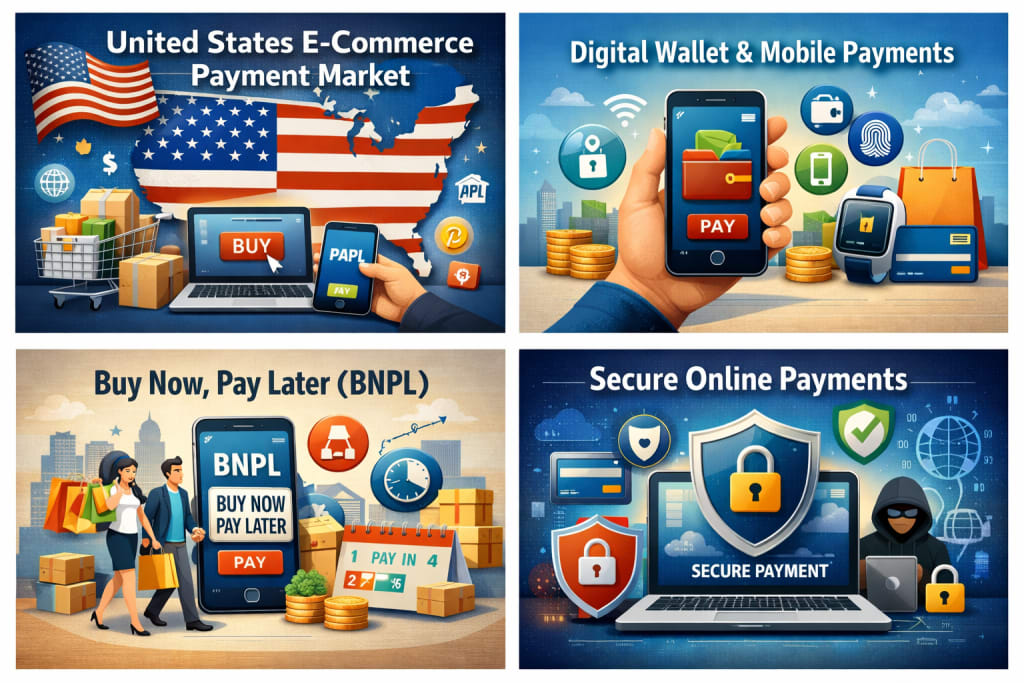
United States E-Commerce Payment Market Overview
The United States e-commerce payment market is undergoing a transformative phase, driven by rapid digital adoption, changing consumer behavior, and continuous innovation in payment technologies. According to Renub Research, the U.S. online payment market is projected to expand from US$ 1.54 trillion in 2025 to US$ 3.80 trillion by 2034, registering a compound annual growth rate (CAGR) of 10.55% during 2026–2034.
This growth reflects the increasing reliance on digital commerce platforms, mobile shopping, subscription-based services, and omnichannel retail models. Consumers now expect fast, frictionless, and secure checkout experiences, compelling merchants and payment service providers to continually enhance payment infrastructure and user experience.
E-commerce payments refer to the digital methods and technologies used to process online transactions when consumers purchase goods or services via websites, mobile apps, or digital marketplaces. These methods include credit and debit cards, digital wallets, account-to-account transfers, buy-now-pay-later (BNPL) solutions, prepaid instruments, and emerging contactless or biometric payment technologies.
United States E-Commerce Payment Market Analysis
The United States has one of the world’s most advanced e-commerce payment ecosystems, supported by strong internet penetration, widespread smartphone usage, and a mature financial services sector. Credit and debit cards continue to dominate online transactions due to their familiarity and universal acceptance. However, digital wallets and mobile payment solutions are rapidly gaining market share because of their convenience, speed, and enhanced security features.
The expansion of subscription commerce, on-demand services, and social commerce has further increased the need for reliable and scalable payment systems. Consumers now transact across multiple channels—websites, mobile apps, and social platforms—creating demand for seamless, interoperable payment solutions. Advanced cybersecurity frameworks, combined with fintech innovation, are accelerating the adoption of sophisticated e-commerce payment platforms across the country.
Growth Drivers in the United States E-Commerce Payment Market
Rapid Expansion of E-Commerce and Omnichannel Retail
One of the most significant drivers of the U.S. e-commerce payment market is the continued growth of online shopping and omnichannel retail. Consumers increasingly shop across multiple touchpoints, including e-commerce websites, mobile apps, social media platforms, and digital marketplaces. This shift has intensified demand for flexible payment options that function seamlessly across channels.
Direct-to-consumer brands, digital marketplaces, and subscription-based services are fueling transaction volumes. Features such as same-day delivery, click-and-collect, and mobile commerce require payment systems that integrate smoothly with logistics, inventory, and customer experience platforms. The competitive landscape of online retail continues to push merchants toward faster, more reliable, and customer-friendly payment solutions.
Increased Use of Digital Wallets and Mobile Payment Services
Digital wallets have emerged as one of the fastest-growing payment methods in the United States e-commerce ecosystem. Consumers favor digital wallets because they offer one-click checkout, stored credentials, and enhanced security through tokenization and biometric authentication.
Mobile commerce growth has further accelerated wallet adoption, particularly among younger consumers who prioritize convenience and speed. Merchants benefit from higher approval rates, reduced cart abandonment, and stronger customer loyalty when offering wallet-based payments. Integration with loyalty programs and BNPL options has made digital wallets even more attractive, positioning them as a core component of modern e-commerce strategies.
Advancements in Payment Technology and Fraud Protection
Technological innovation plays a critical role in shaping the U.S. e-commerce payment market. The use of artificial intelligence, machine learning, and real-time analytics has significantly improved fraud detection and prevention capabilities. These tools enable payment providers to identify suspicious transactions while maintaining a smooth customer experience.
Tokenization, multi-factor authentication, and secure application programming interfaces (APIs) are now standard components of advanced payment systems. Real-time payment infrastructure and instant settlement capabilities are further enhancing trust and efficiency. The introduction of instant payment frameworks has expanded use cases across payroll, insurance payouts, and recurring digital transactions.
Challenges in the U.S. E-Commerce Payment Industry
Rising Cybersecurity Risks and Payment Fraud
Despite technological progress, cybersecurity threats remain a major challenge for the e-commerce payment industry. Data breaches, account takeovers, and sophisticated fraud schemes continue to evolve, posing risks to both consumers and merchants. High-profile incidents can erode consumer trust and increase compliance and remediation costs for businesses.
Smaller merchants, in particular, may struggle to invest in advanced fraud prevention tools, making them more vulnerable to attacks. As transaction volumes grow, maintaining security while ensuring frictionless checkout remains a delicate balance.
Complex Regulatory and Compliance Landscape
The U.S. e-commerce payment market operates within a complex regulatory environment encompassing data protection, anti-money laundering (AML), consumer protection, and security standards. Compliance with federal and state-level regulations can be costly and resource-intensive, especially for companies operating across multiple jurisdictions.
For businesses engaged in cross-border e-commerce, global regulatory requirements further increase complexity. Keeping pace with evolving compliance standards remains a persistent challenge for payment service providers and merchants alike.
United States E-Commerce Digital Wallet Payment Market
Digital wallets represent one of the most rapidly expanding segments of the U.S. e-commerce payment market. Consumers value the speed, convenience, and security offered by wallets, which eliminate the need to repeatedly enter card details. One-click payments, mobile integration, and compatibility with BNPL solutions have significantly boosted adoption.
Merchants increasingly promote wallet usage to reduce checkout friction and improve conversion rates. As mobile shopping and app-based commerce continue to grow, digital wallets are expected to play an increasingly dominant role in the U.S. e-commerce payment landscape.
United States E-Commerce Credit Card Payment Market
Credit cards remain the most widely used payment method for online transactions in the United States. Their popularity stems from widespread acceptance, reward programs, fraud protection, and chargeback mechanisms. Credit cards are particularly favored for higher-value purchases and subscription services.
Although alternative payment methods are gaining traction, credit cards continue to account for a substantial share of e-commerce transactions. Their integration with digital wallets and mobile platforms further reinforces their relevance in the evolving payments ecosystem.
United States E-Commerce Prepaid Payment Market
Prepaid payment solutions are gradually gaining acceptance within the U.S. e-commerce market. These options appeal to consumers seeking greater spending control, privacy, or access without traditional banking relationships. Prepaid cards and digital prepaid solutions are commonly used for gifting, subscriptions, and youth-oriented services.
As digital distribution channels expand, prepaid payment instruments are expected to witness steady growth, contributing to greater financial inclusion within the e-commerce ecosystem.
Application-Wise Market Insights
Electronics & Media
The electronics and media segment is a major contributor to e-commerce payment volumes in the United States. High demand for smartphones, laptops, gaming devices, and digital subscriptions drives frequent and high-value transactions. Credit cards and digital wallets dominate this segment, while BNPL solutions are gaining popularity for expensive electronics.
Fashion Accessories
Online fashion retail continues to grow steadily, driven by social commerce, influencer marketing, and direct-to-consumer brands. Consumers prefer fast, flexible payment options, making digital wallets, mobile payments, and BNPL services particularly popular. Credit cards remain important for premium and luxury purchases.
State-Wise Market Analysis
California
California represents one of the largest and most advanced e-commerce payment markets in the United States. Strong digital infrastructure, a thriving tech ecosystem, and high adoption of digital wallets and BNPL solutions characterize the state’s payment landscape. Advanced fraud prevention and AI-driven risk management tools are widely used by merchants.
New York
New York’s e-commerce payment market benefits from a strong financial services presence and diverse consumer base. Credit cards, mobile payments, and bank-led payment solutions are widely adopted. Industries such as fashion, media, and luxury goods significantly contribute to transaction volumes.
New Jersey
New Jersey’s proximity to major logistics hubs and high per-capita income support consistent growth in e-commerce payments. Secure payment options, including tokenization and mobile commerce solutions, are increasingly adopted by retailers across the state.
Texas
Texas is one of the fastest-growing e-commerce payment markets in the U.S., driven by population growth, digital adoption, and expanding small and medium-sized online businesses. Mobile payments, digital wallets, and BNPL solutions are particularly popular among consumers.
Competitive Landscape and Company Analysis
The U.S. e-commerce payment market is highly competitive, with global technology companies, card networks, and fintech firms driving innovation. Major players include Amazon.com Inc., American Express Company, Apple Inc., Fiserv Inc., Mastercard Incorporated, PayPal Holdings Inc., and Visa Inc..
Each company is analyzed across five viewpoints: overview, key leadership, recent developments, SWOT analysis, and revenue performance. Continuous investment in security, user experience, and global scalability remains central to competitive differentiation.
Market Segmentation
By Type:
Digital Wallet, Credit Card, Debit Card, Account-to-Account (A2A), Buy Now Pay Later (BNPL), Cash on Delivery (CoD), Prepaid, Others
By Application:
Electronics & Media, Food & Personal Care, Fashion Accessories, Furniture & Appliances, Others
By Geography:
California, Texas, New York, Florida, Illinois, Pennsylvania, Ohio, Georgia, New Jersey, and Rest of the United States
Final Thoughts
The United States e-commerce payment market is set for robust and sustained growth through 2034, driven by digital commerce expansion, mobile payment adoption, and continuous innovation in payment technologies. While challenges related to cybersecurity and regulatory compliance persist, advancements in fraud prevention and real-time payment infrastructure are strengthening trust across the ecosystem.
As consumer expectations evolve toward faster, safer, and more flexible payment experiences, merchants and payment providers that invest in innovation and security will be best positioned to capitalize on the market’s long-term growth potential.
About the Creator
Keep reading
More stories from shibansh kumar and writers in The Swamp and other communities.
United States Business Intelligence Market Size and Forecast 2026–2034
Introduction The United States Business Intelligence (BI) market is undergoing a pivotal transformation as organizations increasingly rely on data-driven strategies to navigate complexity, competition, and rapid digital change. According to Renub Research, the U.S. Business Intelligence market is projected to expand from US$ 12.03 Billion in 2025 to US$ 21.64 Billion by 2034, registering a compound annual growth rate (CAGR) of 6.74% during the forecast period 2026–2034.
By shibansh kumar2 days ago in The Swamp
Ukrainian Armor Develops FPV Drone With 120mm Mortar Round
Innovative military technology could change battlefield tactics Ukrainian defense engineers have announced the development of a first-person view (FPV) drone capable of carrying a 120mm mortar round, marking a significant step forward in battlefield innovation. This development comes amid ongoing conflict in the region, where both defensive and offensive technologies are evolving rapidly. The new FPV drone combines remote aerial maneuverability with heavy firepower, allowing operators to engage targets with precision while minimizing risks to personnel. Experts suggest this technology could have major implications for modern warfare, particularly in asymmetric and urban combat scenarios. What Is an FPV Drone With a Mortar Round? FPV drones allow operators to see the drone’s perspective in real time, often through goggles or a screen. Unlike standard surveillance drones, the Ukrainian FPV drone is designed to carry and deploy a 120mm mortar round, a type of explosive weapon traditionally launched from a stationary mortar tube. Key features of the drone include: Aerial maneuverability to navigate complex terrain Live video feed for accurate targeting Payload capacity to carry heavy ordnance safely Potential for precision strikes in areas inaccessible to conventional artillery This combination of technology enables soldiers to deliver firepower more flexibly, reducing exposure to enemy fire and improving operational efficiency. Potential Advantages on the Battlefield Military analysts note several advantages that FPV mortar drones could provide: Precision Targeting Operators can adjust flight paths and deploy rounds with high accuracy, reducing collateral damage. Rapid Deployment Unlike traditional mortars, which require setup and repositioning, drones can reach targets quickly from different angles. Minimized Risk to Personnel Drones can be operated remotely, keeping soldiers out of harm’s way during attacks. Urban Combat Capability The maneuverable design allows drones to navigate tight spaces in urban environments where conventional artillery might be less effective. Psychological Impact The presence of armed drones can influence enemy behavior, creating uncertainty and forcing defensive adjustments. Challenges and Considerations Despite its potential, the FPV drone with a mortar round also presents challenges: Payload Limitations: Carrying a heavy mortar round affects flight stability and battery life. Operational Training: Drone operators require specialized skills to manage flight, targeting, and ordnance deployment safely. Vulnerability to Countermeasures: Drones may be targeted by anti-aircraft systems or electronic warfare measures. Ethical and Legal Concerns: Deploying drones with explosives raises questions about rules of engagement and civilian safety. Experts stress that while innovative, such technologies must be integrated carefully into military strategy to maximize effectiveness and reduce unintended risks. Global Context of Armed Drones The development of armed drones is part of a broader trend in modern warfare. Many countries are exploring unmanned aerial systems (UAS) for precision strikes, reconnaissance, and logistics. FPV drones with heavy ordnance are particularly relevant in conflicts where: Traditional artillery may be restricted by geography or infrastructure Rapid tactical response is essential Minimizing personnel exposure is a priority Ukrainian innovation reflects this trend, combining advanced drone technology with conventional artillery in a new, potentially transformative way. Implications for Future Combat The Ukrainian FPV drone could influence how military planners approach urban combat, defensive positioning, and strike strategy. Potential implications include: Increased reliance on unmanned systems for frontline operations Evolution of anti-drone countermeasures to defend against remote strikes Integration of real-time intelligence with weapons delivery for faster decision-making Changes in tactical training to account for aerial threats in both offensive and defensive contexts Military analysts predict that innovations like this could accelerate the shift toward unmanned and semi-autonomous warfare, particularly in high-intensity conflict zones. Expert Opinions Defense experts note that combining FPV drone technology with traditional mortar rounds is a clever adaptation that leverages existing weaponry in a new format. Strategic Analyst Maria Kovalenko says: “This approach allows forces to project firepower safely and accurately, potentially redefining small-unit tactics.” Drone Technology Specialist Alexei Petrov adds: “The challenge will be balancing payload and maneuverability. If successful, it could serve as a model for other countries developing similar systems.” The technology also reflects a broader push in Ukraine to modernize defense capabilities amid ongoing geopolitical tensions. Conclusion The development of an FPV drone capable of carrying a 120mm mortar round represents a major innovation in military technology. By combining mobility, precision, and firepower, Ukrainian engineers have created a tool that could transform battlefield tactics, particularly in urban and asymmetric warfare. While challenges remain—including payload limits, operational complexity, and countermeasure vulnerability—the potential advantages in speed, accuracy, and personnel safety are clear. This development underscores the ongoing evolution of warfare, where drones increasingly play a central role in both offensive and defensive strategies. As conflicts continue to evolve, the integration of unmanned systems with traditional weaponry may become a key determinant of tactical success, highlighting the importance of innovation in modern defense.
By Fiaz Ahmed 6 days ago in The Swamp
Who Is Tom Homan, Trump’s ‘Border Tsar’ Deployed to Minneapolis?
Tom Homan, the former acting director of U.S. Immigration and Customs Enforcement (ICE) under the Trump administration, has been deployed to Minneapolis in what officials describe as a federal support mission. Homan, often referred to as Trump’s “border tsar,” is known for his hardline stance on immigration enforcement, and his presence in Minnesota has drawn significant attention and sparked debate among local leaders, activists, and federal officials.
By Ayesha Lashari7 days ago in The Swamp




Comments
There are no comments for this story
Be the first to respond and start the conversation.