
United States Autonomous Vehicles Market Size & Forecast 2026–2034
How AI, Sensors, and Policy Shifts Are Driving America Toward a Self-Driving Future

Introduction: A New Era of Mobility Takes Shape
The United States is standing at the edge of a transportation revolution. Autonomous vehicles—once considered science fiction—are rapidly becoming a practical reality on American roads. Powered by advances in artificial intelligence, sensor technologies, high-performance computing, and vehicle connectivity, self-driving systems are reshaping how people and goods move across the country.
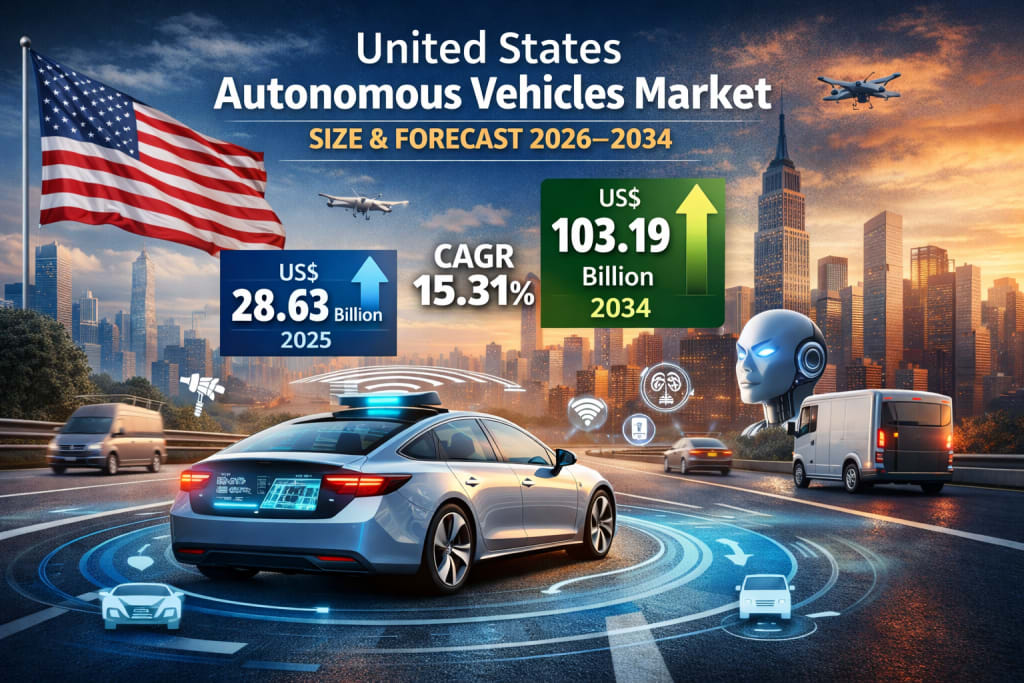
According to Renub Research, the United States Autonomous Vehicles Market is expected to grow from US$ 28.63 billion in 2025 to US$ 103.19 billion by 2034, registering a robust CAGR of 15.31% during the period from 2026 to 2034. This strong growth trajectory reflects rising investments, accelerating technological maturity, and increasing acceptance of automation in mobility solutions.
Autonomous vehicles promise more than just convenience. They represent a fundamental shift toward safer roads, more efficient transportation systems, reduced congestion, and better accessibility for seniors and people with disabilities. From advanced driver assistance systems already in use today to future fully driverless fleets, the US market is gradually but steadily moving toward higher levels of automation.
United States Autonomous Vehicles Market Outlook
Autonomous vehicles are defined as vehicles equipped with advanced technologies that allow them to sense their environment, analyze situations, and perform driving tasks with minimal or no human intervention. These systems rely on a combination of cameras, radar, lidar, GPS, ultrasonic sensors, and powerful machine-learning algorithms to interpret road conditions, detect obstacles, and make real-time decisions.
Autonomy exists on a spectrum—from basic driver assistance features to fully self-driving vehicles capable of operating without human input. In the United States, this gradual progression has allowed consumers, regulators, and manufacturers to adapt step by step, building confidence in the technology while refining safety and performance standards.
Globally and domestically, interest in autonomous vehicles is rising due to their potential to reduce accidents caused by human error, optimize traffic flow, lower logistics costs, and transform urban mobility. Automakers, technology giants, and startups alike are investing heavily in research and development to secure a position in this future-facing industry.
In the US, pilot programs for robotaxis, autonomous delivery vehicles, and smart logistics fleets are already demonstrating real-world applications. These initiatives are helping validate the technology while shaping the regulatory and commercial frameworks that will define the next decade of mobility.
Key Growth Drivers in the United States Autonomous Vehicles Market
1. Strong Investment and Industry Collaboration
One of the most powerful engines behind market growth is technological innovation fueled by massive investment. The integration of AI and machine learning enables vehicles to process enormous volumes of data in real time, improving decision-making accuracy and driving performance. Meanwhile, continuous improvements in lidar, radar, and high-resolution camera systems have significantly enhanced object detection and environmental mapping capabilities.
The declining cost and increasing precision of sensors are making autonomous systems more commercially viable, even for mid-range vehicles. Advances in cloud and edge computing further support real-time data sharing, remote updates, and continuous system learning.
The United States benefits from a strong technology ecosystem where automakers, software companies, semiconductor firms, and startups collaborate closely. Strategic partnerships between traditional automotive manufacturers and tech companies are accelerating development cycles and reducing time-to-market for new autonomous features.
Government support through pilot programs, testing frameworks, and infrastructure initiatives also plays a crucial role in sustaining innovation and commercial momentum.
2. Growing Demand for Safety, Efficiency, and Mobility Services
Road safety remains a major concern in the US, where human error accounts for the vast majority of traffic accidents. Autonomous systems, with their faster reaction times and consistent attention levels, offer a compelling solution to reduce collisions and fatalities.
Beyond safety, urban congestion and changing mobility preferences are boosting demand for autonomous ride-sharing, delivery services, and logistics solutions. Businesses see autonomy as a way to lower operating costs, improve efficiency, and enable 24/7 vehicle utilization without fatigue-related risks.
At the policy level, efforts to standardize reporting and testing processes across states are gradually easing cross-border deployment challenges, making nationwide scaling more feasible for autonomous vehicle operators.
Challenges Facing the Market
1. Regulatory Uncertainty and Legal Complexity
Despite strong momentum, regulation remains one of the biggest hurdles for the US autonomous vehicles market. Rules and approval processes still vary significantly from state to state, creating a fragmented legal environment. Issues related to liability, insurance, safety certification, and data ownership are still evolving.
Extensive testing and validation are required before higher levels of autonomy can gain full regulatory and public approval. Any delays or inconsistencies in policymaking can slow commercialization and increase development costs. A more harmonized federal and state framework will be essential for large-scale adoption.
2. High Development Costs and Public Acceptance
Building reliable autonomous systems is expensive. Hardware, software, simulation, real-world testing, and validation demand significant long-term investment, often with uncertain timelines for returns.
Public trust is another critical factor. Concerns around safety, cybersecurity, and system reliability continue to influence consumer perception. Overcoming these barriers will require transparent communication, proven safety records, and gradual exposure through partially autonomous features before fully driverless systems become mainstream.
Segment Insights: Where the Growth Is Happening
L2 Autonomous Vehicles Market
Level 2 (L2) autonomy currently represents the most commercially mature segment in the US. These vehicles combine features like adaptive cruise control, lane-keeping assist, automatic emergency braking, and parking assistance, all under human supervision.
Automakers are rapidly adopting L2 systems as standard or optional features to improve safety ratings and product differentiation. Growing consumer familiarity, insurance incentives, and continuous software improvements are making L2 autonomy a crucial bridge between manual driving and higher autonomy levels.
Actuators Market
Actuators play a vital role in converting electronic commands into physical vehicle actions, especially in steer-by-wire and brake-by-wire systems. As automation levels rise and electric vehicles become more common, demand for reliable, fail-safe electric actuators is increasing steadily in the US market.
Ultrasonic Sensors Market
Ultrasonic sensors are essential for short-range detection, particularly in parking assistance, low-speed maneuvers, and obstacle avoidance. Their cost-effectiveness and ease of integration make them a staple in L2 and L3 systems, especially in urban driving environments.
HMI Hardware and Software Markets
Human-Machine Interface (HMI) systems are becoming increasingly important as vehicles shift between manual and autonomous modes. Displays, touchscreens, head-up displays, voice controls, and haptic feedback systems help ensure clear communication between the vehicle and occupants.
On the software side, AI-driven interfaces, voice assistants, and over-the-air updates are improving usability, safety, and user confidence—key factors for broader acceptance of autonomous driving technologies.
Vehicle Type and Application Trends
Autonomous Passenger Vehicles
Passenger vehicles dominate the market due to applications in personal mobility, ride-sharing, and car-sharing services. Robotaxi pilots and urban mobility trials have demonstrated strong potential, particularly for reducing congestion and improving accessibility for seniors and people with disabilities.
Defense Autonomous Vehicles
The US defense sector is increasingly adopting autonomous and unmanned ground vehicles for logistics, surveillance, reconnaissance, and hazardous operations. Strong government investment in AI and robotics makes defense a strategically important and financially significant segment of the overall market.
Battery and Propulsion Trends
Autonomous vehicles are closely linked with electric propulsion systems due to their efficiency, lower maintenance needs, and better integration with electronic control systems. Advances in battery energy density, fast charging, and battery management systems are further strengthening this convergence between autonomy and electrification.
State-Level Market Dynamics
California
California leads the US autonomous vehicle landscape thanks to its innovation ecosystem, supportive policies, and concentration of tech and automotive companies. The state hosts numerous pilot programs for robotaxis, delivery vehicles, and shared mobility solutions, driven by urban congestion and strong sustainability goals.
New York
New York’s dense urban environment and focus on public safety make it a key market for controlled testing, smart transit solutions, and last-mile delivery applications. While regulations are more conservative, long-term potential remains strong as urban mobility challenges intensify.
New Jersey
New Jersey benefits from its logistics strength, infrastructure, and proximity to major metro areas. The state is seeing growing interest in autonomous freight movement, port operations, and highway driving solutions.
Washington
Washington’s expertise in software, AI, and cloud computing supports steady growth in autonomous mobility, especially in applications like smart transit, delivery vehicles, and advanced driver assistance systems, aligned with the state’s sustainability goals.
Competitive Landscape
The US autonomous vehicles market features a diverse mix of automotive giants, technology leaders, and mobility innovators. Key companies covered in the market include:
Alphabet Inc.
Amazon.com, Inc.
Apple Inc.
Aptiv
Baidu, Inc.
BMW
Mercedes-Benz Group AG
Didi Chuxing
Ford Motor Company
General Motors
Each of these companies is analyzed across five viewpoints: Overview, Key Person, Recent Developments, SWOT Analysis, and Revenue Analysis, highlighting the competitive intensity and strategic depth of the market.
Market Segmentation Overview
By Level of Driving: L1, L2, L3, L4, L5
By Hardware: Sensors, Actuators, HMI Hardware, Cameras, Radar, Lidar, V2X, Embedded Controls
By Software: HMI, Mapping, Data Security, Embedded Controls, V2X
By Vehicle Type: Passenger, Commercial
By Application: Civil, Defense, Transportation & Logistics, Construction
By Propulsion: BEV, FCEV, HEV, ICE, PHEV
By Geography: Major US states including California, Texas, New York, Florida, New Jersey, Washington, and others
Final Thoughts: The Road Ahead
The United States autonomous vehicles market is entering a decisive growth phase. With the market projected to more than triple in value from US$ 28.63 billion in 2025 to US$ 103.19 billion by 2034, the next decade will define how quickly and how deeply autonomy reshapes American transportation.
While challenges around regulation, cost, and public trust remain, continuous innovation, strategic partnerships, and real-world deployments are steadily building momentum. The future of mobility in the US will not arrive overnight—but it is clearly, and confidently, already on the road.
About the Creator
Keep reading
More stories from shibansh kumar and writers in The Swamp and other communities.
Lithium-Ion Battery Market Size and Forecast, 2026–2034
Introduction The global lithium-ion battery market is entering a phase of unprecedented expansion as electrification, renewable energy integration, and digital transformation reshape the global energy landscape. Lithium-ion batteries have evolved from being a niche power source for portable electronics into a foundational technology supporting electric vehicles (EVs), grid-scale energy storage, industrial equipment, and medical devices.
By shibansh kumar5 days ago in The Swamp
Why Black History Matters in America?
The United States of America is celebrating their 250th anniversary in 2026. I'm proud to be an American and as someone who was born here, I wouldn't imagine myself living anywhere else. This is a country where opportunities are possible. Where anyone can be successful in anything they desire to do. Equality, community, and togetherness are the backbones of what America is and should be about. However, we have an administration who wants to erase and disregard those who have made positive, meaningful impacts in our country, specifically Black figures, such as Martin Luther King, Jr., Rosa Parks, and Maya Angelou. President Trump and his administration have been constantly complaining and fighting against what they call the "Woke agenda". They use this excuse as a distraction from other issues they refuse to address, such as the high cost of living, climate change, and inflation. That equality is dividing America, when in reality, it's bringing us together. Being woke is not tied to a specific political party. No matter where you stand on the political spectrum, you can still care about other people and their plights. Compassion and empathy for others isn't tied to a political party, either. We were taught as children to treat others the way we want to be treated and not judge others because they're different from us. Caring about others isn't a personal attack on your beliefs. It doesn't make you any less of a person. People who are easily offended over African American figures, past or present, or anything related to it, are grasping at straws. Current and future generations need to know who people like Harriet Tubman and Shirley Chisholm were, especially in the classroom. Black History is part of American History. It should be recognized, not hidden or forgotten. Besides, you can't shield children from everything, just because your feelings are easily hurt.
By Mark Wesley Pritchard 7 days ago in The Swamp
Gold bulls hold firm after historic metals sell-off — but silver could be in for a bumpier ride
The precious metals market has rarely looked as dramatic as it did during the recent historic sell-off. Prices across gold, silver, and other metals plunged in a wave of liquidation that rattled investors and raised questions about whether the long-standing bull case for precious metals had finally cracked. Yet, in the aftermath of this sharp decline, gold bulls appear remarkably steady. Silver, however, may be facing a more uncertain and volatile path forward.
By Sajida Sikandara day ago in The Swamp
~ Fired ~
— Ai Intrusion ~ Are you Next ~ Is Ai Evolution after your job? — Few workplaces haven't been affected. Ai is in supermarkets, at doctors' offices, and even monitoring farms. I just can't think of anything this machine is not getting into, can you? For instance: Education ~ Law and Tech jobs will one day have a major influence or be taken over by these inanimate machines, with accuracy and vigor. From mechanics' diagnoses to a wide variety of everyday jobs, including fast food workers, with this input having the ability to cut their unnecessary work hours. I'm certain all of us have been touched by this with our short stories and colorful headings, have you? Even comments are very questionable 'Non-Robot' insertions.
By Jay Kantor7 days ago in Journal



Comments
There are no comments for this story
Be the first to respond and start the conversation.