
U.S. Offers Ukraine 15‑Year Security Guarantee as Part of Peace Plan, Zelenskyy Says
"Kyiv welcomes historic U.S. offer amid complex negotiations, while Zelenskyy urges longer-term guarantees to secure lasting peace."
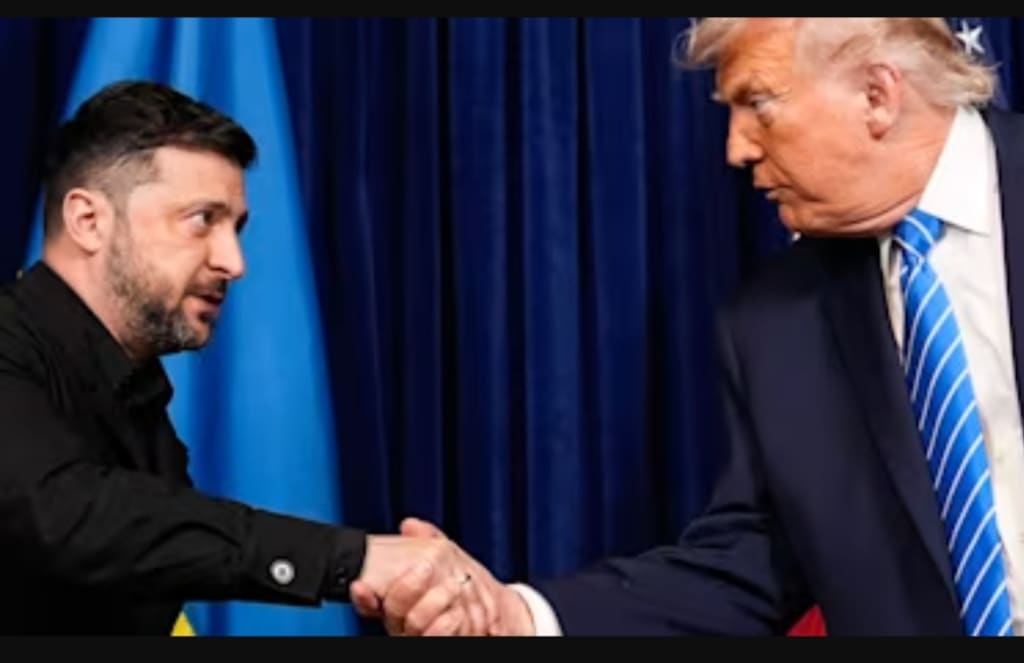
In a pivotal development that could reshape the trajectory of the nearly four‑year war in Ukraine, the United States has offered Kyiv a 15‑year security guarantee as part of a proposed peace plan, Ukrainian President Volodymyr Zelenskyy announced this week. The proposal, discussed during high‑level talks between Zelenskyy and U.S. President Donald Trump at Mar‑a‑Lago in Florida, marks one of the most significant diplomatic initiatives since Russia’s full‑scale invasion began in February 2022. �
Inquirer.com
While both leaders expressed cautious optimism about the peace process, the offer underscores a complex and evolving negotiation dynamic—with Kyiv insisting on stronger, longer‑term assurances and Moscow continuing to oppose terms it views as unfavorable. �
Boston.com
What Is the 15‑Year Security Guarantee?
According to Zelenskyy, the U.S. proposal includes a suite of security guarantees lasting 15 years once a peace agreement is signed—a significant increase in support compared with what Kyiv has received in the past. The guarantee itself is designed to deter future aggression by Russia and provide Ukraine with reassurance that its sovereignty will be respected long after active hostilities cease. �
NBC4 Washington
Although specific operational details of the guarantee have not been publicly disclosed, Zelenskyy has indicated that the deal would encompass mechanisms for monitoring compliance and a tangible “presence” of international partners to help enforce the peace. �
Boston.com
Importantly, any such guarantees would need to be approved by the U.S. Congress and likely by parliamentary bodies in allied states assisting with implementation—highlighting that Washington’s support is conditional on democratic oversight and legislative backing. �
NBC4 Washington
Zelenskyy Seeks More—Up to 50 Years
Despite the historic nature of the U.S. offer, Zelenskyy made clear that he prefers longer, multi‑decade commitments. Drawing comparisons to NATO’s Article 5 mutual defense obligations, he has publicly called for security assurances lasting 30, 40, or even 50 years, warning that a shorter deadline might not sufficiently deter future threats from Russia. �
ft.com
From Kyiv’s point of view, a 15‑year term might not be long enough to fully guarantee stability or to ensure that Ukraine is not vulnerable to renewed attempts at aggression once the guarantee expires. Ukrainian officials say enduring protection measures would signal a truly transformative shift in global security architecture for Eastern Europe. �
ft.com
Behind the Peace Talks
The announcement comes amid intense diplomatic momentum. Trump and Zelenskyy met on December 28, 2025, at the U.S. president’s private resort, where they discussed a broad 20‑point peace plan covering ceasefire terms, territorial questions, and postwar reconstruction frameworks. Trump described the talks as “productive” and suggested that both sides were closer than ever to a breakthrough. �
pbs.org
However, disagreements remain, especially around the status of Russian‑occupied territories such as the Donetsk and Zaporizhzhia regions—areas at the heart of both domestic politics and battlefield realities. Russia’s insistence on retaining influence over these regions contrasts with Ukraine’s demand for full territorial integrity, complicating negotiations. �
wsj.com
To complement U.S. engagement, leaders from the “Coalition of the Willing”—a group of more than 30 countries led by the United Kingdom and France—are set to convene meetings in early January, with national security advisers assembling in Ukraine on January 3 and a summit of heads of state in France on January 6. Zelenskyy has welcomed this broader international engagement as essential to solidifying support for Kyiv and any future peace framework. �
Reuters
Russian Reaction and Broader Geopolitics
The diplomatic push comes against a backdrop of heightened tensions on the ground—and in the broader geopolitical arena. Russian officials have repeatedly dismissed Western proposals that do not align with their objectives, such as demands for Ukraine’s neutrality or limits on Russian control over contested areas. �
Reuters
In the days following the U.S.–Ukraine talks, the Kremlin circulated claims—denied by Kyiv—that Ukraine carried out a drone attack on one of President Vladimir Putin’s residences, a narrative many Western analysts see as an attempt to derail negotiations. Zelenskyy condemned these allegations as “typical Russian lies” intended to stoke fear and justify further military escalation. �
theguardian.com
Meanwhile, Russian leaders have reiterated their belief that the West should accept Moscow’s dominant position on the battlefield, arguing that control over certain key regions gives them leverage in any final settlement. Such statements reveal that peace negotiations are not taking place in a vacuum but rather against a backdrop of competing narratives and strategic calculations. �
Reuters
What Happens Next?
Even with the U.S. offer on the table, experts caution that securing a durable peace will be far from straightforward. Key sticking points remain: the status of occupied territories, how security guarantees would operate in practice, whether Russia will engage in direct negotiations with Kyiv, and how European allies might shoulder responsibility alongside Washington. �
wsj.com
For many in Ukraine, the central question is not just whether a peace deal can be signed, but whether it will hold in the long term. A 15‑year security guarantee may provide a foundation, but Kyiv’s push for more expansive commitments reflects deep concerns about future threats. Whether the U.S. and other partners will move to meet that demand remains to be seen. �
ft.com
In the meantime, Ukrainian and international officials are preparing for a new round of diplomatic engagement early in 2026—a pivotal moment that may determine whether peace moves from hope to reality.
About the Creator
Keep reading
More stories from Aarif Lashari and writers in The Swamp and other communities.
How Are China’s New War Games Around Taiwan Different From Earlier Drills?
China’s recent war games around Taiwan have captured global attention, not because military drills in the region are new, but because these exercises look and feel fundamentally different from earlier ones. While Beijing has conducted drills near Taiwan for decades, the latest maneuvers suggest a strategic shift—one that raises fresh concerns about regional stability and the future of cross-strait relations.
By Aarif Lashari2 months ago in The Swamp
A Gathering of Evil Bosses
“I’m the queen of chin jutting while I smooth my hair, attacking, insulting, and deflecting to protect my appointer.” “Oh, please, Blondi, my hair is curled, highlighted, and longer than yours. I feature television commercials telling immigrants that we will give them a free plane ride home, and if they voluntarily turn themselves in, they will be allowed to legally apply for re-entry. It runs everywhere, and I look good in it! You can’t compete because of your blond hair. Mine is nicer, and my lips are prettier than yours.”
By Andrea Corwin 10 days ago in The Swamp
Is America Attacking Iran?
In short: No large-scale American attack on Iran is happening right now. There are serious tensions between the United States and Iran, and both sides are preparing and warning each other — but as of today there is no confirmed full-scale US invasion or full military strike currently underway. Instead, the situation shows a mix of military buildup, intense rhetoric, and ongoing diplomacy.
By shaoor afridi3 days ago in The Swamp
Magic
Note from the Author: I want to let you know that this is an unusual story, and it has been written purely from whatever is in my unconscious mind, because before I start writing, I get into a flow state that reaches my unconsciousness. I also write in my subconscious mind, which is like a mid-flow state between the conscious and unconscious mind.
By Denise Larkin5 days ago in Fiction




Comments
There are no comments for this story
Be the first to respond and start the conversation.