
U.S. Deports Nine Migrants in Secret, Ignoring Legal Protections
Rights groups accuse the Department of Homeland Security of bypassing courts and due process as families and lawyers learn of the removals only after the migrants were flown out of the country.


The United States has quietly deported nine migrants in what human rights groups describe as a covert operation that bypassed established legal protections and due process. The deportations, carried out late at night and without prior notice to lawyers or family members, have raised alarm among immigration advocates and lawmakers who say the actions undermine both domestic law and international obligations.
According to attorneys representing the migrants, the individuals were removed from U.S. custody despite having active legal claims, including pending asylum applications and appeals against deportation orders. Several of the migrants were reportedly transferred from detention facilities to an undisclosed location before being placed on a chartered flight out of the country. Their whereabouts were unknown for hours, prompting frantic efforts by legal teams to locate them.
Officials from the Department of Homeland Security declined to provide detailed explanations, stating only that the deportations were conducted “in accordance with operational procedures and national security considerations.” However, civil rights groups argue that secrecy itself violated basic safeguards meant to ensure migrants have access to legal counsel and the courts.
The American Civil Liberties Union said at least four of the nine migrants had court hearings scheduled in the coming weeks. “These removals appear designed to prevent judicial review,” said an ACLU attorney familiar with the case. “When the government acts in the dark, it deprives people of their most fundamental right — to challenge the decision before a judge.”
Legal experts note that U.S. immigration law requires authorities to notify lawyers and provide time for appeals, particularly when individuals claim fear of persecution if returned to their home countries. International conventions, including refugee protection agreements, also prohibit deporting individuals to places where they may face torture or political repression.
One migrant, a 27-year-old man from Central America, had reportedly cooperated with U.S. authorities in a criminal investigation and was granted temporary protection while his case was reviewed. His sudden deportation has raised questions about whether political or administrative pressure played a role. Family members learned of his removal only after receiving a brief message from detention officials stating that he was “no longer in U.S. custody.”
Members of Congress from both parties have called for an inquiry. Senator Maria Lopez, a Democrat on the Senate Judiciary Committee, said the operation “sets a dangerous precedent.” “The rule of law does not disappear when it becomes inconvenient,” she said. “If this can happen to nine people today, it can happen to many more tomorrow.”
Within the Biden administration, the episode highlights growing tension between border enforcement priorities and legal obligations. While officials face pressure to demonstrate control over migration flows, critics argue that shortcuts risk eroding trust in the immigration system. Former immigration judge Paul Hernandez said secrecy signals weakness rather than strength. “Transparency is the backbone of legitimacy. Without it, enforcement becomes arbitrary,” he said.
The deportations also come amid renewed scrutiny of emergency powers used by previous administrations to fast-track removals. Advocacy groups fear that mechanisms intended for exceptional circumstances are becoming routine tools of policy. “This mirrors practices we challenged years ago,” said a spokesperson for Human Rights First. “We are seeing history repeat itself under a different justification.”
For the deported migrants, the consequences may be immediate and severe. Lawyers say at least two were returned to countries where they had previously reported threats from gangs and political groups. Efforts are now underway to file emergency motions in federal court seeking explanations from the government and potentially ordering the return of those deported.
The Supreme Court of the United States has previously ruled that migrants on U.S. soil are entitled to due process, regardless of their immigration status. Whether this latest episode violates those standards will likely become the subject of legal challenge.
As details continue to emerge, the incident has reignited debate over how far the government can go in enforcing immigration law without sacrificing transparency and legal protections. For now, the secret deportation of nine migrants stands as a stark reminder of the fragile balance between security and justice — and of the human cost when that balance tilts too far in one direction.
About the Creator
Fiaz Ahmed
I am Fiaz Ahmed. I am a passionate writer. I love covering trending topics and breaking news. With a sharp eye for what’s happening around the world, and crafts timely and engaging stories that keep readers informed and updated.
Keep reading
More stories from Fiaz Ahmed and writers in The Swamp and other communities.
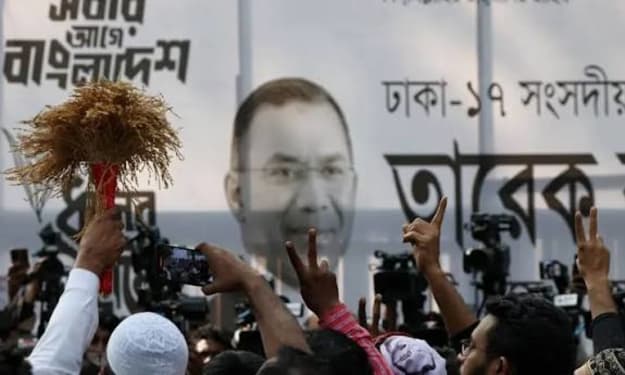
Bangladesh’s Tarique Rahman Poised to Be PM as Jamaat-i-Islami Concedes
Bangladesh’s political landscape appears set for a dramatic shift as Tarique Rahman moves closer to becoming the country’s next prime minister following a concession by Jamaat-i-Islami, signaling the likely formation of a new governing alliance. The development comes after weeks of intense negotiations and political maneuvering following national elections that produced a fragmented result. Jamaat-i-Islami’s decision to step aside from contesting leadership has cleared the way for Rahman, the acting chairman of the Bangladesh Nationalist Party (BNP), to consolidate enough parliamentary support to claim the top office. A Turning Point in Bangladeshi Politics Rahman’s rise marks a pivotal moment for Bangladesh, which has experienced prolonged political tension, economic challenges, and street protests over governance and electoral credibility. Son of former prime minister Khaleda Zia, Rahman has long been a central figure in opposition politics despite living in exile for years amid legal cases that he has consistently described as politically motivated. Sources close to coalition talks say Jamaat-i-Islami concluded that backing Rahman offered the best chance for a stable government capable of commanding majority support in parliament. In a brief statement, party leaders said their priority was “national unity and democratic restoration,” adding that they would cooperate with the incoming administration on key reforms. Political analysts say the concession reflects a broader realignment among opposition forces seeking to challenge years of dominance by the ruling Awami League and to restore what they call competitive democracy. Challenges Ahead for Rahman If confirmed as prime minister, Rahman will inherit a nation facing serious economic pressures. Inflation has strained household incomes, foreign currency reserves remain under stress, and unemployment among young people continues to rise. Business leaders are calling for swift action to restore investor confidence and stabilize markets. Rahman has pledged to focus on economic revival, judicial independence, and electoral reforms. In recent speeches, he promised to bring back “accountability and transparency” to state institutions and to ensure that future elections are free from controversy. “We must rebuild trust between the people and the government,” Rahman said in a recorded message to supporters. “This transition must serve the interests of every Bangladeshi, regardless of political affiliation.” However, critics question whether his leadership can bridge deep divisions in society. Human rights groups have urged the incoming government to protect freedom of expression and avoid reprisals against political rivals. Jamaat-i-Islami’s Calculated Move Jamaat-i-Islami’s concession has drawn mixed reactions. Supporters say it demonstrates political maturity and a willingness to prioritize stability. Opponents accuse the party of seeking influence behind the scenes by aligning with a likely winner. The party has historically played a controversial role in Bangladeshi politics, particularly over its stance during the 1971 war of independence. Its renewed engagement in coalition politics is expected to be closely scrutinized both domestically and internationally. Diplomats in Dhaka say regional partners are watching developments carefully. India, China, and Western governments have expressed hopes that the next administration will uphold democratic norms and maintain balanced foreign relations. Public Response and International Attention News of Rahman’s potential premiership has sparked celebrations among BNP supporters in several cities, while others remain cautious. Many citizens say their main concern is whether the new leadership can improve daily living conditions rather than simply reshuffle political power. “This is a moment of hope, but also uncertainty,” said a university student in Dhaka. “We want jobs, fair prices, and freedom to speak without fear.” International observers see the transition as a test case for Bangladesh’s political future. The country has been a key player in South Asia’s economic growth and a major contributor to UN peacekeeping missions, making stability critical beyond its borders. What Comes Next Formal confirmation of Rahman as prime minister is expected once coalition agreements are finalized and parliament convenes. A new cabinet is likely to be announced shortly afterward, with promises of reforms in policing, courts, and election oversight bodies. Whether this transition leads to lasting political stability remains uncertain. Yet Jamaat-i-Islami’s concession and Rahman’s rise suggest a rare opening for change after years of entrenched political rivalry. As Bangladesh stands at a crossroads, the coming weeks will reveal whether this shift will usher in a new chapter of governance or deepen the challenges facing one of South Asia’s most populous nations.
By Fiaz Ahmed a day ago in The Swamp
Why Black History Matters in America?
The United States of America is celebrating their 250th anniversary in 2026. I'm proud to be an American and as someone who was born here, I wouldn't imagine myself living anywhere else. This is a country where opportunities are possible. Where anyone can be successful in anything they desire to do. Equality, community, and togetherness are the backbones of what America is and should be about. However, we have an administration who wants to erase and disregard those who have made positive, meaningful impacts in our country, specifically Black figures, such as Martin Luther King, Jr., Rosa Parks, and Maya Angelou. President Trump and his administration have been constantly complaining and fighting against what they call the "Woke agenda". They use this excuse as a distraction from other issues they refuse to address, such as the high cost of living, climate change, and inflation. That equality is dividing America, when in reality, it's bringing us together. Being woke is not tied to a specific political party. No matter where you stand on the political spectrum, you can still care about other people and their plights. Compassion and empathy for others isn't tied to a political party, either. We were taught as children to treat others the way we want to be treated and not judge others because they're different from us. Caring about others isn't a personal attack on your beliefs. It doesn't make you any less of a person. People who are easily offended over African American figures, past or present, or anything related to it, are grasping at straws. Current and future generations need to know who people like Harriet Tubman and Shirley Chisholm were, especially in the classroom. Black History is part of American History. It should be recognized, not hidden or forgotten. Besides, you can't shield children from everything, just because your feelings are easily hurt.
By Mark Wesley Pritchard 14 days ago in The Swamp
If You Write A Book, Don’t Tell Anyone
There are days when I’m grateful Amazon doesn’t tell me specifically who has bought my book and who hasn’t. If they did, I would be heartbroken when I read the list and noticed all the important names in my life were not on my list of customers.
By Ellen Frances7 days ago in Writers



Comments
There are no comments for this story
Be the first to respond and start the conversation.