
Trump’s Surprising Shift: White House Talks with ‘Terrific’ Petro After Months of Feuding
From fiery insults to unexpected diplomacy, Trump’s evolving tone toward Colombia’s leftist president signals a strategic recalibration in U.S.–Latin America politics.
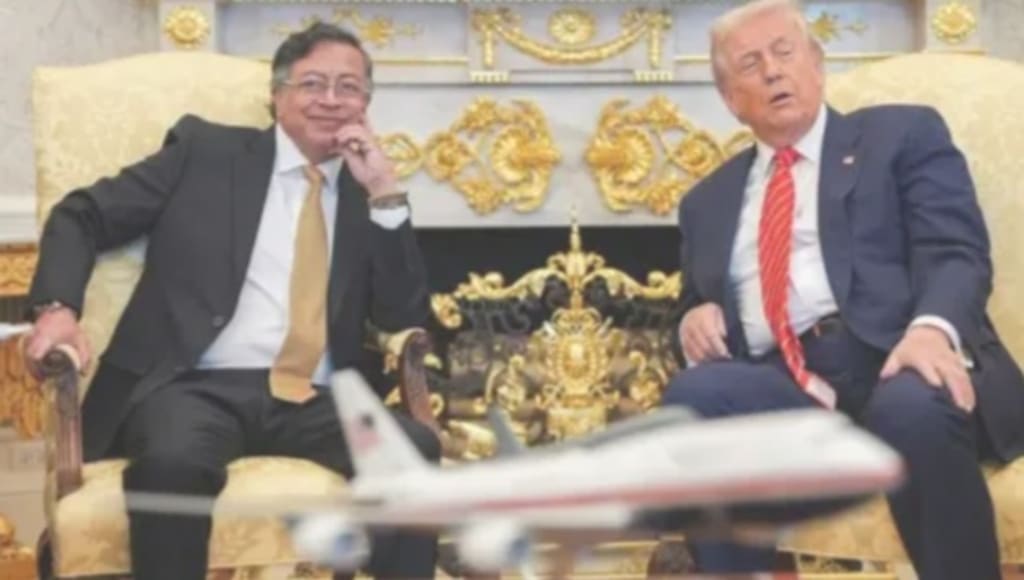
For months, Donald Trump and Colombian President Gustavo Petro appeared locked in an ideological standoff that symbolized the wider rift between conservative populism and Latin America’s new left. Their exchanges—marked by sharp rhetoric, public criticism, and mutual distrust—left little room for cooperation. That is why reports of renewed talks, and Trump’s unexpected praise of Petro as “terrific,” have raised eyebrows across diplomatic and political circles.
The sudden shift is not just surprising; it may be strategic.
Trump, known for his combative style and unapologetic disdain for leaders he considers weak or radical, has rarely softened his tone without a purpose. Petro, a former guerrilla and Colombia’s first leftist president, has openly criticized U.S. drug policy, environmental hypocrisy, and what he sees as Washington’s historic interference in Latin America. Their feud seemed inevitable—almost scripted.
Yet politics, especially international politics, has a way of bending toward pragmatism.
From Public Clashes to Private Calculations
The earlier tensions between Trump and Petro reflected deeper structural disagreements. Petro has pushed for a rethinking of the war on drugs, calling for legalization and development-focused solutions. Trump, by contrast, has long favored hardline enforcement, border security, and pressure on drug-producing nations. On climate change, Petro positions himself as a global environmental advocate, while Trump has famously dismissed climate alarmism as an economic burden.
These differences spilled into public view, amplified by social media and press conferences. Petro’s critiques of U.S. capitalism and Trump’s blunt dismissal of leftist leaders created a narrative of irreconcilable hostility.
But international relationships are rarely governed by ideology alone.
Behind closed doors, shared interests often matter more than public posturing. Colombia remains a key U.S. ally in the region—strategically located, economically significant, and central to migration and security concerns. Any American leader serious about hemispheric influence cannot afford to ignore Bogotá.
Why the Change in Tone?
Trump’s apparent willingness to engage Petro suggests a recognition of geopolitical reality. Latin America has shifted leftward in recent years, with progressive governments gaining power across the region. Ignoring or antagonizing them outright risks ceding influence to rival powers such as China and Russia, both of which have been actively expanding their footprint through trade, infrastructure, and diplomacy.
By reopening dialogue with Petro, Trump may be signaling flexibility without surrendering his core positions. Complimenting Petro as “terrific” does not necessarily imply agreement—it implies usefulness.
Trump has always viewed diplomacy through a transactional lens. Leaders are valued not for their ideology, but for what they can deliver: cooperation on migration, counter-narcotics efforts, energy access, or regional stability. If Petro can be a partner on even a few of these fronts, Trump’s instinct would be to make the deal.
Petro’s Incentives to Engage
The shift is not one-sided. Petro, despite his criticism of U.S. policy, understands Colombia’s economic and security ties to Washington remain vital. U.S. investment, trade access, and military cooperation continue to play a major role in Colombia’s stability.
Engaging Trump—especially one known for unpredictability—may be a way for Petro to protect Colombia’s interests, soften potential pressure, and secure space for his domestic agenda. Even limited cooperation could help Petro manage economic challenges at home while projecting international relevance abroad.
In that sense, the talks represent mutual damage control rather than ideological reconciliation.
A Broader Signal to the Region
Trump’s outreach to Petro could also be read as a message to other Latin American leaders: confrontation is optional, negotiation is possible. For a figure often accused of alienating allies, this pivot suggests an awareness that influence requires engagement—even with critics.
It also challenges the simplistic narrative that Trump’s foreign policy is purely confrontational. While his style remains abrasive, his record shows moments of unexpected diplomacy when strategic benefits are clear. From North Korea to the Middle East, Trump has repeatedly demonstrated a willingness to break taboos if it puts him in control of the narrative.
Latin America may now be part of that recalibration.
Skepticism Remains
Of course, words are not policy. Compliments can vanish as quickly as they appear, especially in Trump’s political universe. Any cooperation between Trump and Petro will face resistance—from U.S. hardliners skeptical of leftist governments, and from Petro’s supporters wary of aligning with a figure they see as emblematic of American unilateralism.
Moreover, structural disagreements on drugs, climate, and social policy remain unresolved. A few cordial meetings will not erase decades of mistrust or ideological divergence.
Still, diplomacy often begins with tone. And tone, in this case, has clearly changed.
Conclusion: Pragmatism Over Pride
Trump’s surprising shift toward Gustavo Petro highlights a recurring truth of global politics: yesterday’s adversary can become today’s negotiating partner. Whether driven by strategy, necessity, or political calculation, the move underscores Trump’s instinct for leverage and Petro’s understanding of power dynamics.
In a world defined by uncertainty and competition, even the most unlikely conversations can reshape relationships. The real question is not why Trump and Petro are talking—but what, if anything, they can accomplish once the rhetoric fades and reality sets in.
For now, the feud has cooled, the language has softened, and the door—unexpectedly—remains open.
About the Creator
Keep reading
More stories from Ayesha Lashari and writers in The Swamp and other communities.
Painful Times in My Marriage: Melinda French Gates Reflects on Ex-Husband Bill Gates in Epstein Files
In an exclusive reflection on her personal and emotional journey, Melinda French Gates has publicly addressed the painful moments in her marriage with Bill Gates, particularly in light of his controversial relationship with financier Jeffrey Epstein. In a recent statement linked to the Epstein files, Melinda shared her feelings, struggles, and the impact these events had on her personal life, her marriage, and ultimately, her decision to part ways with the tech magnate after 27 years of marriage.
By Ayesha Lashari4 days ago in The Swamp
Why Black History Matters in America?
The United States of America is celebrating their 250th anniversary in 2026. I'm proud to be an American and as someone who was born here, I wouldn't imagine myself living anywhere else. This is a country where opportunities are possible. Where anyone can be successful in anything they desire to do. Equality, community, and togetherness are the backbones of what America is and should be about. However, we have an administration who wants to erase and disregard those who have made positive, meaningful impacts in our country, specifically Black figures, such as Martin Luther King, Jr., Rosa Parks, and Maya Angelou. President Trump and his administration have been constantly complaining and fighting against what they call the "Woke agenda". They use this excuse as a distraction from other issues they refuse to address, such as the high cost of living, climate change, and inflation. That equality is dividing America, when in reality, it's bringing us together. Being woke is not tied to a specific political party. No matter where you stand on the political spectrum, you can still care about other people and their plights. Compassion and empathy for others isn't tied to a political party, either. We were taught as children to treat others the way we want to be treated and not judge others because they're different from us. Caring about others isn't a personal attack on your beliefs. It doesn't make you any less of a person. People who are easily offended over African American figures, past or present, or anything related to it, are grasping at straws. Current and future generations need to know who people like Harriet Tubman and Shirley Chisholm were, especially in the classroom. Black History is part of American History. It should be recognized, not hidden or forgotten. Besides, you can't shield children from everything, just because your feelings are easily hurt.
By Mark Wesley Pritchard 6 days ago in The Swamp
Self Help: Grifters' Gospel
On Self-Help, Snake Oil, and the Illusion of Change Psychology professionals and students can be imagined on two opposite sides of a line called self-help books: likely a larger group opposes pop-science and step-by-step manuals filled with talk of success, journaling, and not giving a f**k; others love them, but they aren’t many.
By Avocado Nunzella BSc (Psych) -- M.A.P 6 days ago in BookClub


Comments
There are no comments for this story
Be the first to respond and start the conversation.