
Trump’s Iran Options: “Token” Nuclear Enrichment to Taking Out Khamenei
A personal look at the dangerous crossroads shaping America’s next move in the Middle East
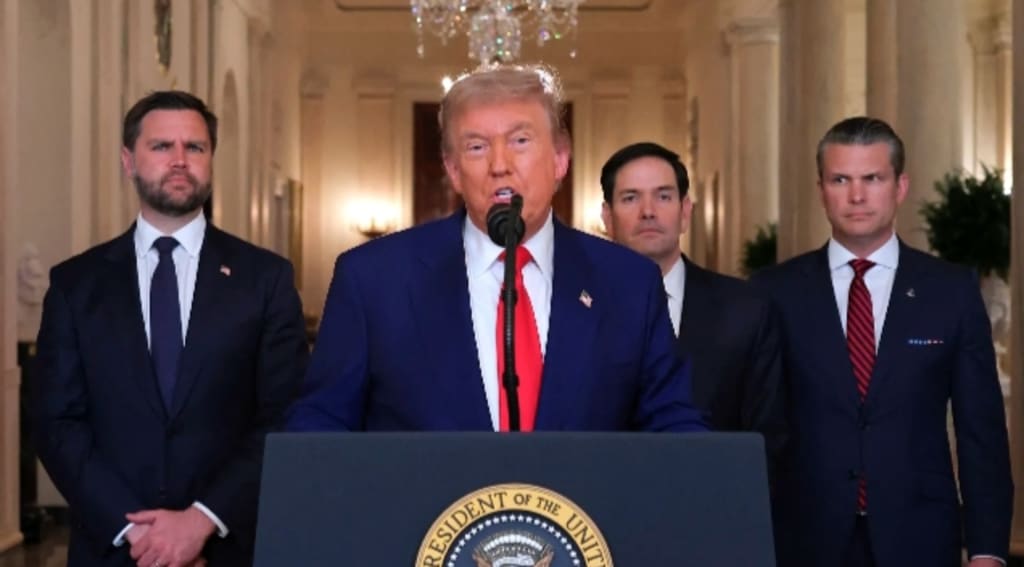
When I first read reports outlining President Donald Trump’s possible strategies toward Iran, I had to pause. The range of options being discussed — from allowing limited, “token” nuclear enrichment to considering the assassination of Supreme Leader Ali Khamenei — feels less like routine diplomacy and more like a geopolitical tightrope stretched over a powder keg.
This isn’t just another round of tense rhetoric between Washington and Tehran. It’s a moment that could fundamentally alter the Middle East — and perhaps America’s global standing — for years to come.
The Idea of “Token” Nuclear Enrichment
Let’s start with the least explosive option on the table.
Some officials suggest the United States might consider permitting Iran to maintain a small, heavily monitored uranium enrichment program — essentially symbolic, tightly capped, and designed to ensure it cannot be weaponized. In theory, this “token” enrichment could serve as a diplomatic compromise. Iran preserves its claim to peaceful nuclear rights, and the U.S. secures strict verification mechanisms to prevent weapon development.
On paper, it sounds like a pragmatic middle ground.
But diplomacy with Iran has always been layered with distrust. Hardliners in Washington argue that any enrichment capability, however limited, creates a pathway to escalation. Meanwhile, factions inside Tehran see restrictions as infringements on sovereignty.
The question I keep returning to is this: Can symbolic compromise truly build trust when decades of suspicion shape every interaction?
The Other End of the Spectrum
Then there’s the option that jolts you upright.
Reports indicate that military advisors have presented scenarios involving direct strikes against Iran’s leadership — including potentially targeting Khamenei himself. The phrase “taking out Khamenei” carries staggering implications.
Assassinating a sitting supreme leader of a sovereign nation would not be a limited tactical maneuver. It would represent an unprecedented escalation in U.S.–Iran relations. The ripple effects would extend far beyond Tehran — across Iraq, Lebanon, Israel, the Gulf states, and potentially into global energy markets.
History shows that so-called “decapitation strategies” rarely guarantee regime collapse. More often, they produce chaos, retaliation, and hardened resolve among surviving leadership. In Iran’s case, the political system is not solely dependent on one individual. Power structures are deeply institutionalized within the Revolutionary Guard and clerical establishment.
If anything, such an action could unify factions that otherwise disagree.
And that’s the paradox: the most aggressive option might actually strengthen the forces it seeks to dismantle.
The Strategy Behind the Signals
Why float such dramatically different options at the same time?
Part of it may be negotiation tactics. In high-stakes diplomacy, projecting strength can serve as leverage. If Tehran believes military action is a genuine possibility, it may be more inclined to compromise.
But that strategy carries risk. When both sides escalate rhetoric and military preparedness simultaneously, miscalculations become more likely. An accident, a proxy clash, or a misinterpreted signal could tip the balance toward confrontation before negotiations fully play out.
It’s worth remembering that U.S.–Iran tensions have simmered for decades. From sanctions to cyber operations to regional proxy conflicts, the relationship has rarely stabilized. Every new crisis builds on unresolved grievances from the last.
This time feels different because the stakes are so starkly defined: nuclear capability versus regime survival.
Iran’s Perspective
From Tehran’s viewpoint, the situation looks equally existential.
Iran insists its nuclear program is for peaceful purposes. It frames enrichment as a sovereign right under international agreements. Any suggestion of assassinating its leadership is not merely hostile — it’s an attack on national identity and religious authority.
Public threats from Washington may reinforce hardline narratives within Iran that the U.S. cannot be trusted under any circumstances. That perception could undermine reformist voices advocating engagement.
Ironically, extreme pressure sometimes narrows political space for moderation.
Regional Consequences
The Middle East doesn’t exist in isolation. Israel, Saudi Arabia, and other regional actors are closely watching every signal from Washington and Tehran.
Israel has long warned it will not tolerate a nuclear-armed Iran. Gulf states worry about instability spilling across borders. Europe fears energy market disruptions and refugee crises.
A limited nuclear compromise might calm markets and reduce tensions. A targeted strike on Iranian leadership could ignite retaliation across multiple theaters — from Hezbollah in Lebanon to militias in Iraq.
When we talk about options, we’re not discussing theoretical chess moves. We’re talking about decisions that could reshape alliances, markets, and civilian lives.
The Risk of Overconfidence
One thing that stands out in moments like this is how easy it is for policymakers to assume control over escalation. Military plans often emphasize precision, intelligence, and calculated outcomes. But war rarely unfolds according to design.
Eliminating a leader doesn’t automatically eliminate ideology. Destroying facilities doesn’t erase knowledge. And once conflict begins, public opinion — on both sides — can harden rapidly.
The United States must weigh not only what it can do, but what it should do.
Is There Still a Diplomatic Window?
Despite the dramatic options circulating, negotiations haven’t collapsed. That matters.
Even amid military planning, diplomatic backchannels reportedly remain active. Iran is said to be preparing proposals. The U.S. is evaluating potential frameworks. That coexistence of threats and talks reflects a familiar but fragile dynamic.
Diplomacy works best when both sides see advantage in restraint. The moment either side believes force offers a clearer path, the incentive to compromise shrinks.
The coming weeks could determine which path gains momentum.
A Crossroads Moment
As I look at the full spectrum — from token enrichment to targeting a supreme leader — what strikes me most is how narrow the middle ground appears.
There is room for compromise. There is space for de-escalation. But it requires discipline, patience, and political courage from leaders who operate in environments that often reward boldness over caution.
Trump’s Iran options are not merely policy choices; they represent competing visions of power. One relies on negotiation under pressure. The other flirts with transformative force.
History will judge which path prevails — and whether it preserves stability or accelerates confrontation.
For now, the world watches as Washington weighs its next move, fully aware that in geopolitics, the distance between symbolism and shock can be dangerously small.
About the Creator
Why Black History Matters in America?
The United States of America is celebrating their 250th anniversary in 2026. I'm proud to be an American and as someone who was born here, I wouldn't imagine myself living anywhere else. This is a country where opportunities are possible. Where anyone can be successful in anything they desire to do. Equality, community, and togetherness are the backbones of what America is and should be about. However, we have an administration who wants to erase and disregard those who have made positive, meaningful impacts in our country, specifically Black figures, such as Martin Luther King, Jr., Rosa Parks, and Maya Angelou. President Trump and his administration have been constantly complaining and fighting against what they call the "Woke agenda". They use this excuse as a distraction from other issues they refuse to address, such as the high cost of living, climate change, and inflation. That equality is dividing America, when in reality, it's bringing us together. Being woke is not tied to a specific political party. No matter where you stand on the political spectrum, you can still care about other people and their plights. Compassion and empathy for others isn't tied to a political party, either. We were taught as children to treat others the way we want to be treated and not judge others because they're different from us. Caring about others isn't a personal attack on your beliefs. It doesn't make you any less of a person. People who are easily offended over African American figures, past or present, or anything related to it, are grasping at straws. Current and future generations need to know who people like Harriet Tubman and Shirley Chisholm were, especially in the classroom. Black History is part of American History. It should be recognized, not hidden or forgotten. Besides, you can't shield children from everything, just because your feelings are easily hurt.
By Mark Wesley Pritchard 19 days ago in The Swamp
US judge expresses concern about government’s role in Washington Post raid
A U.S. federal judge has expressed serious concern over the government’s role in a controversial raid involving the Washington Post, raising questions about press freedom, the limits of law enforcement authority, and the protection of journalistic sources in the digital age.
By Fiaz Ahmed about 8 hours ago in The Swamp
There's A Hole in My Bucket
It’s a well-known fact that Liza Dufresne was always the brains in the family. She was the one who always came up with the brilliant schemes the Dufresne kids carried out when they were younger. Like when they tricked Mrs. Claybourn into paying for a trip to Disney World. Liza convinced her that their parents had been kidnapped and were being held for ransom for the total price of three tickets. In reality, they were away on a weekend getaway for their anniversary. When they returned, Liza told the Claybourns that they did not like to talk about the ordeal. Their parents never found out how they got the money. Mrs. Claybourn never found out that the Dufresne parents were never really in any danger.
By David E. Perry2 days ago in Fiction


Comments
There are no comments for this story
Be the first to respond and start the conversation.