
Trump’s Federal Funding Freeze Sparks Legal Battles and Public Outcry
Trump's federal funding freeze disrupts Medicaid, student aid, food assistance, and housing programs, sparking legal battles and uncertainty for millions of Americans.

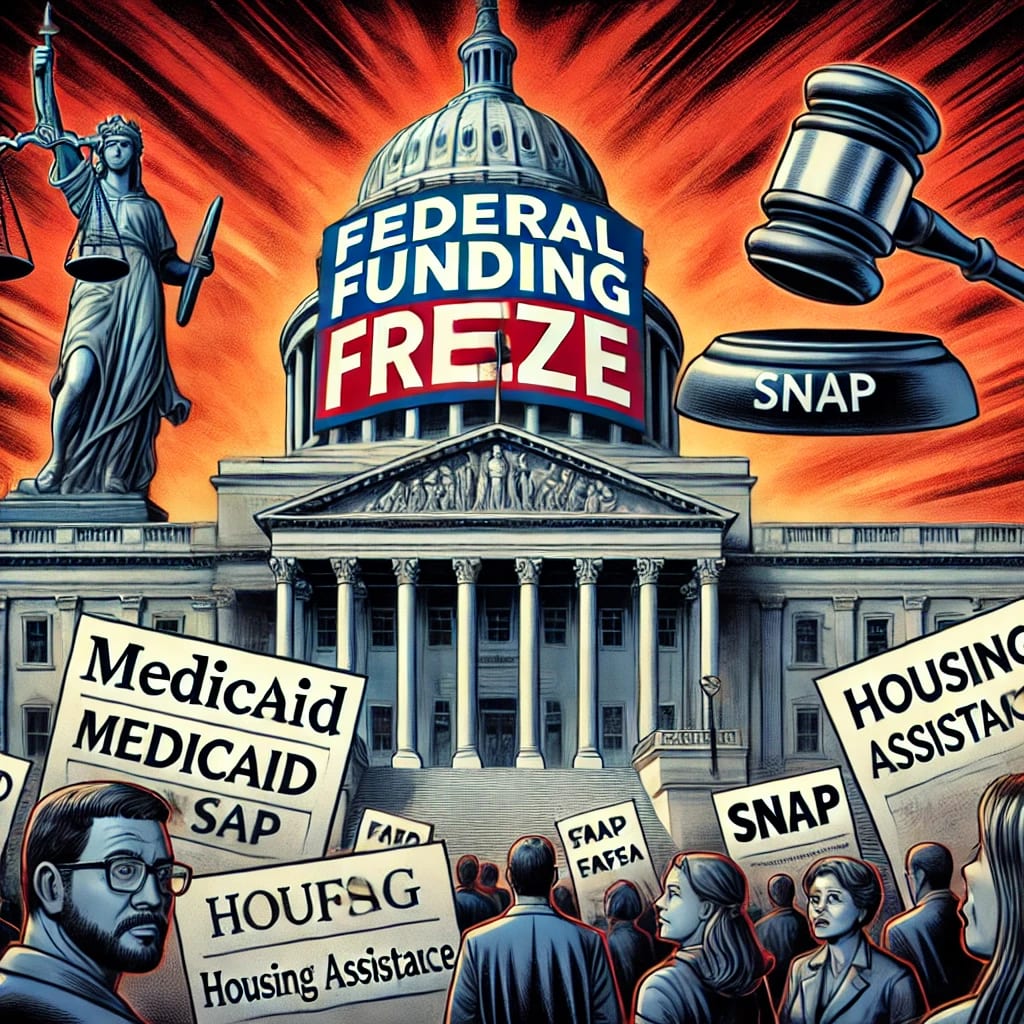
In a significant policy move, the Trump administration announced a sweeping freeze on federal grants, loans, and financial aid programs, causing widespread disruptions and legal challenges. This decision, issued through a memorandum from the Office of Management and Budget (OMB) on January 27, 2025, aimed to reassess federal spending priorities but led to immediate economic and social concerns.
The Scope of the Federal Funding Freeze
The directive instructed federal agencies to halt disbursements of all federal financial assistance, including grants, Medicaid reimbursements, and student aid. The freeze affected multiple programs, including:
- Federal Student Aid (FAFSA & Pell Grants): Many students faced uncertainty about their education funding.
- Medicaid & Medicare: Healthcare providers reported issues accessing Medicaid portals, delaying reimbursements and patient care.
- SNAP & WIC Benefits: The Supplemental Nutrition Assistance Program (SNAP) and Women, Infants, and Children (WIC) programs experienced disruptions, leaving many families concerned about food security.
- Section 8 Housing Assistance: Delays in housing subsidies raised fears of eviction among low-income families.
- Head Start & Meals on Wheels: Child education and senior nutrition programs faced funding uncertainties, jeopardizing essential services.
While the OMB memo claimed Social Security and Medicare payments would remain untouched, the lack of clear guidance caused confusion among beneficiaries and program administrators.
Reasons Behind the Freeze
According to the Trump administration, the funding freeze was enacted to review federal expenditures and ensure that taxpayer money was not directed toward initiatives deemed misaligned with its policy priorities. The OMB memo cited concerns about wasteful spending on programs related to diversity, equity, and inclusion (DEI), labeling them as "Marxist" initiatives. The administration argued that realigning federal funds with its vision was necessary to curb excessive government expenditure and focus on "America First" policies.
Immediate Fallout and Confusion
The sudden freeze caused immediate disruptions. Healthcare facilities, especially those dependent on Medicaid reimbursements, struggled to provide timely care. Universities warned students about potential delays in receiving their Pell Grants and FAFSA disbursements. Many low-income families dependent on food assistance programs like SNAP found themselves in a precarious situation as state agencies faced funding shortfalls. The uncertainty also raised concerns among non-profits that rely on federal grants to operate essential programs.
Legal Challenges and Judicial Response
The broad scope of the freeze led to swift legal challenges. Democracy Forward, a legal advocacy group, filed a lawsuit arguing that the administration had no legal authority to unilaterally halt funds appropriated by Congress.
On January 28, 2025, U.S. District Judge Loren AliKhan issued a temporary injunction against the freeze, preventing its immediate enforcement. The judge stated that the executive branch lacked the power to override Congress's appropriations and that such a move violated the Impoundment Control Act of 1974, which prevents the president from withholding funds without congressional approval. A hearing was scheduled for February 3 to further evaluate the case.
Political Reactions
The freeze ignited fierce debates across the political spectrum.
- Democratic leaders condemned the move, calling it an unconstitutional overreach. Senate Minority Leader Chuck Schumer called the action "reckless and unlawful," arguing that millions of Americans relying on federal assistance were put in jeopardy.
- Republican supporters defended the freeze as a necessary step to eliminate government waste and realign funding with conservative values.
- State officials struggled with the abrupt halt in federal assistance, with some governors warning of severe economic consequences if the freeze continued.
Impact on Key Federal Assistance Programs
Medicaid and Medicare
Hospitals and clinics across the country reported that Medicaid reimbursement portals were either down or delayed, preventing them from receiving funds for patient care. Many states warned that prolonged funding disruptions could lead to hospital closures and reduced services for low-income individuals.
Student Financial Aid (FAFSA, Pell Grants, Federal Student Loans)
With FAFSA applications for the 2025 academic year already in progress, students and educational institutions feared delays in aid distribution. Universities reported a spike in inquiries from students worried about tuition payments and financial aid eligibility.
Food Assistance (SNAP & WIC)
Recipients of SNAP benefits experienced delays in accessing funds, leading to increased demand at food banks. WIC participants also faced uncertainty, with some state agencies unable to process benefits due to the freeze.
Section 8 Housing Assistance
Delays in housing subsidies left thousands of families at risk of eviction. Housing advocates warned that the freeze could lead to an increase in homelessness if not resolved quickly.
Head Start and Meals on Wheels
Early childhood education programs like Head Start faced potential closures, impacting thousands of low-income families. Meals on Wheels programs, which deliver food to seniors, also reported funding issues, raising concerns about food insecurity among the elderly.
Future Implications and Possible Outcomes
As the legal battle continues, the fate of federal funding remains uncertain. Judge AliKhan’s temporary injunction has provided some relief, but a final ruling will determine whether the freeze stands or is permanently blocked.
If the court upholds the freeze, millions could face disruptions in essential services. Conversely, if the court rules against the administration, it would reinforce congressional control over federal appropriations and limit the executive branch’s ability to unilaterally halt funding in the future.
Conclusion
The Trump administration's federal funding freeze has sparked widespread concern, legal battles, and uncertainty for millions of Americans relying on federal assistance. As the case unfolds in court, the country awaits a resolution that will determine the future of critical programs that support healthcare, education, housing, and food security. The outcome will not only affect beneficiaries but also set a precedent for how executive power can be exercised over federal funding in the years to come.
About the Creator
Minecraft APK Download (Android, Pro Unlocked)
Fast free Minecraft APK Download for Android. Get Minecraft Pocket Edition, mods, and the latest version. Enjoy building and exploring in Minecraft PE. NBS Reborn APK.
Keep reading
More stories from Minecraft APK Download (Android, Pro Unlocked) and writers in The Swamp and other communities.
Understanding Student Loans in the United States
Student loans play a significant role in helping millions of Americans achieve their higher education dreams. With the rising costs of college tuition, many students rely on loans to bridge the financial gap. However, navigating the world of student loans can be challenging, as it involves various types of loans, repayment options, and long-term implications. This article sheds light on the key aspects of student loans in the United States.
By Minecraft APK Download (Android, Pro Unlocked)about a year ago in The Swamp
The Forsyth House Fire
Since 1851, Forsyth House has stood on the corner of Union Street and Gordon Street in the heart of Glasgow. Its iconic, or was... because on Sunday 8th of March, 2026, a fire broke out in a small, seemingly un-named shop in the building and tore all that history down. As I write, the rubble is still unsettled and the street is still blocked off. Central Station is quiet on the upper level, and around 30 small businesses have quite literally gone up in smoke.
By S. A. Crawford3 days ago in The Swamp
My Village Has Become Deserted: How Russia’s War Is Emptying Its Rural Communities
Subtitle: Conflict, conscription, and economic collapse are driving residents away from Russia’s countryside, leaving once-lively villages silent and abandoned.In many remote villages across Russia, the effects of the ongoing war with Ukraine are being felt far from the front lines. While the world often focuses on military developments and geopolitical tensions, rural communities inside Russia are quietly experiencing a different kind of devastation—depopulation. In countless small settlements scattered across the country’s vast countryside, residents say their villages are slowly emptying as young men leave for war, families relocate to cities, and local economies collapse. In the small farming village of Novaya Zarya in western Russia, longtime resident Marina Petrovna remembers when the streets were filled with children and tractors moved steadily through nearby fields. Today, the silence is overwhelming. “My village has become deserted,” she says. “Every year there are fewer houses with lights on at night.” Since the start of the war in 2022, many rural areas have seen a sharp decline in population. Young men have been mobilized into the military or have volunteered for service, often leaving behind elderly parents and abandoned homes. Some families have fled to cities or even abroad, fearing further mobilization or seeking economic stability. Demographic decline was already a serious problem in rural Russia before the war began. According to analysts, many villages had been losing residents for decades as young people migrated to urban centers such as Moscow and Saint Petersburg in search of better jobs, education, and healthcare. The war has accelerated this trend dramatically. Local officials in several regions report that schools have closed due to falling enrollment, while clinics struggle to remain open with limited staff. In some places, buses that once connected villages to nearby towns no longer run because too few people remain to justify the service. Economically, the situation has also deteriorated. Agriculture, which is the backbone of many rural communities, depends heavily on manual labor. With a significant number of working-age men gone, farms are struggling to plant and harvest crops. Some fields now lie untouched, slowly returning to wilderness. The social fabric of village life is also unraveling. Community gatherings, traditional festivals, and local markets have become rare. In villages where dozens of families once lived, only a handful of elderly residents remain. They often rely on neighbors for support, but even those networks are weakening. Experts say the problem may worsen if the conflict continues. Russia’s rural regions already face an aging population and declining birth rates. War casualties, migration, and economic hardship could deepen these demographic challenges for years to come. Sociologists warn that entire settlements could disappear. In parts of Siberia and the Russian Far East, villages have already been officially removed from maps after losing all permanent residents. Similar fates may await others if current trends continue. Despite the hardships, some residents remain determined to stay. For older villagers, leaving their homes and farmland is unthinkable. “Our parents and grandparents built this place,” says Petrovna. “Even if the village becomes empty, this is still our home.” The Russian government has announced several rural development programs in recent years, aiming to modernize infrastructure and encourage people to remain in smaller communities. However, critics argue that wartime priorities and economic sanctions have limited the impact of these initiatives. For now, the quiet transformation of rural Russia continues largely unnoticed by the outside world. While battles rage hundreds or even thousands of kilometers away, the consequences are reshaping everyday life in villages across the country. As night falls in Novaya Zarya, only a few houses glow faintly in the darkness. Where laughter, farm work, and village gatherings once defined daily life, there is now a growing stillness—an echo of a countryside slowly fading away.
By Fiaz Ahmed 8 days ago in The Swamp



Comments
There are no comments for this story
Be the first to respond and start the conversation.