
Trump Reverses Course on Governors Meeting, Invites Democrats After Initial White House Snub
Partisan tensions flare ahead of the National Governors Association meeting as President Trump restores bipartisan access to a key White House session — but controversy over dinner invitations lingers.

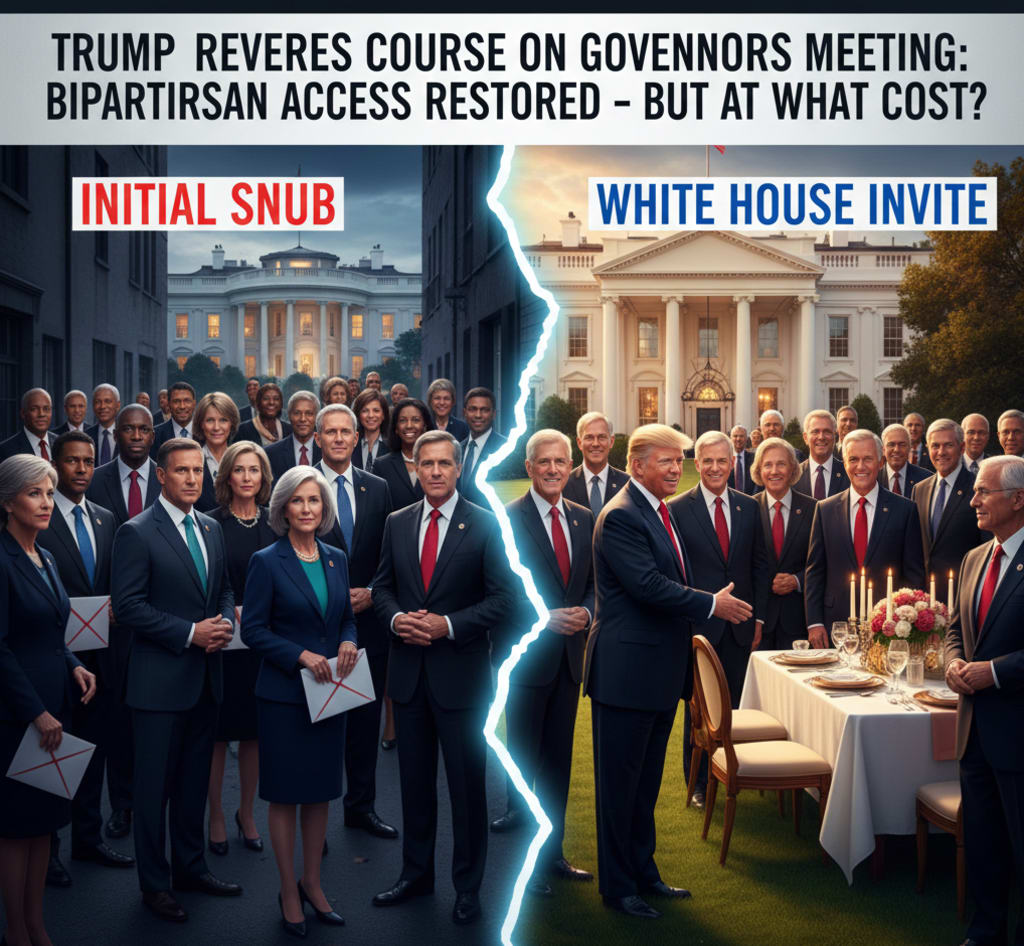
In a political climate already defined by sharp division, a long-standing bipartisan tradition nearly fractured this week when President Donald Trump initially excluded Democratic governors from a White House meeting tied to the National Governors Association (NGA) annual gathering.
After swift backlash — including criticism from within Republican ranks — the White House reversed course, announcing that all governors from every state and U.S. territory would be invited to attend the formal business breakfast on February 20.
However, not all Democratic governors were invited to a related White House dinner, keeping partisan tensions alive and raising broader questions about federal-state cooperation.
________________________________________
A Bipartisan Tradition Faces Disruption
For decades, the National Governors Association annual meeting has served as one of Washington’s rare bipartisan spaces. Governors from both parties gather to discuss pressing national issues including:
• Infrastructure funding
• Disaster response coordination
• Healthcare policy
• Education reform
• Economic development
Traditionally, the White House portion of the event has been structured as a nonpartisan opportunity for dialogue between state leaders and the president — regardless of party affiliation.
That expectation was shaken when early reports indicated that only Republican governors would receive invitations to the White House meeting portion of the NGA event.
Democratic governors quickly signaled they had not received invitations, prompting concern that a bipartisan forum was being transformed into a partisan one.
________________________________________
White House Reversal After Pushback
The situation escalated as criticism mounted — not just from Democrats, but also from key Republican officials.
Oklahoma Governor Kevin Stitt, chair of the NGA and a Republican, played a pivotal role in calming tensions. According to reporting, Stitt communicated to governors that President Trump clarified his intent to host all governors at the formal business breakfast in support of the NGA’s annual session.
Following that outreach, the White House confirmed that governors from every state and territory would be invited to attend the official meeting.
The reversal helped preserve at least part of the bipartisan framework traditionally associated with the gathering.
________________________________________
Dinner Invitations Spark Continued Controversy
While the business meeting was restored to full participation, controversy persisted over a separate White House dinner scheduled around the NGA event.
Reports indicated that not all Democratic governors received invitations to the dinner, including Maryland Governor Wes Moore and Colorado Governor Jared Polis. Their offices stated that initial invitations had either not been issued or were rescinded.
In response, several Democratic governors signaled they would boycott the dinner if the exclusions remained in place.
Most Democratic governors reportedly signed onto a collective statement criticizing what they described as an erosion of bipartisan norms.
They argued that selective invitations — even to a social event — undermine the cooperative foundation that has historically defined federal-state engagement.
________________________________________
White House Defends Invitation Authority
White House Press Secretary Karoline Leavitt defended the administration’s handling of the guest list, emphasizing that the president retains discretion over invitations to White House events.
“The president has the right to determine who is invited to events at the White House,” she said, reinforcing the administration’s position that social gatherings are distinct from formal governance sessions.
Legally and traditionally, the White House does control event guest lists. However, critics argue that symbolism matters — especially during moments designed to promote unity across party lines.
________________________________________
Internal GOP Concerns
Notably, the initial exclusion of Democratic governors also sparked discomfort within Republican leadership circles.
Governor Stitt emphasized unity and cross-party collaboration in written communications to fellow governors. He warned that excluding Democratic governors could divide the NGA and weaken its ability to advocate collectively for states’ interests.
His intervention appears to have influenced the president’s decision to reopen invitations for the formal meeting.
The episode highlights a broader reality in American politics: even within party ranks, there are competing perspectives about how aggressively partisan to make traditionally bipartisan forums.
________________________________________
Why the NGA Meeting Matters
The National Governors Association is more than a symbolic gathering. It provides:
• Direct access to federal leadership
• Opportunities to coordinate on disaster relief
• Collaboration on cross-state economic initiatives
• Discussions on healthcare funding and Medicaid
• Education and workforce development policy alignment
In times of natural disasters, economic downturns, or public health emergencies, strong federal-state relationships are critical.
When trust between state executives and the White House becomes strained, policy implementation can suffer.
________________________________________
Broader Political Implications
The controversy comes at a time of heightened partisan polarization nationwide. Governors from both parties are navigating complex issues including inflation, border security, education reform, and public safety.
Political analysts suggest the invitation dispute reflects deeper tensions between state and federal leadership, particularly in an election-year environment where symbolism carries amplified weight.
Some Republican supporters argue that the president’s control over guest lists is appropriate and within executive authority.
Democratic critics counter that breaking with bipartisan norms signals a shift toward more confrontational governance.
Regardless of perspective, the optics of the dispute have drawn national attention.
________________________________________
Impact on Federal-State Collaboration
Even though the formal business breakfast will now include all governors, the episode may have lingering consequences.
Trust — once strained — can be difficult to fully restore.
Democratic governors who considered boycotting the dinner emphasized that shared leadership requires mutual respect. Some observers worry that symbolic divisions may spill into substantive policy discussions.
When governors must negotiate disaster funding, infrastructure grants, or emergency response coordination, political friction at the top can complicate those efforts.
________________________________________
Media and Public Reaction
Major news outlets have framed the incident as an unusual break from tradition. Political commentators have debated whether it signals:
• A temporary political flare-up
• A strategic partisan shift
• Or a preview of future state-federal tensions
Public reaction has largely followed partisan lines, with supporters defending executive discretion and critics lamenting the erosion of bipartisan norms.
________________________________________
What Happens Next?
With invitations restored for the business meeting, attention now turns to participation levels and tone.
Will Democratic governors attend both events if invited?
Will bipartisan cooperation be restored?
Or will the dinner dispute cast a longer shadow over future NGA gatherings?
Governor Stitt and NGA leadership have expressed hope that the restored invitation list will allow governors to focus on shared goals rather than political division.
However, the episode underscores how fragile bipartisan traditions can become in a deeply polarized environment.
________________________________________
Conclusion: A Tradition Tested
President Trump’s initial decision to exclude Democratic governors from a White House meeting tied to the National Governors Association sparked swift backlash and ultimately led to a partial reversal.
While the formal business session will proceed with bipartisan participation, the controversy surrounding dinner invitations reveals ongoing partisan tension in federal-state relations.
At its core, the episode highlights a broader national question:
Can bipartisan governance traditions survive in an era of heightened political polarization?
As governors gather to address policy challenges affecting millions of Americans, the strength of their collaboration — across party lines — may matter more than ever.
About the Creator
Adil Ali Khan
I’m a passionate writer who loves exploring trending news topics, sharing insights, and keeping readers updated on what’s happening around the world.
Keep reading
More stories from Adil Ali Khan and writers in The Swamp and other communities.
The U.S.–China Tech Race: Why the World Might Be Looking at It All Wrong
For the past decade, the narrative dominating global headlines — from Washington to Beijing to Brussels — has been the so-called tech race between the United States and China. It’s often portrayed as a high-stakes sprint where only one superpower can win, shaping the future of artificial intelligence (AI), semiconductors, biotech, and advanced technologies. But this familiar framing might be misleading — and not just overly simplistic. In reality, the competition is far more complex, strategic, and interconnected than a zero-sum race, and understanding it accurately matters for policymakers, investors, and everyday citizens alike.
By Adil Ali Khan5 days ago in The Swamp
Why Black History Matters in America?
The United States of America is celebrating their 250th anniversary in 2026. I'm proud to be an American and as someone who was born here, I wouldn't imagine myself living anywhere else. This is a country where opportunities are possible. Where anyone can be successful in anything they desire to do. Equality, community, and togetherness are the backbones of what America is and should be about. However, we have an administration who wants to erase and disregard those who have made positive, meaningful impacts in our country, specifically Black figures, such as Martin Luther King, Jr., Rosa Parks, and Maya Angelou. President Trump and his administration have been constantly complaining and fighting against what they call the "Woke agenda". They use this excuse as a distraction from other issues they refuse to address, such as the high cost of living, climate change, and inflation. That equality is dividing America, when in reality, it's bringing us together. Being woke is not tied to a specific political party. No matter where you stand on the political spectrum, you can still care about other people and their plights. Compassion and empathy for others isn't tied to a political party, either. We were taught as children to treat others the way we want to be treated and not judge others because they're different from us. Caring about others isn't a personal attack on your beliefs. It doesn't make you any less of a person. People who are easily offended over African American figures, past or present, or anything related to it, are grasping at straws. Current and future generations need to know who people like Harriet Tubman and Shirley Chisholm were, especially in the classroom. Black History is part of American History. It should be recognized, not hidden or forgotten. Besides, you can't shield children from everything, just because your feelings are easily hurt.
By Mark Wesley Pritchard 13 days ago in The Swamp
Rise in Half-Term Holiday Bookings After Rainy January
After weeks of relentless rain, grey skies, and post-holiday fatigue, travel agents across the UK are reporting a sharp rise in half-term holiday bookings. The unusually wet January has left many families craving sunshine, fresh air, and a much-needed change of scenery. As schools prepare for the February break, travel companies are witnessing a noticeable spike in last-minute reservations, with beach destinations and short European city breaks leading the way.
By Ayesha Lashari2 days ago in The Swamp
Analyse this!
Wanna know how to improve your writing? There is a simple, quick, tried and tested method. Tried and tested by who? By me, as it happens, and I can guarantee that it will work for you. I know what I am talking about. Not always, of course, but certainly in this case.
By Raymond G. Taylor7 days ago in Writers



Comments
There are no comments for this story
Be the first to respond and start the conversation.