
Trump, Imran Khan, and the Military: Pakistan’s Political Deadlock
Will the Trump administration side with Pakistan’s military establishment or the 250 million people demanding democracy and the rule of law? The U.S. has long favored military regimes in the region — what would make them change course now?

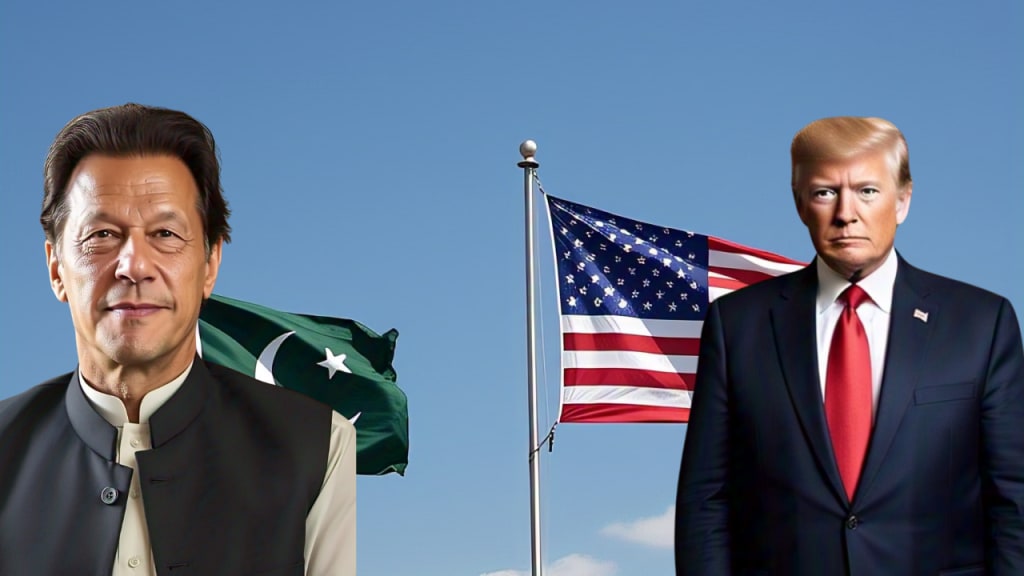
When addressing Congress, President Trump thanked the government of Pakistan for assisting in the capture of an individual allegedly responsible for a bomb attack during the U.S. withdrawal from Afghanistan. This statement has sparked debate, particularly within Pakistani social circles. Many believed that once Mr. Trump returned to office, he would take steps to promote democracy. However, these hopes were shattered when he acknowledged the efforts of Pakistan’s current government — a government that, according to a lot of visible evidence, stole the people’s mandate in the general elections of February 8, 2024.
From the very beginning, the U.S. administration has been dealing with Pakistan’s military establishment rather than its politicians. They appear confident in this relationship, a stance also adopted by the Biden administration. After Trump’s remarks, many people, particularly in Pakistan, lost hope, as it became evident that the current establishment has much to offer from its Pandora’s box, while Imran Khan and his party don’t have much to offer beyond their pleas to restore democracy and the rule of law in the country.
In the infamous cipher, believed to have originated from the U.S., it was stated that Washington sought to replace Mr. Khan with someone more aligned with their interests. Otherwise, Pakistan would face harsh consequences. This warning was directed at the military establishment of that time. Mr. Khan disclosed its contents to the public and media.
Before Trump’s return, the international community favored Pakistan’s military establishment due to its longstanding loyalty. Several members of Trump’s cabinet have openly supported Imran Khan and democracy in Pakistan, calling for the release of the former prime minister and the restoration of law and order. Their tweets created a significant impact on Pakistan’s political landscape. However, Trump’s recent statement has dealt a major blow to efforts to restore democracy and rule of law.
The U.S. Administration’s Options
Looking at historical precedents, Western countries have consistently preferred dealing with the military in the region. They openly and covertly support military dictatorships while championing democracy only when it aligns with their interests. For instance, in the 1950s, when Iranian Prime Minister Mohammad Mossadegh nationalized the oil industry — threatening British and American interests — the U.S., with the help of military generals, reinstated the Shah, leading to over two decades of oppressive rule until the 1979 revolution.

People, Democracy, or Military Establishment?
Intelligence agencies, CENTCOM, and military personnel are generally more comfortable engaging with Pakistan’s military rather than its civilian leadership. This is unlikely to change. Speculation suggests that the recent arrest was orchestrated with CIA assistance to strengthen ties between the Pakistani establishment and the Trump administration. If the establishment secures Trump’s backing to continue its model of military rule, it may achieve short-term regional interests. However, the long-term sustainability of this approach remains uncertain.
The situation across Pakistan is dire. Decades of hardship have taken a toll on the population, leading to widespread protests — both peaceful and armed — against the current regime. While the establishment remains in control for now, this state of affairs cannot persist indefinitely. Public desperation is growing nationwide. Pakistan has already ranked among the top countries in terms of attempted emigration in recent years. If the U.S. administration seeks a long-term, stable, and friendly relationship with the Pakistani people, it must support democracy. However, if it continues backing the current setup, only time will tell how long the military can continue serving U.S. interests.
What the Current Establishment Has to Offer
The establishment has several strategic offerings that are difficult for the West to ignore. These include fostering better relations with India to counterbalance China, distancing itself from Beijing, and potentially opening another front against the Taliban in Afghanistan — something already hinted at by government officials.
Given its long-standing ties with the U.S. and Western nations, the establishment is well-positioned to secure continued support for its authoritarian rule. They simply need to prove that they can maintain power indefinitely with their current tactics.
Options for PTI, the People & Democracy Advocates
Pakistan Tehreek-e-Insaf (PTI) and democracy advocates have failed to offer the West tangible incentives. Their approach is no good to bring the desired results. Their appeals center around restoring democracy and the rule of law — but why would foreign powers be interested? What’s in it for them?
This is the critical question that PTI and other pro-democracy forces must address. They need to convincingly assure the U.S. that if they assist restoring democracy, they will maintain even better relations than the current regime. They must demonstrate their ability to completely neutralize terrorism, manage the Taliban, and turn former adversaries into strategic allies for the U.S. They can cite Imran Khan’s tenure as proof, highlighting how terrorist attacks ceased under his leadership. Unlike the establishment, which has often been accused of enabling regional terrorism, PTI can position itself as a more effective and long-term solution for U.S. interests.

Trump has the mindset of a businessman. If he sees a proposal that both saves billions of dollars and eliminates threats, he will be interested. PTI must clearly communicate this and also its vision that aligns with democratic governance, not Islamic rule — something that remains a major concern for U.S. policymakers. If Trump and his team perceive Imran Khan as an Islamist leader — as portrayed by the current establishment — they will be reluctant to support him or democracy in Pakistan. PTI must emphasize Khan’s Western exposure, his alignment with democratic values, and his commitment to regional stability.
It is the responsibility of PTI and pro-democracy forces to secure U.S. support by addressing its interests and alleviating its fears. Pleas for democracy and human rights alone will not suffice — realpolitik demands clear benefits.
A Pivotal Moment
The situation is delicate and can shift in any direction. While nothing is certain, the likelihood of the U.S. siding with Pakistan’s military establishment over Imran Khan and democracy remains high.
“The U.S. supports democracy if and only if it conforms to strategic and economic objectives.” — Noam Chomsky
About the Creator
DR3AM3R
I write about history, current affairs, and social issues to inspire change. Through storytelling, I expose injustices and challenge norms. My goal is to spark critical thinking, soon share powerful stories to drive awareness and action.
You Already Know What to Do — So Why Aren’t You Doing It?
We always feel the need for change, something better, and more. It is true for most of us that we can always be better than we are now. Laziness, distraction, and fear of stepping out of our comfort zones prevent us from performing at our best. This mindset also hinders our growth, stopping us from continuing our journey of self-improvement. But we all have the ability to become better than we were yesterday. We can choose one or multiple areas to improve at a time. With careful planning, genuine interest, and dedicated time, we can bring significant change into our lives.
By DR3AM3R10 months ago in Motivation
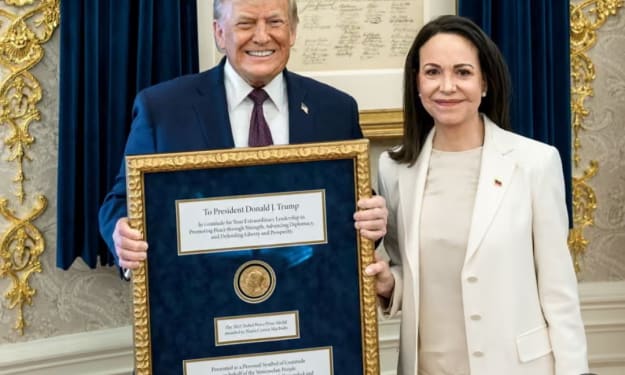
María Corina Machado Presents Trump With Her Nobel Peace Prize Medal
Venezuelan opposition leader María Corina Machado has made international headlines after presenting former US President Donald Trump with her Nobel Peace Prize medal, a highly symbolic gesture that has sparked intense political debate both inside and outside Venezuela. The moment, which took place during a high-profile meeting, was framed by Machado as a tribute to Trump’s role in confronting authoritarianism in Venezuela and supporting democratic movements in Latin America.
By Aarif Lashari4 days ago in The Swamp



Comments
There are no comments for this story
Be the first to respond and start the conversation.