
Trump and Colombia’s Petro: Old Rivals Testing a Diplomatic Thaw
From sharp rhetoric to cautious dialogue, an unexpected meeting signals a possible reset between Washington and Bogota


In a development that would have seemed unlikely just a year ago, former U.S. President Donald Trump and Colombian President Gustavo Petro are set to meet on Tuesday, exploring what both sides are calling a tentative thaw in a relationship long defined by mistrust and ideological distance. The planned meeting does not signal instant friendship, but it does suggest that political rivals—once openly critical of each other—are now willing to test whether pragmatic dialogue can replace public sparring.
At the heart of this moment is a recognition that geopolitics rarely stays frozen forever. Interests shift, pressures evolve, and leaders who once dismissed each other sometimes find value in conversation, if not consensus.
A History of Tension
Trump and Petro represent starkly different political traditions. Trump rose to power on a nationalist, conservative platform that emphasized border security, law-and-order policies, and skepticism toward leftist governments in Latin America. Petro, by contrast, is Colombia’s first left-wing president, a former guerrilla turned reformist leader who has consistently criticized U.S. drug policy, global capitalism, and what he sees as Washington’s heavy-handed influence in the region.
Their differences were not merely theoretical. During Trump’s presidency, Colombia was one of the United States’ closest allies in Latin America, but that partnership was rooted in security cooperation and the “war on drugs,” a framework Petro has openly challenged. Petro has argued that decades of militarized drug enforcement have failed, fueling violence rather than stability. Trump, meanwhile, repeatedly praised hardline approaches and pushed allies to intensify coca eradication efforts.
Public comments from both men reinforced the divide. Petro has accused Trump-style politics of undermining democracy and worsening inequality, while Trump-aligned voices have portrayed Petro as dangerously radical. Against that backdrop, the idea of a face-to-face meeting once seemed improbable.
Why Meet Now?
So why now? The answer lies less in personal chemistry and more in political calculation.
For Trump, who remains a dominant figure in U.S. politics, engaging Petro offers a chance to demonstrate statesmanship on the global stage. Meeting a leftist leader he once opposed allows Trump to frame himself as a dealmaker capable of dialogue across ideological lines. It also signals to Latin American audiences that he is not uninterested in the region, even when governments there do not align neatly with his worldview.
For Petro, the motivation is equally pragmatic. Colombia’s economy, climate goals, and security challenges are deeply intertwined with U.S. policy. Petro has pushed for international cooperation on climate change, debt relief, and a rethinking of drug policy. Speaking directly with Trump gives him an opportunity to explain his agenda to one of the most influential political figures in the United States, rather than allowing intermediaries or critics to define it for him.
In short, both leaders have something to gain by talking, even if agreement remains elusive.
What’s on the Table
While official agendas have been kept deliberately broad, several issues are expected to dominate the discussion.
Drug policy is likely to be central. Petro has called for a global shift away from punitive approaches, arguing for regulation and public health strategies instead. Trump’s past stance suggests skepticism, but a direct exchange could clarify where compromise, if any, might exist—particularly around shared goals like reducing violence and weakening criminal networks.
Migration is another key topic. Colombia has absorbed millions of Venezuelan migrants in recent years, a humanitarian effort that has strained public services. The United States, meanwhile, remains deeply concerned about migration flows throughout the hemisphere. Coordination on regional stability could emerge as a point of mutual interest, even if solutions differ.
Climate and energy policy may also surface. Petro has positioned Colombia as a leader in climate action, pushing to move away from fossil fuels. Trump, famously critical of climate agreements, may not embrace Petro’s vision, but the economic implications of energy transitions and regional investment could still prompt practical discussion.
Symbolism Matters
Even if no concrete agreements emerge, the symbolism of the meeting is significant. In international politics, dialogue itself sends a message. It signals to allies, critics, and domestic audiences that hostility is not the only option.
For Colombia, the meeting underscores Petro’s willingness to engage across ideological divides, countering narratives that paint him as inflexible or anti-American. For Trump, it reinforces his long-cultivated image as a leader unafraid to meet adversaries or critics if he believes it serves a strategic purpose.
Importantly, the meeting also reflects a broader trend in global politics: ideological purity often gives way to realism. Leaders may clash in public, but private conversations can open doors that rhetoric alone keeps closed.
Cautious Optimism, Realistic Expectations
No one involved is suggesting that Trump and Petro will suddenly become allies. Their core beliefs remain far apart, and domestic political pressures on both sides limit how far any rapprochement can go. Critics in Colombia worry Petro may legitimize policies they oppose, while Trump’s supporters may question the value of engaging a leftist leader.
Still, diplomacy rarely begins with full agreement. It begins with a willingness to sit at the same table.
Tuesday’s meeting should be viewed less as a breakthrough and more as an experiment—an attempt to see whether shared interests can coexist with deep ideological differences. In a polarized world, that alone carries weight.
As Trump and Petro prepare to meet, the real question is not whether they will resolve long-standing disagreements, but whether they can establish a channel of communication that outlasts a single conversation. If they do, this moment may be remembered not as a dramatic pivot, but as a quiet step toward a more pragmatic, less confrontational relationships.
About the Creator
Saboor Brohi
I am a Web Contant writter, and Guest Posting providing in different sites like techbullion.com, londondaily.news, and Aijourn.com. I have Personal Author Sites did you need any site feel free to contact me on whatsapp:
+923463986212
Keep reading
More stories from Saboor Brohi and writers in The Swamp and other communities.
US House Takes Up Deal to Restore Government Funding, Tuesday Vote Expected
As Washington inches closer to a government shutdown deadline, the US House of Representatives is preparing to take up a bipartisan deal aimed at restoring government funding, with a pivotal vote expected on Tuesday. The move comes after days of negotiations, closed-door meetings, and mounting public pressure to keep federal agencies open and functioning.
By Saboor Brohi about 8 hours ago in The Swamp
Weeks of Rail Disruption End as York Track Update is Completed
For the past several weeks, commuters and travelers in the UK have faced significant disruptions as rail services between key destinations were halted, rerouted, or delayed. The disruption was particularly felt in York, where vital track updates were underway, causing significant inconvenience. However, the weeks of rail disruption have finally ended as the York track update is completed, marking a new chapter in improving rail services across the region. With the project now finished, travelers and local residents alike are breathing a sigh of relief. But beyond the temporary inconvenience, what do these upgrades mean for the future of rail travel in York and beyond? The Scale of the Disruption: Why York Was Affected For weeks, major train services, including those linking York with cities like Leeds, Manchester, and London, were severely impacted. Delays, cancellations, and altered routes became a regular part of the daily commute. The disruption was largely due to essential track upgrades and maintenance that aimed to modernize and expand York's rail infrastructure. The project was part of a larger national push to improve the UK's railway network, addressing aging infrastructure and increasing capacity to meet growing demand. Unfortunately, such large-scale projects often result in temporary inconvenience, and York’s historic station became a key focal point for this disruption. The upgrade, involving everything from track replacement to signaling enhancements, was crucial for improving travel efficiency and safety on one of the busiest rail lines in the country. However, the temporary inconvenience was a reminder of how vulnerable transport systems can be to essential infrastructure work. The Benefits of the York Track Update: What Travelers Can Expect While commuters may have endured weeks of disruption, the completed upgrades now offer long-term benefits for rail passengers across the region. 1. Increased Capacity One of the most significant benefits of the York track update is the increase in capacity. The modernized track and upgraded signaling systems will allow for more frequent and efficient trains, reducing overcrowding during peak hours. This will be especially helpful for commuters traveling between York and major cities like London, Manchester, and Edinburgh. With the growing demand for rail travel and the UK's commitment to reducing carbon emissions by encouraging more sustainable transport options, improving rail capacity is essential. These updates will help the region accommodate future growth in passenger numbers. 2. Improved Efficiency and Reduced Delays The track upgrade also means fewer delays. Newer signaling systems, along with modernized tracks, will improve the flow of trains, reducing the risk of signal failures and track-related disruptions. Previously, mechanical issues or track wear could lead to delays, but with the new infrastructure in place, reliability should improve. Travelers can expect more punctual services, leading to a smoother travel experience and, importantly, fewer disruptions to their schedules. 3. Enhanced Safety Features Safety is a top priority in any infrastructure project, and the York track update is no exception. With upgraded tracks and more modern signaling systems, the project ensures that York’s rail network meets the latest safety standards. This reduces the likelihood of accidents or incidents caused by outdated infrastructure, providing passengers with peace of mind while traveling. A Stronger Foundation for the Future: National Rail Investment The completion of the York track update is part of a larger, ongoing effort by the UK government and the rail industry to modernize and expand the country’s rail infrastructure. Similar projects are happening in cities and regions across the country as part of the Rail Network Enhancement Programme. For York, in particular, this update serves as a reminder of the region’s historical and continued significance within the national rail network. York station, with its strategic location on the East Coast Main Line, is a critical hub for connecting major cities like Edinburgh, London, and Leeds. The recent upgrades will ensure that it continues to serve this important role for years to come. Additionally, the completion of this project shows a commitment to enhancing regional connectivity, which is vital for economic growth and social cohesion. By improving the rail infrastructure in cities like York, the UK is encouraging travel to less congested areas, making it easier for people to commute and connect with other parts of the country. The Reaction: How Local Communities Have Responded While the track update’s completion is a positive step forward, it’s important to acknowledge the frustrations faced by local commuters and residents during the period of disruption. For weeks, York saw a mix of disgruntled travelers, diverted bus services, and crowded alternative routes. However, there has been a notable shift in sentiment now that the project has been completed. Local businesses and residents have expressed relief at the return of a more reliable transport service. In particular, local businesses in York, which rely on visitors traveling via train, will benefit from improved connectivity. With easier access to York and the surrounding areas, tourism and retail sectors are expected to see a boost. Future Plans: What’s Next for York’s Rail Network? Even though the York track update is now complete, it’s not the last piece of the puzzle. York’s rail infrastructure is still undergoing a series of enhancements designed to future-proof the station and improve travel further. In addition to track upgrades, there are plans for station modernization, including better passenger facilities, more seating, and improved access for disabled passengers. The UK government has committed to additional funding for the rail sector as part of a broader push to achieve carbon-neutral transport by 2050. In this context, York is set to play a pivotal role in the ongoing modernization of the national rail network. Conclusion: A New Chapter for York and Beyond The completion of the York track update marks the end of weeks of rail disruption, but it also signals the beginning of a more efficient, reliable, and sustainable future for travel in the region. While the disruptions were certainly inconvenient, the long-term benefits of the upgrades are clear: increased capacity, improved safety, and a stronger foundation for future rail services. As the UK continues to invest in its rail infrastructure, projects like the York track update are an essential step in building a modern, resilient transport network. Commuters, local businesses, and visitors alike will all benefit from these improvements for years to come. While delays and disruptions have caused frustration, the finished project ensures that York’s rail network is well-equipped to meet future demands. For travelers, it means more options, less waiting, and a smoother journey to their destinations.
By Aarif Lashari7 days ago in The Swamp
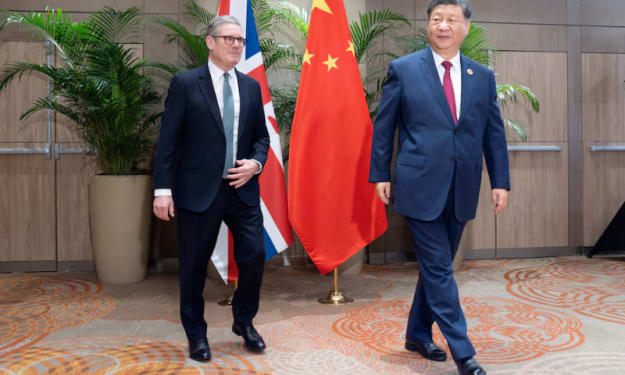
UK’s Starmer Heads to China to Repair Ties as He Navigates Tensions with the US
When British Prime Minister Sir Keir Starmer stepped onto Chinese soil this week, it wasn’t just another overseas visit — it was a signal. A signal that the United Kingdom is rethinking how it engages with the world’s major powers at a time when global alliances feel more fragile than ever. Starmer’s trip to China, the first by a UK leader in nearly eight years, comes amid strained relations with the United States, rising geopolitical uncertainty, and growing pressure to revive Britain’s economic prospects. Walking this diplomatic tightrope won’t be easy, but Starmer seems determined to prove that the UK doesn’t have to choose sides in an increasingly polarized world. Why This Visit Matters China is the world’s second-largest economy and the UK’s fourth-largest trading partner, with annual trade nearing £100 billion. Despite that, political relations between London and Beijing have been frosty in recent years, weighed down by concerns over human rights, cybersecurity, Hong Kong, and alleged espionage. Starmer’s visit marks a clear attempt to reset the tone. Rather than isolation or confrontation, his government is pursuing what it calls a “pragmatic” approach — one that recognizes China’s economic importance while still maintaining safeguards around national security and democratic values. Before departing, Starmer made his position clear: engaging with China does not mean abandoning the United States. “The UK won’t have to choose,” he said, emphasizing that economic realism must coexist with political caution. Economic Pressures at Home At the heart of this diplomatic push is economics. The UK economy has struggled with sluggish growth, high living costs, and post-Brexit uncertainty. For Starmer, unlocking new trade and investment opportunities is essential — and China represents a vast, largely untapped market for British businesses. The prime minister arrived in Beijing accompanied by senior ministers and business leaders from sectors including finance, healthcare, technology, and manufacturing. Meetings with Chinese President Xi Jinping and Premier Li Qiang are expected to focus on boosting cooperation, easing trade barriers, and encouraging Chinese investment into the UK. Currently, Chinese direct investment accounts for only a tiny fraction of total foreign investment in Britain — a figure Starmer hopes to improve. The US Factor Looms Large Starmer’s outreach to China cannot be separated from the current state of UK-US relations. Tensions with Washington have risen in recent months, driven by disagreements over trade policy, NATO commitments, and a more unpredictable American foreign policy stance. The US remains Britain’s closest ally and largest investor, but recent rhetoric and actions have made European leaders increasingly uneasy. By opening channels with Beijing, Starmer appears to be signaling that the UK intends to maintain strategic independence, even while preserving its transatlantic ties. It’s a delicate balancing act — one that will be closely watched in Washington as well as in European capitals. Critics Sound the Alarm Not everyone is convinced this reset is a good idea. At home, critics have accused the government of being too soft on China, warning that economic engagement could come at the cost of national security or moral credibility. Human rights organizations have urged Starmer to directly raise issues such as the erosion of freedoms in Hong Kong and the treatment of ethnic minorities in China. Security experts have also voiced concerns about expanding Chinese influence in the UK, particularly following approval for a new, large Chinese embassy in London. Skeptics fear that closer ties could increase the risk of surveillance or political interference. Starmer’s government insists that safeguards remain firmly in place. Britain’s Foreign Influence Registration Scheme, designed to monitor foreign lobbying and political activity, reflects this effort to engage without compromising security. Can Trade and Trust Coexist? One of the biggest questions surrounding Starmer’s visit is whether warmer diplomatic ties will actually translate into tangible economic gains. Previous British governments have attempted similar engagement strategies with China, often with limited long-term success. While trade volumes have grown, significant increases in Chinese investment or market access have proven elusive. Analysts warn that optimism must be tempered with realism. China’s economic slowdown, domestic policy priorities, and increasing self-reliance could limit how much progress can be achieved, regardless of political goodwill. Still, supporters argue that refusing to engage would only marginalize Britain further in a multipolar world. Europe Is Watching Closely Starmer’s visit also reflects a broader European reassessment of China. Across the continent, leaders are attempting to strike a balance between economic cooperation and strategic caution. The UK’s renewed engagement could serve as a test case for how middle powers navigate a world increasingly shaped by competition between Washington and Beijing. If Starmer can secure meaningful agreements without undermining democratic principles or security, it may strengthen Britain’s diplomatic standing and offer a model for others. A High-Stakes Diplomatic Gamble Ultimately, this trip is about positioning the UK for a future that looks very different from the past. Starmer is betting that Britain can maintain strong ties with the US while rebuilding pragmatic relations with China — all without losing its voice on human rights or national security. It’s a gamble shaped by economic necessity and geopolitical reality. Whether this strategy pays off will depend on what follows after the handshakes, photo-ops, and press statements fade. For now, Starmer’s China visit sends a clear message: the UK is no longer content to stand on the sidelines of global power shifts. Instead, it is trying to carve out a role that is flexible, independent, and economically focused — even if that path is fraught with tension. As the world watches how this diplomatic balancing act unfolds, one thing is certain: Britain’s relationship with both China and the United States is entering a new, more complicated chapter.
By Aqib Hussain7 days ago in The Swamp



Comments
There are no comments for this story
Be the first to respond and start the conversation.