
Transportation Battery Market Size and Forecast 2025–2033
A Global Shift Toward Electric Mobility Accelerates Battery Demand

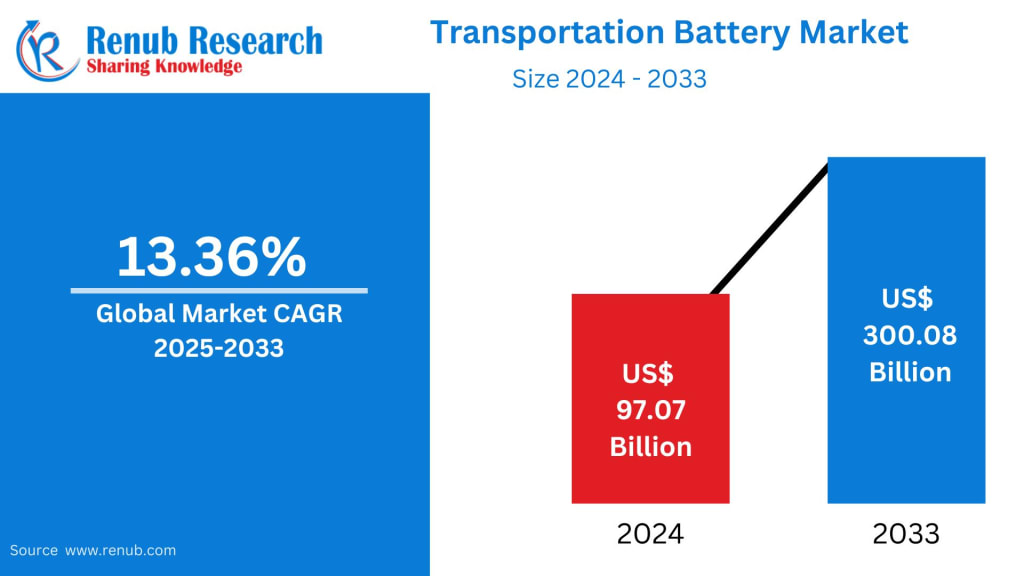
The Transportation Battery Market, valued at US$ 97.07 billion in 2024, is projected to reach US$ 300.08 billion by 2033, expanding at a CAGR of 13.36% between 2025 and 2033, according to Renub Research. The surge in global EV adoption, rapid advancements in battery technologies, stricter emissions regulations, expanding charging infrastructure, and increasing government incentives are collectively propelling unprecedented growth in this sector.
As governments, automakers, and energy ecosystems accelerate the shift away from internal combustion engines (ICE), transportation batteries—especially lithium-ion solutions—are becoming the backbone of tomorrow’s mobility. From electric passenger cars to commercial vehicles, buses, and emerging mobility segments, the battery market is witnessing robust, long-term momentum.
Global Transportation Battery Market Overview
The transportation battery sector has entered a transformative decade, driven largely by the worldwide push toward clean energy transitions and sustainable mobility. As electric vehicles move from niche to mainstream, the importance of safe, durable, high-performance batteries has increased significantly.
Batteries now serve as the core enabling technology for the electrification wave sweeping across automotive, aviation, maritime, and last-mile delivery sectors. Among all technologies, lithium-ion batteries dominate the market due to their superior energy density, efficiency, and rapid rate of innovation.
Governments across the globe are adopting policies that support electric mobility. These include:
EV purchase subsidies
Reduced registration taxes
Zero-emission mandates
Incentives for local battery production
Support for charging infrastructure development
These initiatives have significantly lowered the total cost of ownership (TCO) for electric vehicles, boosting both consumer and commercial adoption.
However, challenges persist. Raw material shortages, recycling inefficiencies, high manufacturing costs, and uneven charging infrastructure remain major bottlenecks. Despite these obstacles, global investment continues accelerating, elevating transportation batteries into one of the most dynamic and strategic industries of the decade.
Key Growth Drivers for the Transportation Battery Market
1. Rising Global Adoption of Electric Vehicles
Electric vehicles (EVs) are no longer optional—they are central to global climate action strategies. With nearly every major country committing to net-zero targets, EV adoption is expected to grow exponentially through the 2030s.
Consumers are increasingly drawn to EVs due to:
Lower operating costs
Improved driving ranges
High-performance models
Better charging access
Environmental consciousness
Commercial fleets—logistics, ride-hailing, public transport—are also electrifying rapidly to reduce emissions and operational overheads. This surge in electric mobility directly fuels battery demand, from small-capacity packs in two-wheelers to high-capacity, long-cycle batteries for heavy trucks.
2. Government Regulations and Incentives
Regulatory pressure is arguably the strongest accelerant for battery market expansion. Many governments have set clear deadlines to phase out ICE vehicles, with some targeting 2030 to 2035.
Supportive measures include:
Purchase incentives for EV buyers
Tax credits for automakers
Investments in national charging networks
Emission reduction mandates
R&D funding for next-generation batteries
These policies significantly reduce EV price barriers, encouraging rapid penetration across both developed and emerging markets.
3. Technological Advancements in Battery Chemistry
Rapid innovation in battery technologies is reshaping the competitive landscape. Key developments include:
High-density lithium-ion batteries enabling longer ranges
Solid-state batteries promising greater safety and 2–3x energy density
Faster charging capabilities reducing downtime
Longer cycle life for electric trucks and buses
Cost declines driven by manufacturing scale and material efficiency
As these technologies mature, EVs become more practical, economical, and scalable—boosting battery demand across all segments.
Major Challenges in the Transportation Battery Market
1. Battery Recycling and Environmental Concerns
Improper disposal of lithium-ion batteries can lead to:
Water and soil contamination
Mineral resource depletion
Hazardous chemical leakage
Recycling infrastructure is still developing and lags behind the rapid rise in EV adoption. Efficient recovery of materials like lithium, nickel, and cobalt is essential to meet long-term sustainability goals.
2. Battery Longevity and Performance Limitations
Even with advancements, challenges remain:
Gradual battery degradation
Reduced driving range over time
High battery replacement costs
Performance drops in extreme weather
Addressing these issues is crucial to boosting consumer confidence and maximizing adoption across commercial vehicle fleets.
Regional Transportation Battery Market Analysis
🇺🇸 United States Transportation Battery Market
The U.S. market is expanding rapidly due to:
Federal and state EV incentives
Rising consumer EV adoption
Automaker commitments to electrification
Infrastructure investments via the Inflation Reduction Act (IRA)
Tesla, GM, Ford, and new entrants are heavily investing in domestic battery production. However, raw material dependence and recycling gaps remain persistent challenges. Still, the U.S. is set to become one of the fastest-growing battery markets globally.
🇩🇪 Germany Transportation Battery Market
Germany is the powerhouse of Europe’s automotive sector. Growth is driven by:
Strong EV manufacturing ecosystem (BMW, VW, Mercedes-Benz)
Government-backed subsidies
Stringent EU emission norms
Extensive charging infrastructure
Germany’s large consumer base and technological expertise continue to reinforce its dominance in the European EV battery market. Yet, challenges like material shortages and high production costs remain areas of concern.
🇮🇳 India Transportation Battery Market
India’s transportation battery market is one of the most promising in Asia due to:
Rapid electrification of 2-wheelers and 3-wheelers
FAME II incentives
State EV policies
Rising fuel costs driving EV adoption
Investments by Tata Motors, Mahindra Electric, Ola Electric, and others
Infrastructure limitations and import dependence for battery materials pose challenges. Nonetheless, as India pushes toward net-zero and clean mobility, the market is poised for strong double-digit growth.
🇸🇦 Saudi Arabia Transportation Battery Market
Saudi Arabia’s market is gaining momentum under Vision 2030, emphasizing:
Diversification from oil
Renewable energy development
EV-friendly policies and infrastructure
Investments in local battery and EV manufacturing
Though still emerging, the kingdom’s strategic investments position it as a potential EV and battery hub in the Middle East.
Transportation Battery Market Segmentation
Battery Type
Lead-Acid
Lithium-Ion
Other Battery Types
By Vehicle Type
Passenger Cars
Commercial Vehicles
By Drive Type
Internal Combustion Engine (limited hybrid applications)
Electric Vehicles
Regional Coverage
North America: United States, Canada
Europe: France, Germany, Italy, Spain, United Kingdom, Belgium, Netherlands, Turkey
Asia Pacific: China, Japan, India, Australia, South Korea, Thailand, Malaysia, Indonesia, New Zealand
Latin America: Brazil, Mexico, Argentina
Middle East & Africa: South Africa, Saudi Arabia, UAE
Key Companies Covered
Panasonic Corporation
Exide Industries
VARTA
Hitachi Group Ltd
Robert Bosch GmbH
SAMSUNG SDI Co. Ltd
LG Chem Ltd
Each player is analyzed through four viewpoints:
Overview
Key Personnel
Recent Developments & Strategies
Product Portfolio & Financial Insights
Final Thoughts
The Transportation Battery Market is entering a high-growth era as global mobility shifts from fossil fuels to electricity. With a projected value of US$ 300.08 billion by 2033, the industry is set to redefine the future of transportation, integrating advanced chemistries, sustainable production, and interconnected energy systems.
The next decade will witness:
Breakthroughs in solid-state and fast-charging technologies
Expanding localized manufacturing ecosystems
More affordable EVs
Greater circularity through recycling
Massive increases in battery production capacity globally
As nations and industries move toward cleaner energy, transportation batteries will remain the linchpin of global sustainability and technological progress.
About the Creator
Diya Dey
Market Analyst
U.S. Navy Is Chasing Several Oil Tankers in the Atlantic
The United States Navy has reportedly deployed several ships to monitor and intercept a group of oil tankers moving through the Atlantic Ocean. While details remain limited, officials suggest the operation is part of a broader effort to enforce international maritime regulations, prevent illegal shipments, and protect global energy security. The unfolding situation has drawn attention from governments, energy markets, and security analysts, who are closely monitoring the implications for both geopolitics and global commerce. The Tankers and the Operation The vessels in question are reportedly a mix of large oil tankers carrying crude from various regions. The U.S. Navy’s engagement suggests concerns over either regulatory compliance or the potential diversion of energy resources to unauthorized destinations. Sources indicate that the Navy is coordinating with allied forces to track the vessels' movements, ensuring that they do not enter restricted or sanctioned areas. The Atlantic Ocean has long been a critical corridor for global energy trade, connecting major oil-producing regions in Africa, South America, and the Middle East with consumer markets in Europe and North America. Interceptions in these waters are rare but significant, signaling that authorities have intelligence about potentially illegal or high-risk shipments. Why the Navy Is Involved Naval involvement in tracking commercial tankers is not standard procedure, but it is sometimes necessary when there are concerns about sanctions violations, smuggling, or threats to international security. According to maritime law, coastal states can monitor vessels in their territorial waters, but operations in the open ocean often require coordination with international partners. In this case, the U.S. Navy’s pursuit appears to be preventive, ensuring that the oil shipments are properly documented and that no vessels are breaching international sanctions regimes. Analysts note that such actions also serve a political purpose, sending a clear message to entities attempting to bypass regulations that the U.S. and its allies are vigilant about maritime commerce. Global Energy and Market Implications The news of naval activity around oil tankers has caused ripples in global energy markets. Even a temporary disruption or the perception of restricted supply can trigger fluctuations in oil prices. Traders are closely watching the movements of the vessels and awaiting official statements on whether the tankers are carrying sanctioned cargo. Energy analysts emphasize that the Atlantic is a high-traffic route, and any incident involving naval forces and commercial ships could have cascading effects. Supply chain logistics, insurance premiums for shipping companies, and regional energy security all hang in the balance while the Navy conducts its operation. Potential Geopolitical Dimensions Observers are also evaluating the geopolitical context. The tankers’ origins, destinations, and ownership may have implications for ongoing international disputes, sanctions enforcement, or regional conflicts. Past incidents involving tanker interceptions have highlighted the sensitive nature of global energy politics, where control over resources and adherence to regulations intersect with national interests. Some experts suggest that the Navy’s proactive approach may also reflect broader U.S. concerns about rival nations or non-state actors attempting to exploit maritime trade for economic or strategic gains. By tracking and potentially detaining tankers suspected of irregular activity, the U.S. is reinforcing its role as a global maritime enforcer. Challenges of Maritime Enforcement Enforcing regulations across vast oceans presents numerous challenges. The Navy must rely on a combination of satellite tracking, intelligence reports, and aerial surveillance to locate and follow multiple moving vessels. Communication with ship crews, coordination with international authorities, and adherence to legal protocols are all critical to ensuring the operation proceeds without escalating into conflict. Experts note that such operations require balancing assertiveness with diplomacy. Intercepting commercial ships on the high seas can be controversial, especially when there is ambiguity over compliance or ownership. The Navy’s careful approach is aimed at preventing misunderstandings while maintaining the credibility of international maritime law. Looking Ahead As the U.S. Navy continues to track these oil tankers, the global community watches closely. Official statements from the Department of Defense or the State Department may provide more clarity on whether the tankers are violating regulations or if this is a preventive security measure. Meanwhile, shipping companies and international markets remain alert to any developments that could affect the flow of energy or maritime commerce. Ultimately, this situation underscores the strategic importance of maritime security in today’s interconnected world. The Atlantic Ocean, a vital artery for energy and trade, continues to be a theater where law, geopolitics, and commerce intersect. The Navy’s ongoing operation is a reminder that securing these waters is not just about military presence but also about maintaining trust, order, and stability in the global energy system.
By Fiaz Ahmed 3 days ago in The Swamp


Comments
There are no comments for this story
Be the first to respond and start the conversation.