
Tragic Plane Crash in Washington D.C: What We Know So Far
This comprehensive post uncovers the events, causes, and aftermath of this heart-wrenching aviation disaster.

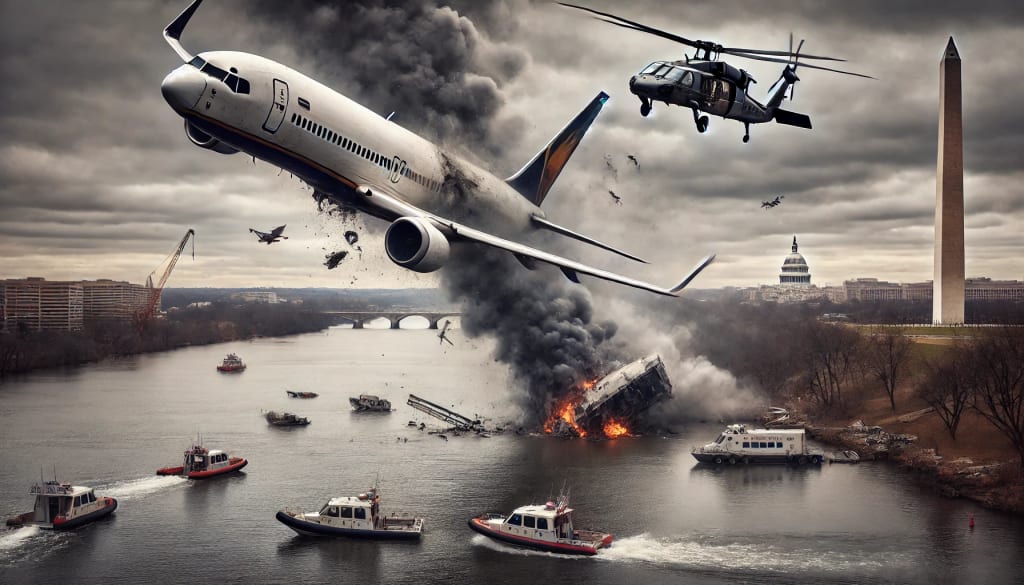
A horrific mid-air collision over Washington, D.C. has left the nation in shock. The accident involved American Airlines Flight 5342 (AA5342), a Bombardier CRJ700 regional jet operated by PSA Airlines, and a Black Hawk helicopter belonging to the U.S. military. The incident occurred near Reagan National Airport (DCA), causing the aircraft to crash into the Potomac River, leading to multiple casualties.
Rescue efforts were launched immediately, but survivors are few, and authorities are still assessing the damage. The National Transportation Safety Board (NTSB) and the Federal Aviation Administration (FAA) are conducting a thorough investigation into what went wrong.
How the Tragic Event Unfolded
Reports indicate that Flight 5342 was approaching Reagan National Airport when it collided with the Black Hawk helicopter. The impact caused severe structural damage to both aircraft, leading to an uncontrollable descent. The commercial jet broke apart as it crashed into the Potomac River, while debris from the helicopter was scattered across the riverbanks and city streets.
Eyewitnesses described the horrifying moment when flames and smoke engulfed the sky. Many in Washington, D.C., initially thought it was a terrorist attack before learning about the aviation accident.
Passengers and Victims
A full passenger list has yet to be disclosed, but among the confirmed casualties are members of the U.S. Figure Skating Team, including Spencer Lane and Jinna Han. The tragic news has deeply impacted the sports community, as these athletes were training for the upcoming championships.
Other well-known names on board reportedly included former figure skating champions Evgenia Shishkova and Vadim Naumov, along with their son, Maxim Naumov. The crash has left the figure skating world mourning their loss.
Additionally, all crew members aboard Flight 5342 are believed to have perished. The Black Hawk helicopter carried four U.S. Army personnel, and while some reports suggest one may have survived, officials have not confirmed this.
Possible Causes of the Collision
Aviation experts are analyzing multiple factors that could have contributed to this catastrophic accident. Initial theories suggest:
- Air Traffic Control (ATC) Miscommunication: If conflicting instructions were given to the Black Hawk pilot or the CRJ700 crew, a collision could have been unavoidable. Investigators are reviewing radio transmissions and radar data.
- Failure of Collision Avoidance Systems: Modern aircraft are equipped with Traffic Collision Avoidance Systems (TCAS), which alert pilots to nearby aircraft. If the TCAS was ignored, disabled, or malfunctioned, this could have contributed to the crash.
- Unauthorized Military Flight Path: The Black Hawk helicopter was reportedly on a training mission, raising questions about whether it had proper clearance to be in civilian airspace.
- Weather Conditions: Investigators are also examining whether low visibility, fog, or turbulence played a role in the accident.
Government Response and Public Reaction
Transportation Secretary Sean Duffy expressed deep condolences to the victims' families, emphasizing that aviation safety remains a top priority. He assured the public that the FAA and NTSB will conduct a full investigation.
Meanwhile, former President Donald Trump called for a review of aviation policies, particularly regarding military and commercial aircraft sharing airspace near high-risk areas like Washington, D.C. Some lawmakers have blamed the FAA’s Diversity, Equity, and Inclusion (DEI) hiring policies, arguing that they compromised safety standards by prioritizing diversity over experience in critical aviation roles.
Critics argue that this air traffic congestion issue has been a long-standing problem at Reagan National Airport, where high volumes of flights operate in limited airspace.
Historical Parallels: Air Florida Flight 90
The Washington, D.C. plane crash is being compared to the Air Florida Flight 90 disaster in 1982, when a Boeing 737 crashed into the Potomac River due to pilot error and icy conditions. That crash led to major improvements in pilot training and de-icing procedures. Experts now believe this latest tragedy will also bring significant changes in airspace regulations.
The Investigation Ahead
The NTSB investigation will focus on:
- Black box recordings from Flight 5342 and the Black Hawk
- Radar and air traffic control communication records
- Weather conditions at the time of the crash
- Survivor and eyewitness testimonies
In the coming weeks, experts will reconstruct the final moments of both aircraft to determine what led to the deadly impact.
Financial and Legal Consequences
The crash has sent shockwaves through the aviation industry, especially for American Airlines and PSA Airlines. Stock prices for American Airlines have dropped as investors worry about lawsuits and regulatory consequences. Families of victims may file wrongful death lawsuits, and if FAA regulations are found to have contributed to the accident, the government could also face legal scrutiny.
The military’s role in this tragedy is another key factor. If the Black Hawk’s flight path was unauthorized or improperly coordinated with civilian air traffic controllers, it could result in policy changes for military training flights near busy airports.
Conclusion
The Washington, D.C., plane crash is a devastating reminder of the dangers of shared airspace between military and commercial aircraft. The investigation will take months, but the aviation industry is already facing tough questions about air traffic control safety, collision avoidance technology, and airport congestion.
As families mourn their loved ones, the public waits for answers. Will this tragedy lead to stricter regulations? Could it have been prevented? Only time will tell.
About the Creator
Matt Guides
I'm Just A Random Guy That Creates Content!
Keep reading
More stories from Matt Guides and writers in The Swamp and other communities.
Laken Riley Act: A Lifeline for Victims of Sexual Assault
The internet has brought immense convenience and connectivity to our lives, but it has also given rise to new and serious dangers, especially for children. Online predators actively lurk on social media, gaming platforms, chatrooms, and other digital spaces, seeking to exploit and manipulate vulnerable young users.
By Matt Guidesabout a year ago in The Swamp
Parallel Protests
I haven't written for quite some time, but I have A LOT of thoughts about yesterday's protest rally against our government's involvement and complicity in America's war on Iran, on the harbourside of my home city Bristol, and I need to put them somewhere. My gorgeous girlfriend is always a loving and listening ear and sharing it all with her will always be a healthy and happy way of processing the mental and emotional weight, but getting it straight in my brain to share means writing it all down in straight lines, so, here we are and thanks for being here.
By Steph Cole6 days ago in The Swamp


Comments
There are no comments for this story
Be the first to respond and start the conversation.